Showing posts with label Dingtuna. Show all posts

Sunday, June 25, 2017

More than a name: Lars Ericsson

Despite the slow pace of posts to the blog, I have been very busy the past few months on family history. The results, though, are not a neat and tidy story: they're usually small discoveries that generate more questions than answers. So in order to keep you all informed on these, I think posts for the near future will be shorter than my recent efforts.

Back in my post from 25 Nov 2016, West to Västmanland and Västerås, I outlined what I´d learned about the direct male lineage of the Johnsons-Westerlunds. The last person that I had any real data for was Johan Larsson, born in Lillhärad in 1738, died in Dingtuna in 1799. I had the name of his father, Lars Ersson (or Ericsson or Eriksson, all forms of the name are commonly encountered) from the birth record in Lillhärad.

Sign to the church at Lillhärad. View of the countryside, roughly (and totally by chance) in the general direction of Bännby.

Unfortunately, that was all that I had from the family´s time in Lillhärad. This is because although the birth records begin in 1703, the household examination records only go back to 1835. Recall that the household examinations were when the local priest would visit the family and test them on their knowledge of their religion and ability to read the Bible. Obviously, the records beginning in 1835 were not going to tell me anything about Lars Ersson and his wife Margareta Ersdotter. By looking through the birth records for Lillhärad, page by page, I was able to find another child born to Lars and Greta, a daughter named Margareta (born in 1740). But without the household examination records, I was stuck, unable to further trace any of those three people.

Husförhöret, painted by Kilian Zoll in 1854. The pastor stands examining the household on their understanding and ability to read the Bible. Note the side comments, such as the serving of brandy (brännvin) from a small keg on the left. Thanks to Sven Backlund for pointing this painting out to me in the February 2016 issue of Arosiana, from the Västerås Släktforskarklubb.

Birth record for Margreta Larsdotter (1740-1798). Born 7 April, baptized 9 April, father Lars Ericsson from Bänbo, witnesses to baptism listed on right.

So that was as far as I could go using the records available through ArkivDigital. In fact, that´s all the records there are, at least in terms of parish births, deaths, marriages, and household examinations. If they´re not in ArkivDigital, then either they never existed or they´ve been lost. But there is another source of information, the Royal Archive or Riksarkivet (SVAR).

The archives have been working hard to make digital copies of their holdings and make them available online. They now have over 100 million images of documents and artifacts. The oldest dates from the 10th Century, a single parchment page from a missal originally from England. The archives today are housed in a 6-story building near Stockhom. I'm not sure that ”building” is the right word since the structure was not built up, but down, blasted into the bedrock well below the water level of Lake Mälaren. This is definitely a place that I want to visit the next time we find ourselves in Stockholm.

The digital holdings of SVAR include all of the parish records that I've been working with over the past few years. However, they also include a huge resource that I hadn't yet tackled, the mantalslängd. In the words of Christopher Bullock in 1716: “‘Tis impossible to be sure of any thing but Death and Taxes.” The mantalslängd is a record of taxes owed and paid to the government. A mantal was a measure of the wealth of land. It sounds very similar to the Old English hide, the amount of land needed to support a peasant family (one defintiion of several through the centuries). Exactly what a mantal was is subject to some debate. It may, at some time or place, have been the land required to support a family. Another option is that is was the land required to provide and support a mounted warrior. The important point is that the mantal was the basis for taxation. Registers were maintained of people subject to this tax and how much they owed. The archives have copies of these registers, and they extend back in time into the mid 1600s, years before the King directed the parishes to maintain records. So this has the potential to give us a glimpse farther back in time.

There's a downside to these records (of course there is!). First, not everyone was subject to taxation. Exceptions were noble families, soldiers, very young people, and very old people. The records, at least in the earliest days, only listed the person heading the household. If that was a man with a family, his name would be listed, but not his wife, minor children, or anyone else in the home such as an elderly parent. All others were simply counted. To make it worse, often only the given name of the head of household was given. This last problem was mitigated to some extent by the fact that each little cluster of homes within a region had its own name. If you're lucky, then there was only one Lars in the area you're interested in, so you could be confident you'd found the right guy.

Where has all of this led me in terms of the history of the Westerlunds? While the oldest records for births and marriages in the parish of Lillhärad started in 1703, the mantalslängd begins in 1643. The two children that were born there were Johan (in 1738) and Margareta (in 1740). So I went to the mantalslängd for 1738. There are 91 names listed there, and – fortunately – their surnames/patronymics are given. Even better, there is only one Lars Ericsson in the parish, living in a place called Bänbo (now spelled Bännbo).

The relative positions of Lillhärad and Bännbo (in the upper right corner of the image. Lars Ericsson and family lived in Bännbo while in the Lillhärad parish.

Going through the Lillhärad registers year by year we find a Lars Ersson from 1737–1744, but no farther. We get a little unexpected gift in the final 1744 record. The record says ”Lars Ersson til Bäckeby i Lundby ....” I haven´t been able to figure out the last word, but it doesn´t matter. The entry translates as "Lars Ersson to Bäckeby in Lundby".

Lundby is a parish in the southwestern suburbs of the city of Västerås, and in the household records there we find the family. But now the family has expanded from two children to seven! The two we had are there, and their birth dates match those I´d found in the Lillhärad birth records. This is what gives me the confidence that I´ve got the right Lars Ericsson.

To elaborate a bit, the ”1745” in the leftmost column tells when the family moved into the parish. The next column are names and titles. We have Lars Ersson (Ersson is a shortened version of Eriksson); wife Margeta Ersdotter; Carin daughter; son Johan; dotter Margareta; son Lars; son Anders; twins Lisa and Maja. Lisa´s name is crossed out because she died during the period covered in the book (on the far right it says ”754 8/4 död” or ”8 April 1754 died.” The column to the right of the names are the birth dates. Here we find birthdays for everyone starting with father Lars (24 Sep 1698) to the twins (08 Jan 1753)! The next few columns are, basically, their grades in how well they knew their religion. The next set of numbers are the dates when each individual moved away, followed by where they went. Unfortunately, this priest did not record the place of birth. In later years it became standard practice, and this helps greatly in knowing that you´re following the right paper trail when so many names are so similar.

To continue forward in time, Lars, Margareta and the youngest children then moved to Dingtuna in 1756. Lars died the next year, sometime in November 1757. Here is the entry from the parish death records. Roughly translated (pardon my Swedish), it says Lars Ersson, crofter from Bählby region, born in Norrby parish, married to Marg. Ersdotter and had 11 children, of which 8 are still living. Died the ... (no number)... November of tuberculosis. 58 years old.

This death record provides two very important further clues. First of all, Lars had 11 children, and I´d so far only accounted for seven! Second, it says that Lars was born in Norrby parish and he died at the age of 58. Given that he died in November, the odds are that he'd already had his birthday that year. The household record from Lundby records his date of birth as 24 Sep 1698. So there´s a small discrepancy in dates between the two records. If the birthday is right, then he would have been 59 when he died. We´re within a year, though, and hopefully the birth record from Norrby would decide the issue.

Norrby parish, now in the town of Sala, is about 30 miles north of the Västerås area. My first impression was that this was a bit far afield. People certainly did move around lot, particularly farm hands looking for work wherever they could find it. But all the other movements I´d seen so far were much smaller distances: 6.8 miles from Lillhärad to Lundby (church to church), and 4.4 miles from Lundby to Dingtuna. Then the birth records in Norrby failed to register a child named Lars born to a father named Erik in either 1698 or 1699. The closest I came was a Lars Ersson born 2 Sep 1700. So far I haven´t been able to find and follow the records of that Lars, so that I can rule him in or out as my target. The place name Norrby is not particularly uncommon, basically it simply means north (norr) village (by). There are several places by the name of Norrby in the vicinity of Västerås. I tried looking in all of those, but never found the right combination of name, father, and birthdate (even allowing for errors). So for now, Lars Eriksson is still where the Westerlund family runs into the mists of time, but now we have a lot more information about him.

I think I´ve been able to follow Lars some distance back from his time in Lillhärad. From the record that gave the jump in the number of children from 2 to 7, there was one child born before the family moved to Lillhärad in 1737. This was Carin, and she was born 4 Jun 1736. When I followed where she went through her life, I eventually came upon a 1775 household record that said that she was born in Skerike. This is another parish in the immediate vicinity of those where we know the family lived. Sure enough, in the birth records for Skerike we find Carin, daughter of Lars Ersson and Margareta Ersdotter. So before they lived in Lillhärad, they lived in Skerike. Following similar methods I´ve been able to trace Lars back in time from Skerike from Dingtuna in 1729, and then in Dingtuna all the way back to 1711 )at the age of 13).

And those missing children? We have seven and we´re missing four. They turned out to be Brÿta (1735-1735), Kiersten (1733-1743), Anna (1732-??), and Erik (1731-??). Remember also that I knew nothing but the birth date for Margareta. I mention her now because in 1771 she was working as the housekeeper for the Frankenheim family, first for the father and then the son Captain (in the army) Axel Hendrik Frankenheim. It was Capt. Frankenheim who gave Margreta away when she was married. The remarkable thing is that she is listed in the 1771 record as Greta Vesterlund. This, so far, is the earliest record I´ve found for use of the name Westerlund.

Given the question marks in the dates for some of the children and the continuing mystery of the birth of Lars Ersson, there are still many discoveries waiting to be made. And then I had the descendants of seven more children that survived Lars to follow through the records and bring their histories to light. I´ve made a lot of progress there with much more to go. There are some surprising findings that I´ll be sharing with you soon.

And, appropriate to the season, let me wish you all a “Glad Midsommar” or Happy Mid-summer. Definitely a holiday we should all adopt.

Photo from hejsweden.com

Friday, November 25, 2016

West to Västmanland and Västerås

Road to Västerås

Note: This is a continuation of a description of our trip to Sweden during July-August, 2016.

I think one of the common things that people do first when researching their family history is to see how far back in time they can trace their direct male line, following the family name. I was no exception, and here's a brief summary of what I've found to date, starting with my own father:

  1. Norman F. Johnson (1933-2001), born Ilion, New York, USA
  2. Fredrik A. Johnson aka Arthur Westerlund (1888-1937), born East Hempstead, New York, USA
  3. Gustaf Alfred Westerlund (1855-1923), born Teda, Uppsala, Sweden
  4. Johan Erik Westerlund (1825-1899), born Björksta, Västmanland, Sweden
  5. Johan Westerlund aka Johan Larsson (1794-1869), born Dingtuna, Västmanland, Sweden
  6. Lars Jansson (1769-1831), born Dingtuna, Västmanland, Sweden
  7. Johan Larsson (1738-1799), born Lillhärad, Västmanland, Sweden
  8. Lars Ericsson (????-????)
  9. Erik ???? (????-????)

The older generations, from Gustaf Alfred on back, all came from the area in and around the city of Västerås. This is one of the oldest cities in Sweden, having been occupied for a thousand years. It's located on the northern shore of Lake Mälaren, about 60 miles (100 km) west of the capital Stockholm in the province (län) of Västmanland. Its population in 2014 was approximately 144,000 people, so it's sizable, but not at all overwhelming. Since it is the focus of Westerlund family history, this (among other reasons) made it one of the prime places to visit on our trip.

Map of Västerås area

The map above is a modern political map of the area, showing the names of the populated places in the area. If you're interested, I got this map from the Lantmäteriet site (www.lantmateriet.se), and with this link you can see the map and zoom in and out to get further details. The old church records, however, are arranged not by town (or kommun), but by parish. To help keep you oriented, the map below shows the boundaries of the parishes (församlingen) within Västmanland.

Map of parishes of Västmanland

Västerås is a bustling city, and one of the major employers for more than a century is a multinational company called ABB. The modern company is the result of a merger between Asea AB of Sweden (founded in Västerås) and a Swiss company. According to its own advertising "the merged entity became the world's leading supplier in the $50 billion electric power industry." Its dominance as the employer in Västerås is commemorated in a sculpture found in the center of town. It's called ASEA-Strömmen, the ASEA stream, showing the workers commuting to work on their bikes with briefcases and lunchboxes in hand.

ASEA-Strömmen sculpture.

Behind the sculpture you can see the Statdshotellet, our base of operations while in the area.

Many relatives moved in and out of the city over the years, presumably following job opportunities. The center of the city is really dominated by the Västerås cathedral. Like most cathedrals, this one has constantly been expanded, repaired, and renovated through the years, but the oldest parts were first built in the 1200's.

Västerås CathedralInterior of Västerås Cathedral
Interior of Västerås CathedralBaptismal font in Västerås Cathedral.
Västerås Cathedral

From the city we made short excursions to visit the parishes whose names I've been seeing in the records. Let's start with the oldest records for the Westerlund lineage, the birthplace of Johan Larsson in 1738: Lillhärad. On the map below I've zoomed in a bit on the area just to the west of Västerås, and circled in red three of the parishes that I'll be mentioning.

Map showing church locations visited west of Västerås.

Lillhärad is toward the top of the map. Like most of these parishes outside of the city, they're in the middle of active farmland: lots of grain fields, probably mostly wheat, along with smaller livestock operations. The small church of Lillhärad is fairly recent and was built long after the birth of Johan Larsson. It currently still hosts baptisms, weddings, and funerals, but for regular services it's rented out to the local Russian Orthodox congregation. Note the separate wooden building housing the bell tower.

Lillhärad parish church.
Lillharad parish church.Lillhärad parish church.
Lillhärad

The next two generations of Westerlunds (or, Westerlunds-to-be) were born in Dingtuna. This is the southernmost parish circled in red on the map. The parish dates from the Middle Ages and, originally, served as the "mother parish" for the church in Lillhärad. Today they're linked again. The present church is the result of extensive renovations undertaken in 1842. Johan Larsson moved to Dingtuna as a teenager in 1758 and remained until his death on 18 Jul 1799. His son Lars and Lars's son, also named Johan, were born here. The church was closed, so we didn't get a chance to get inside. There is a small graveyard adjacent to the church, and a larger, newer one across the road. The wall separating that newer cemetery from the road is built from pieces of old gravestones. I'm sure there's an interesting story there, certainly with histories extending back to the 1200s, there's just not enough physical space to do everything. But my historian instincts quiver at the thought of the loss.

Dingtuna parish church.Dingtuna parish church.
Dingtuna parish church.Wall of broken gravestones across road from Dingtuna parish church.
Dingtuna

From here we move to the area to the east of the city of Västerås. Here's the map with the parishes to be mentioned circled in red.

Map of churches visited to east of Västerås.

I'll start at the top with Björksta. Johan Erik Westerlund was born in Björksta on June 9, 1825. His first wife was Johanna Larsson (1820-1871) with whom he had two sons, Gustaf Alfred and Gottfrid Theodor. After Johanna died, he married Carolina Jansdotter (1824-1900). Johan Erik lived and worked in numerous parishes in the vicinity. Eventually in 1898 the couple moved about 35 miles south to Åker in the province of Södermanland where they lived out their lives.

The Björksta parish church is quite old, the earliest part dating from the 1200s. The picture clearly shows that the bell tower was a later addition to the building, dating from the 1400s. The bowl of the baptismal font dates from 1529, so it is very likely the one where Johan Erik was baptized. The church is situated in the midst of flat farmland interspersed with hills. While the church sounds - and is - very old, a thousand years ago all of the flat area was underwater as Lake Mälaren reached much farther than it does now. There is evidence of even older residents of the area in the form of rock carvings. There are quite a number of these in the general area, including some right next to the church. These carvings date from the Bronze Age, from 1800 to 500 B.C., in other words, these carvings are at least over 2500 years old! The carving on the left in the picture is supposed to be a stylized chariot, and the other elongate carvings are ships.

Björksta parish church. Farmland surrounding Björksta parish church.
Baptismal font in Björksta. Björksta parish church.
Reading the tourist information about local rock carvings. Rock carvings near Björksta church.
Björksta

From Björksta we continued south to Ängsö. At the time I knew very little about this area: I'd heard that there was a castle there, and as we were driving around the countryside we saw a sign pointing us to Ängsö and decided on a whim to check it out. I've later discovered that lots of the family came from the island. Johan Erik Westerlund's first wife, you recall, was Johanna Larsson. Johanna was born in Teda, a parish to which I'll get shortly. Here's her direct ancestral line as I now understand it:

  1. Johanna Larsson (1820-1871), born Teda, Uppsala
  2. Lars Andersson (1760-1829), born Ängsö, Västmanland
  3. Anders Ersson (1723-1762), born Ängsö, Västmanland
  4. Erik Mattsson (1700-1748), born Ängsö, Västmanland
  5. Mats Mattsson (1675-1719), born Ängsö, Västmanland

So there are lots of relatives from Ängsö. Of course, the wives of these generations were also born there as well. I hadn't yet worked all this out when we visited. Inside the church at Ängsö we were greeted by a local volunteer who described the history of the church, again it's amazing old, dating to the 1340s. The volunteer, Tom, also filled us in on the local ghost stories. Just for fun, there's a YouTube video that plays up these stories for Halloween. I liked it because these were exactly the roads and walks we took when we explored the area. In the video the blocky, square building is the castle, and it's located right next to the church across a small courtyard.

I hope that was fun! Here are some of our pictures. Sorry, I didn't record any no ghosts or skeletons.

Ängsö parish church. Ängsö parish church.
Interior of Ängsö parish church.Chatting with local volunteer Tom in Ängsö church.
Ängsö

As you can see, I've organized our visits to parishes by following the history of the Westerlunds, beginning from the earliest records and moving forward in time. That leaves us with the last generation, Gustaf Alfred Westerlund. He was the last of my direct ancestors in the Westerlund line who was born in Sweden. He was born in Teda on March 9, 1855. Our visit to Teda, though, was special because it was organized by my third cousin, Hans Malmkvist. Hans's great grandfather was Gottfrid Westerlund, brother of my great grandfather Alfred. Teda is a tiny farm community found just over the provincial border in Uppsala. Our visit there was special for two reasons. First, we were accompanied not only by Hans and his wife Kristina, but by Hans's brother, Gunnar, and his sister Birgitta and her husband Torbjörn Engkvist. Second, Hans arranged a visit to the actual house where the Westerlund family lived and where his great grandfather Gottfrid was born in 1863. The house, called Leversta, is very small, really with only two usable rooms. The current owner uses it primarily as a vacation home.

The house in Leversta (Teda, Uppsala). Old stove in Leversta house.
Group photo at Leversta. Teda parish church.
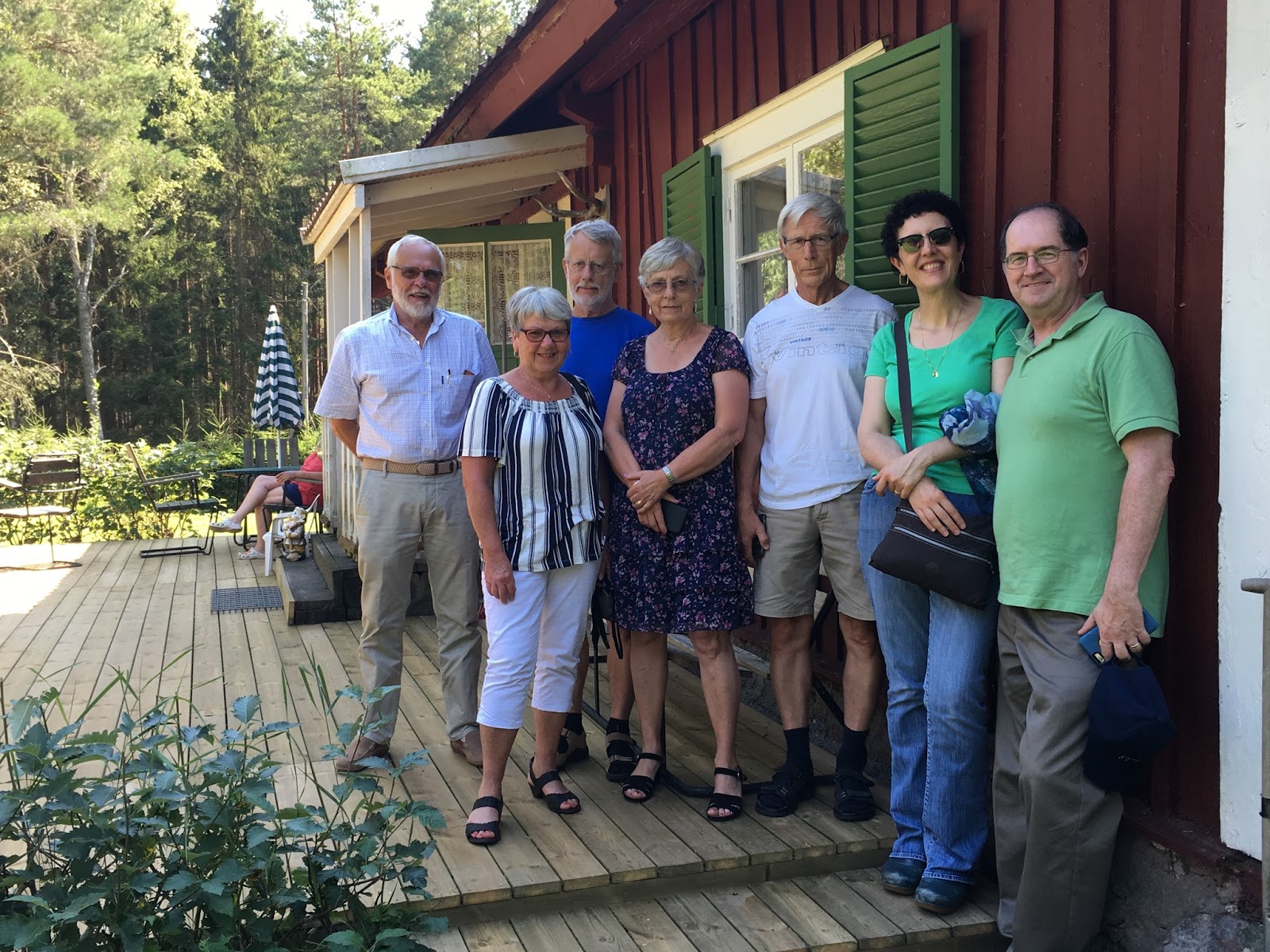
Teda. Upper left: Leversta, the house where Gottfrid Westerlund was born. Upper right: all-in-one stove for the home. Lower left: group picture. From left to right: Torbjörn Engkvist, Kristina Malmkvist, Hans Malmkvist, Birgitta Engkvist, Gunnar Malmkvist, Luciana, yours truly. Lower right: parish church of Teda.

Our trip to the home at Leversta was not the end of the day, though. We visited Anundshög, a Viking burial mound site. In addition to the mound, there are two large stone ships and a large runestone on the site. Estimates of its age are imprecise, but we're talking about the Iron Age (500 BC - 1050 AD). From there we went to the Vallby Open Air Museum (Vallby Friluftsmuseum), a living historical museum with old buildings from around Västmanland illustrating the ways of life of Swedes in the region. To cap off the day, Hans and Kristina invited us to their home for dinner. They told us that the meal was similar to a Midsummer Day's meal, with such delicacies as freshly made pickled herring, baked salmon, new potatoes fresh from Hans's garden, and a wonderful dish called Janssons Frestelse, or Jansson's Temptation. Just who Jansson was is a matter of some dispute, but the dish is wonderful: think scalloped potatoes with anchovies or sprats instead of ham. I tried making it when I got back home from a recipe on the Internet, and, while it was really good, believe it or not I think I needed even more anchovies! Now I've learned that perhaps anchovies are the wrong sort of canned fish, and what I really need to try are sprats. I'm game!

At dinner we got the chance to meet Hans and Kristina's daughter Lotta Werneholm and her husband Claes. Lotta carries on the family tradition of working for ABB, following in her father's footsteps. Gunnar told us that his son, Daniel, is living and working in Manhattan: I need to find the Swedish coffee shop Fika where he works. The name Fika refers to the honored Swedish tradition of a coffee break, classically taken with cinnamon rolls or similar pastry. Hans broke out some of the old family photo albums to show us and gave me a chance to put some faces to the names I'd seen in the old written records. In sum, it was a fantastic welcome, and I couldn't be more thankful for the friendliness and hospitality!

Stone ships and mounds at Anundshög. Strolling through Vallby Friluftsmuseum.
Left: The stone ships of Anundshög. Right: Strolling through Vallby Friluftsmuseum.
Around the dinner table at the Malmkvists. Hans and Birgitta showing me the family photos.
Left: Dinner at the Malmkvists. Starting from the lower left corner and going clockwise around the table are Gunnar Malmkvist, me, Birgitta Engkvist, Hans Malmkvist, Kristina Malmkvist, Lotta Werneholm, Claes Werneholm, and Torbjörn Engkvist. Right: Hans and Birgitta showing me pictures from the family photo album.
A short video clip showing Hans and Kristina harvesting potatoes for dinner from their backyard garden.

While the Westerlund family history begins and is concentrated in the area around Västerås, here we also first crossed paths with the other half of my Swedish family, the extended relatives of Johanna Charlotta Barthelson, the wife of Gustaf Alfred and my great grandmother. The Barthelson story, for me, is focused in the province of Värmland, and I'll be concentrating on our visit there in the next blog post. But through the magic of the Internet and a shared interest in family history, in Västerås we also had the great pleasure of meeting another cousin from that Barthelson side: let me introduce you to Sven and Eva Backlund.

Eva and I are third cousins once removed. To try to translate that into something more understandable, that means that Eva's great grandfather, Per Barthelson (1814-1858), was my great great grandfather. So for me it's 5 generations to get back to Per, for her it's only four generations. Eva has quite a number of family treasures, and she's been tremendously generous in sharing them with me. For example, here are some photos from the past, starting with the most recent generations:

The Carl Ferdinand Gustafsson family.
The Gustafsson family, with Eva's mother, Margit (1910-1993), second from the right, and Eva's grandparents Carl Ferdinand Gustafsson (1882-1956) and Johanna Maria Karlsson (1884-1988) in the center.
Carl August Gustafsson. Fredrika Pettersson.
Eva's great grandparents, Carl August Gustafsson (1851-1886) and Fredrika Pettersson (1857-1927).

Sven and Eva took us to the parish church of Svedvi, located a bit west of Västerås near the town of Halstahammar. Svedvi is the parish in which my great grandmother, Lotta Barthelson, was born in 1861. The church here dates to the 1200s, and next to it is a large, flat, gray stone which the notes on the church's history say was a blood altar from the pre-Christian, heathen times!

Svedvi parish church. The blood altar at Svedvi.
Svedvi. Current church on the left, the heathen blood altar on the right.
Visiting Svedvi church. A history lesson about Svedvi from Sven Backlund.
Sven, Eva, and I at Svedvi parish church. On the right, Sven giving me a (much needed) history lesson about Svedvi.

From the church, we then visited the Strömsholm canal in Halstahammar. The 62-mile long canal was originally used as a means of transport of iron from the steelworks to the north south to Lake Mälaren (and from there to anywhere in the world). Now it's a very pleasant park and outdoor museum. In one of the main office buildings of the old canal administration there is a line of photos showing the administrators and engineers in charge of running the canal. When Eva saw the name of Daniel Stafsing, the canal CEO in the early 1900s, she reached into her bag and produced work testimonial dated 26 June 1907, written by Stafsin commending her grandfather, Karl Gustafsson.

After our field trip, Eva and Sven invited us to their home for dinner. We were treated to Aperol Spritzes and delicious curried salmon. To cap off another great day, they broke out their family heirloom treasures, including old photographs and even a pair of small shoes made by hand by one of Eva's family. I have to ruefully I admit that I don't remember the details about the shoes. Eva, if you're reading this post, please add a comment to remind me of the story!

Lock at the Strömsholm Canal. Bucolic scene along Strömsholm Canal.
Strömsholm Canal
Eva Backlund exhibiting letter from Daniel Stafsin. The letter from Daniel Stafsin.
Commendation letter from Daniel Stafsin for Karl Gustafsson.
Aperol spritzes with the Backlunds. Enjoying family treasures with the Backlunds.
Dinner with the Backlunds.

So wraps up a brief summary of our visit to Västerås. The weather was wonderful, the people even better, and lots to see and learn. And I haven't even touched on our other day trips in the area. There's no way that I can adequately express my thanks and gratitude to all of those who so warmly greeted and shared a bit of their lives with us. Tack så mycket! From Västerås, we next drive about four hours west to really get into the Barthelson experience in Värmland.

West Cork Update

This blog post comes to you from the city of Cork, Republic of Ireland. I had initially planned this trip to be tagged on to the end of th...