Sunday, March 22, 2015

Cue the Trumpets

For the past several weeks I've been poring through Swedish church records from the 18th and 19th centuries. So it's exciting when something comes up that adds some real color to the picture. This posting is about just such a happy event that occurred last weekend.

ancestry.com Hint icon
I primarily make use of the website ancestry.com to store data, pictures, and other sources and to build the family tree. Ancestry has over 2 million subscribers around the world, and it's one of the major players in the market. One of its features is that unless you've specified that your family tree is “Private,” then anyone in that user-base can see the data you've entered. (Not to worry: unless given explicit permission to do so, all information about living people is hidden from other users.) They also have a “Hint” function, which will send you suggestions of other information available that you might find relevant. So it's this way that I've been able to find and make contact with other more distant members of the family who are also involved in researching their past. Finally, if you find that someone has a useful bit of information like a story or an image, then you can link that to your own tree. The original person, in turn, gets a notification that this has been done.

Last weekend I saw that the birth and death records I'd found for Alma Viktoria Larsson (my 2nd cousin 2x removed) had been saved by another user, Ken Olsen. I'd made brief contact with Ken earlier; he's a fourth cousin: we share 3rd great grandparents (that's 5 generations back) Per Barthelsson (1814-1858) and Kjerstin Persdotter (1814-1888). The person in question, Alma Viktoria, was the sister of Ken's grandmother, Signe Teresa Larsson. On an impulse I went to Ken's tree to see where he'd added the documents just to double-check that our records agreed. I was pleasantly surprised to see that there was an image:

newspaper clipping saved by Signe (Larsson) Olsen

This turns out to be a newspaper clipping kept over the years by Signe. The caption is a bit hard to read. What I can make out is “Fröken Tora Larrson” and then only a couple of words below that. The word fröken in Swedish means a young lady, like Fräulein in German. Ken's caption to the image is “Alma Tora Larsson competed at the 1912 Summer Olympics finished 8th in the 10 meter diving platform.” This immediately set me to some Internet searching both to corroborate the information and to see what else I could find.

The Summer Olympic Games in 1912 were held in Stockholm. Some of the participants are well known to this day, at least to Americans of a certain age. Duke Kahanamoku was on the U.S. swimming team and won a gold medal in the 100 meter freestyle and a silver medal on the relay team.

Duke Kahanamoku receiving Olympic gold from King Gustav V
Duke Kahanamoku receiving gold medal from King Gustav V.

Jim Thorpe won the gold medals for both the pentathlon and heptathlon. He completely dominated the competition: of the fifteen track and field events in these two competitions, he finished in first place in nine! At the conclusion of the Games, King Gustav V of Sweden congratulated him with the words, “Sir, you are the greatest athlete in the world.” To which Thorpe replied, “Thanks, King.”

Jim Thorpe at the 1912 Olympics
Jim Thorpe at the 1912 Olympic Games.

It turns out that the 1912 Olympics was the first time that there was a women's diving competition. As far as I can make out in this first competition the women were limited to what was called plain diving which consisted of a standing dive from both the 5m and 10m platforms, and then a running dive from both heights. No flips, twists, handstands: just jump in and land headfirst!

Tora Larsson did indeed compete in the Games as part of the Swedish team. Actually, the team was fairly large with 12 members. From the website of the Swedish Olympic Committee I was able to find pictures of ten of them, including one of Tora! The image is cropped pretty closely, so it's hard to get the full impression of what she looked like. (Note: the website did not have images of Ester Edström or Elsa Andersson.)

1912 Swedish womens diving team

The diving competition was held in two stages, two preliminary rounds from each of which the top four contestants would advance to the final round. Tora did pretty well in the prelim, but, unfortunately finished eighth in the final. The gold medal was won by her teammate, Greta Johansson (pictured below), and the silver by another teammate, Lisa Regnell.

The first women's diving gold medalist, Greta Johansson (age 17) of Sweden.

I hope that you studied the team pictures carefully, because there's going to be a test. I was able to find a couple of videos of the Swedish women's diving team at the 1912 Olympics. One can be seen at the official Olympics website featuring Gerda Johansson: Click here. (Gerda is not the diver who won the gold, that was Greta. Gerda did not make it into the final round.) The video shows the two types of dives involved. But pause the video near the end when there's a picture of several divers. Can you identify them? (Hint: Gerda is second from the right.) Specifically, do you think that Tora's in the picture? I'm not sure, but just maybe.... Here's a screen grab from the end of the video. This image is not actually a video, although it looks like it. You'll need to go to the official Olympic site to see it (the link is just above):

screen grab of Olympics video of Greda Johansson

Here's another video of the team: Click here. I'm pretty sure that Tora's not in this video, but, see if you can identify any of the others. Here's another screen shot:

Screen shot of Youtube video on Swedish 1912 diving team.

I came across another web page from the Queen Mary University of London entitled “William Allan Stewart's memories of the Olympics 1912.” Originally I did a quick browse through the images that were posted and didn't find anything particularly interesting. But then I took a closer look at a photo on which is written “Swedish and English swimmers.” As you can tell from their uniforms only one is on the English team (unless, like football/soccer players, they exchange jerseys), and the other five are on the Swedish team. When I actually saw the picture (instead of the thumbnail), I immediately thought I recognized Tora on the far right. Take a look at the picture and let me know what you think!

Swedish and English swimmers, 1912 Olympics

Finally, I do have a positively identified picture. It comes from the official report of the 1912 games, a document that I can send you if you're interested. It has a full page picture of Tora in mid-dive! I think that's a fitting way to end this post. I never imagined that there was an Olympic athlete in the family. Thanks very much to Ken for sharing that gem!

Sunday, January 25, 2015

Good fishing grounds

It's been a while since my last post, and I've already failed to live up to my biweekly target. It's been a busy time, though: aside from the Thanksgiving and Christmas holidays, we had to prepare for attending the annual meeting of the Entomological Society of America. Just imagine, over 3000 people talking bugs all week! This year the meeting was held in Portland, Oregon. It's really a pretty bad time of year if you want to see anything other than the inside of hotels and the convention center, but it is a good chance to get together with friends from around the US and the world. So I really can't complain too much (just a little bit, though).

Most of the genealogical research I've been doing for several months now has concentrated on the Swedish side of the family. Partly this is because it was very poorly known to me: in contrast, my Harrigan relatives have done quite a bit of work. But the big reason for this concentration is that the documents that are available from Sweden are very extensive. OK, you have to learn a bit of Swedish along the way, but I've found that for that all the German courses that I took in grad school have been very helpful. I'm also digging in and trying to learn real Swedish along the way.

So what is it about the Swedish records that make them so useful? In the U.S. the federal government conducts a national census every 10 years. Some states, in turn, have their own census that helps to fill in the gaps. For example, the state of NY had its own censuses in 1892, 1905, 1915, and 1925. This helps a lot when you're trying to follow people as they move.

In Sweden the Lutheran Church is the state church, and its priests were charged with keeping records of the parishioners: births, deaths, baptisms, marriage banns, marriages, familiarity with religious teachings, literacy, even whether a child had been vaccinated against smallpox. The core resource are the parish household records, the församlings husförhörslängd. Here, for example, is the page from the household record for the parish of Teda (in Uppsala county) where Johan Erik Westerlund (my 2nd great grandfather) lived together with his young family.

There's a wealth of useful information here for the family historian. Names, of course, in the left-hand column, with titles for each person directly above. A dräng is a farm-hand, hustru is wife, and son is son (surprise!). The next set of columns gives information on the birth (födelse-) of each person: the year (år), month and day (månad och dag, expressed as day/month), and the place of birth. So we see that the father, Johan Erik, was born on 9 Jun 1825 in Björksta; mother Johanna Larsdotter was born on 11 Mar 1820 in Teda (with a different spelling); and the two sons Gustaf Alfred (9 Mar 1855) and Gottfrid Teodor (15 Jun 1863) were also born in Teda. The Äktenskap columns refer to dates of marriage (Gift) or widow(er)ing (Enkling or Enka). The Flyttat columns tell from where and when the family moved into the parish to be recorded in the book. In this case, the family came to Teda from Björksta in 1857 as recorded on page 104 of the previous parish household record book. Finally, Död would record the date of death of the person. I´m not showing the facing page in this image so that you get sufficient resolution to be able to read it, but the columns there give information on the person´s ability to read and understand the Lutheran catechism and also to where, and when the person might have moved out of the parish. In this case, the Westerlund family left Teda on 24 Oct 1865 for the town of Kungsåra.

As you can see, these records can be quite detailed and give very valuable information on the relationships between people, their professions, and movements. When it all goes right, you can follow a person from one book to another, from one town to another, from birth to death. But it wouldn´t be any challenge if everything always went right, would it? There are the typical minor problems you´d expect: misspellings, people don´t go where they say they are, people emigrate without leaving me a forwarding address, etc. Here are my big problems, though.

First, until well into the 20 th century, these records were all handwritten. In the example above the handwriting is excellent, and I think easily legible. Check out these examples for the other end of the spectrum.

Any guesses? I picked these two examples because, based on other evidence, I do know what they say. The first, written in blue ink, is the name Elin Maria Axelsson (4th cousin 2x removed). The second says Gevaldigern Vesterlund, and it refers to Constable Axel (Jansson) Westerlund (4th great grand uncle, 1784-1840).

The second difficulty in handwriting arises from the fact that in the old days the Gothic script was used. Here´s an example of that:

This is the birth and baptismal record of my 5th great grandfather, Johan Larsson. I will not pretend that I can read everything, but this is what I can tease out now. On the left it says Martius, Latin for the month of March. The two numbers are the birth and baptismal days. Then, in the big block of text you see the underlined name Johan, the name of the child. Preceding that you can see the name of the father: Lars Ericsson (yes, really!). On the right hand side are the witnesses or godparents (not sure): I see the name Erick Pärsson and wife, Anders Pärsson and wife Anna Pärsdotter, and then maid (i.e., single, marriageable woman) Anna Larsdotter).

My last difficulty comes not from handwriting, but is a reflection of societal change beginning in the early 19th century. My first example of a parish household record was rich with information. However, in the 1800s people began moving to city regions, and one area of tremendous growth was Stockholm. I think that as a result of the sheer numbers involved, the household records in Stockholm were much sparser in terms of the information recorded. Here´s an example:

This is the entire record! All it records is the city quarter (Cupido), the house number, name of the persons, and birth year. The records that I was interested in are the fourth and fifth handwritten lines. There, it records the workman´s widow Lindberg and her son U.A. This refers to Brita Stina Lindberg (born in 1782) and her son Ulric August (born in 1822). (I´ll have more about Brita in another post, I promise!) Sometimes the records are even more obtuse, just listing 4 children - no names, thank you - or in other cases the name of the head of household and the number of people living there. The record in the picture comes from St. Nikolai parish, the main cathedral in the Old Town or Gamla Stan. Stockholm had a whole series of other parishes as well, so to follow a clue that a person moved to Stockholm, you have to check the records from each parish in order to find them. Things got so bad, both with a massive influx of people into Stockholm, constant moving from one parish to another, and emigration that the church basically gave up on trying to maintain the records.

I should say at this point that all of these records are accessible online. The images I´ve included here come from ArkivDigital (you have to pay, but it´s been well worth it to me). You can read up on them at www.arkivdigital.net. After they gave up in Stockholm toward the end of the 19th century, you can still access a database with many records, but not always with images of the real record. That you can find at Rotemansarkivet.

OK, a special treat now. Two weeks ago I got an email from a Mr. Hans Malmqvist. He noticed that people in the family tree I have on ancestry.com overlapped with those in his. In particular, his grandmother, Beda Sofia Westerlund (1891-1975; she is my 1st cousin 2x removed). He said that he had a picture of Beda Sofia, her parents, and brothers and sisters outside the family house in Lerbo, Södermanland around 1914. Hans asked if I would be interested. To use the vernacular, OMG! Absolutely! Here you are:

The head of house is the bearded gentleman, Gottfrid Teodor Westerlund. (See, we've come full circle from the beginning of this post. Gottfrid was my great grandfather´s brother.) From left to right we have the matriarch Ida Sofia Karlsson (1857-1942); son Sigurd (1888-1967); Gottfrid (1863-1919); daughter Anna Maria (1893-1975); daughter Beda Sofia (1891-1975); daughter Margreta (1898-1933); and son Eric Ture (1895-1974). Hans tells me that the family still owns the little house, now with some additions. It started out as a soldier´s house. In those days, in lieu of conscription into the army, the local community would "convince" someone to be their contribution to the armed forces, in return for which the community would supply the soldier with a home and land to farm. Eventually, somehow, this one passed into the hands of the Westerlund family and remains there to this day. Help me out, though: I look at this and I wonder what those plants are that they're standing in. Are they potatoes?

I hope you found this interesting. More on the Swedish family links to come! As always, please post or send me comments, questions or suggestions. Hej då!

Sunday, November 2, 2014

The Butcher of Kansas City

Jack-o-lantern

This headline was too good to pass up for a Halloween post! My subject today is a follow on from the last post on the Barthelsons in New York City. As I noted then, I've been somewhat surprised at the number of people in the family that emigrated to the U.S. Not all of them stayed permanently, but since I started out knowing only about one or two, it's been quite a revelation. This line of inquiry was really instigated by a cousin's query. I'd been burrowing back through the records on Barthelsons, and as I did so I was recording what I found on ancestry.com (if you're interested, I think you can see what I've gathered: it's all under the Johnson Family tree, under the user name baeus2). Anyway, I then received an inquiry about one of the persons I'd recorded, Carl Victor Barthelson (b. 1849) that was mentioned in the last post. That query came from a direct descendant of Carl, Anne Meyer Nordström – so thanks to you, Anne!

The Carl Victor Barthelson in question was born in Västerås, Västmandland, in 1849, son of Per Barthelson and Kjerstin Persdotter. On 5 May 1872 he married Anna Christina Eriksson in Karlstad, a city in the province of Värmland (to the west of Västmanland). Together they had six children: ill-fated twins Anna Christina and Elin Maria (1872-1872), Victor Emanuel (1873?), Carl Johan (1875-?), Anna Viktoria (1877-1877) and Herman Mathias (1879-?). The question marks aren't meant to signify any great mystery, only that I haven't yet had the chance to follow up on those persons in the records. Carl Victor's profession is recorded as “slaktare,” Swedish for butcher or meat-cutter. I understand that this was the family business, and quite a number of Barthelsons have this as their profession in public documents. You may remember that when my great grandmother, Lottie, had her mother committed to the Brooklyn Home for the Aged, the document said that the mother's father was a butcher. Also that our poor lamented August Barthelson had been a well-to-do butcher in Sweden.

For reasons that are as yet unknown, in 1884 Carl Victor Barthelson left his wife and three children in Karlstad and emigrated to the U.S. As far as I know, he never returned. His wife, Anna, lived until 1922. Therein lies a tale, I'm sure. My focus in this posting, though, is was happened to Carl Victor in the States?

If you get on ancestry.com and search for that name, one of the early hits you'll find is a man named Carl Victor Barthelson, living in Kansas City, Missouri. Actually, the name varies a bit, but is still recognizable: Carl Victor, Karl Viktor, Charles V., Charles W. I won't bore you with all the permutations by which supposedly literate American recorders murdered the name Barthelson. Aside from the name itself, this gentleman is particularly attractive as a match for our Swedish emigre because he, too, was a butcher/meat cutter. I'll bet that there was a lot of work for that profession derived from the stockyards of Kansas City.

Kansas City stockyards

We're generally in good shape as far as the availability of records goes as well, because the state of Missouri has placed not only the data from their birth, death and marriage records online, but you can also download copies of the documents themselves! We can find, for example, a copy of the marriage license of Charles Barthelson, age 25, resident of Jackson Co., Missouri (= Kansas City) to Miss Emma Erickson, age 26, on 29 June, 1887. Charles/Karl/Carl appears in the KC city directories, beginning in 1886 and continuing uninterrupted until 1911. Barthelson is not such a common name, neither in the U.S. nor in Sweden. Combine that with the fact that Carl Victor in KC is also a butcher, the we have a match, right? Not so fast, my friend.

Charles Barthelson, Emma Erickson marriage license, 1887

The glaring inconsistency – undoubtedly noted by the math fiends – is that the Carl Victor in Kansas City was claiming to be substantially younger than the Carl Victor that left Sweden. The latter was born in 1849; the former – both on the basis of his marriage license as well as the censuses of 1900 and 1910 – was born around 1862, a difference of 13 years plus or minus. Now I can understand hedging your age (Jack Benny comes to mind!), but could you really pull off saying that you're 13 years younger than you actually are? Although I might say no, it's impossible to definitively say one way or the other.

As a result of this impasse, I just didn't know what to make of the Kansas City records. But I think I may have broken through the logjam. The break came when I was trying to write an earlier blog post about my 2nd great grandmother, Catharina Charlotta Barthelson. Her father had died and mother remarried, and I was having a bit of trouble trying to track her whereabouts after her father's death. I found her, eventually, in 1861 living in Västerås along with the focal point of this post, her brother Carl Victor. But then I noticed a couple of things in that record. First, above Carl Victor's name was the annotation “Fosterbarnet herren” (I think I've got that right), indicating that the names below were the foster children of those listed above. And above that, as head of the previous family, was a name I didn't recognize: Lars Persson Bartelsson. That surname was too close to be just a coincidence, don't you think?

parish record from Karlstad, 1861

A couple days of digging revealed that Lars was born the illegitimate son of Catharina's father Per, hence the Persson. I'm not sure how or if he was ever legitimized – yet another trail to follow – but it is clear that he was Catharina's uncle. Not only that, but as you can see in the record, one of the sons of Lars Persson Bartelsson was named Carl Victor Bartelsson. More than that, this Carl Victor was born on 4 September, 1862, and therefore was exactly the same age as the butcher in Kansas City. As with so many others in the family, Carl's father, Lars, was a butcher. Lars died young, a victim of alcoholism and delerium tremors. I haven't seen any record of this Carl being classified as a butcher in the Swedish records, though. He emigrated at the age of 19, unmarried, and destination unspecified other than North America.

What happened to the Carl Victor of Kansas City? Carl and Emma had two children (that I know of), a daughter Hildur born in 1888, and a son Harold born in 1897. Emma was committed to a state hospital in 1906, and she remained a ward of the state until her death of a stroke in 1920. As I noted earlier, Carl Victor is in the KC directories until 1911. A helpful contributor to ancestry from that area posted a transcription of the short notice from the Kansas City when he died at the age of 50 in 1912. Daughter Hildur never married. She was a music teacher in Kansas City until her death in 1942.

Harold served in the U.S. Army in World War I, in 1919 achieving the rank of Corporal, Company H, 63rd Infantry. He eventually settled down in the Bay Area of California, where he married Helen Joyce Holloway in 1921. Joyce was a prominent pianist, and the two met during a visit she made to an army camp where Harold was stationed. The couple divorced sometime between 1928 and 1936, but she retained the use of the name Barthelson for the rest of her career, even after remarrying. Joyce's career was a great success. She studied at the Oakland Technical High School in California, graduating in 1918. She attended the University of California, Berkeley; studied piano with Elizabeth Quaile, Helene Barere and Harold Bauer, composition with Julius Gold, Otto Cesana and Roy Harris, orchestration with Nicolas Flagello, and conducting with Antonia Brico. From 1922-1935 she toured with the Arion Trio, playing with Josephine Holub (violin) and Margaret Avery (cello). In the photo, Joyce is in the center, with Josephine on the left and Margaret on the right (I think!) She was staff pianist NBC radio San Francisco and KGO Oakland, and in 1936-1938 conductor of the Women's Symphony in New York. In 1944, she and Virginia Hoff Greenburg founded the Hoff-Barthelson Music School in Scarsdale, NY. In 1942 she married Benjamin Morris Steigman, but continued to use the name Barthelson through the rest of her life. She died in Scarsdale in 1986.

To briefly go back to Harold, in 1941 or 1942 he married Ardis Sara Olive Jones, a dental hygienist. He was a builder. They continued to live in the Bay Area for many years, and later moved to Magalia, California. Harold died in 1983, and Ardis in 1993. As far as I know, neither had any children.

I've probably digressed too far. To summarize, I've pretty much concluded that the butcher of Kansas City probably isn't the Carl Victor Barthelson we'd been searching for. He's likely a relative, but not the target. I would really love to see his death certificate in the hope that his parents' names are listed. He died in a hospital in Kansas City, Kansas, but the state has no documentation for him. They suggested that I check in Kansas City, Missouri where he lived. But the death certificate isn't in their on-line records. I suppose there's a chance that they have the document but, for some reason, it wasn't digitized and placed online. So I'm pretty much back at square one. There is still the unidentified brother of Johan August who was living on West Twenty-sixth Street in Manhattan to find, and that seems like the best bet for progress.

One thing that I've learned from this exercise is that coincidences occur more commonly that I'd thought. We started out looking for a butcher from Sweden named Carl Victor Barthelson. Well, we found one, but it turns out that he wasn't the right one. And I learned that he's not the only one: there was another Carl Victor Barthelson, butcher, who moved from Sweden to Chicago (and later to New York). I'm pretty sure that this isn't the one I'm after, either, since he had a child born in 1882, the same year that the Swedish records say that my Carl left Karlstad for the U.S. The lesson is to get as much corroborative evidence as possible, but still always leave open the possibility that your conclusions will turn out to be wrong!

Sunday, October 26, 2014

Barthelsons in NYC

The Swedish side of my family has always been very mysterious to me. I never knew any of the folks who emigrated, nor any of the first generation born in the U.S. My dad's paternal grandparents were Gustav Alfred Westerlund and Johanna Charlotta Barthelson, both of whom arrived in New York in the early 1880s. As I've had a chance to burrow back through the records, I've been finding that they were not the only members of their families to emigrate. My focus in this posting are a few of the Barthelsons who came to and stayed in the New York City area.

My great grandmother, Lottie, was born on 27 December, 1861 in Svedvi, Västmanland, Sweden. Her mother, Catharina Charlotta Barthelson, was unmarried at the time, and Lottie's father is not recorded in the parish archive's record of her birth.(To try to minimize confusion arising from the fact that mother and daughter shared, and seemed to have used the names Charlotta and Lottie, I will refer to my great grandmother as Lottie, and to her mother as Catharina.) Lottie's marriage license claims that her father's name was Oscar Barthelson; so far I've not found anyone by that name, other than a boy who died very young. Catharina actually did not live in Svedvi, but in the city of Vasterås, about 10 miles (16 km) east. At that time Catharina was living with her brother, Carl Victor. Catharina and Carl's father, Per, had died in 1858, and their mother had remarried and lived in Svedvi. Catharina gave birth to Lottie while visiting her mother in Svedvi. Carl Victor will figure in this blog in the future, but I'll have to leave that just as a teaser for now.

It appears that Catharina emigrated to the U.S. on 26 May, 1882, leaving from Stockholm. It's not clear to me if Lottie travelled with her on the same ship, but later census records give the daughter's date of arrival in New York as 1881 (1900 census), 1882 (1920 census) or 1883 (1930 census). In 1888 Catharina married Hermann Maleus Eugen Rundström, ten years her junior. Hermann's occupation in 1888 is given as “detective”, “agent” in the 1890 city directory, “editor” in the New York census of 1892, and in the 1900 national census it's “special policeman.” Catharina and Hermann lived in Brooklyn: in 1888 at 56 Pacific Street and in 1900 at 189 West Ninth Street. Interestingly, in the 1892 census Herman Rundstrom is listed, followed by “Lottie Rundstrom” (= Catharina); then there's a 43 year old waiter from Sweden named Oswald Silverson, and two young girls, Annie Rundstrom (aged 12) and Sarah Rundstrom (aged 8). The names in this census are are just listed and aren't explicitly broken down into families or households, but I would guess the recorder was taking names sequentially so that Oswald, Annie and Sarah are living with Hermann and Catharina. I have no idea who Oswald is or if he has any importance to the family; perhaps he was just a boarder. The marriage with Catharina was Hermann's second, so I presume that Annie and Sarah were his daughters by the previous marriage. I know very little about Hermann's life in Stockholm, so that's a job for the future. Hermann passed away from a stroke at the relatively young age of 51 on 4 July, 1906. The place of death is cited as 298 Clinton Drive, and his occupation at that point as “janitor.” He is buried in Evergreen Cemetery in Brooklyn/Queens.

Herman Rundstrom death certificate

In an earlier blog I described how later, in 1915, Catharina was committed to the New York City Home for the Aged and Infirm, Brooklyn Division. She doesn't appear in the 1920 census, and I searched in vain for records from the home itself. What I did stumble across, however, was disturbing. It is the death certificate for Charlotte Runstrom, giving the date of death as 25 November, 1915. The certificate wasn't issued in Brookly, though, but in Manhattan at the City Home Hospital. It seems that just a few months after entering the Brooklyn home for the aged, she died of “asphyxiation by submersion in the river.” I've had no success in scouring the newspapers for any account of the accident (or something else?). Was there a police report filed? On the document the coroner states that an inquiry is pending. Actually, I just noticed that little tidbit in writing up this blog, so I'm just starting to see if a report was actually ever produced. So her death remains a mystery for the time being. Catharina was also buried in Evergreen Cemetery. When we visited there earlier this summer I had no idea that there were any other family interments to investigate. I suppose I'll just have to go back.

Catharina Charlotta Barthelson death certificate

So, my great great grandmother, Catharina Charlotta Barthelson has a tragic accident and dies in the river. On the scale of bad news, though, I'm afraid that's not the worst story to tell. Let's move on to consider that of other brother, not Carl Victor yet, but Johan August Barthelson.

Perhaps I should stop here and give you an outline of this part of the family, so that we can keep track of who's who. Here are the basic facts as I've been able to reconstruct them. I begin with Per Barthelson and list the next two generations. The plus sign (+) is placed before spouses or unmarried "partner," the numbers indicate the generation (first, second, and third). The names of persons in this blog posting are highlighted.

1. Per Barthelson (1814-1858)
   +Ingeborg Jansdotter (?-?) [never married]
   2. Lars Persson Barthelson (1835-1866)
      +Brita Stina Lundell (1833-1897)
      3. Anna Larsdotter (1856-1857)
      3. Per August Barthelson (1858-?)
      3. Ingeborg Maria Barthelson (1859-1892)
      3. Carl Victor Barthelson (1862-?)
      3. Anna Louisa Barthelson (1864-?)
      3. Christina Charlotta Barthelson (1864-1869)
   +Kjerstin Persdotter (1814-1888) [name also cited as Christina]
   2. Johan August Barthelson (1841-1914)
      +Christina Mathilda Wahlström (1836-1883)
      3. Alma Fredrika Barthelson (1864-?)
      +Emma Gustafva Pettersson (1860-1940) (2nd wife)
      3. Emma Vilma Augusta Barthelson (1892-?)
      3. Harold Carl Barthelson (1895-1944)
   2. Catharina Charlotta Barthelson (1843-1915)
      +Oscar ????
      3. Johanna Charlotta Barthelson (1861-1922)
      +Hermann Maleus Eugen Rundström (1854-1906)
   2. Per Oscar Barthelson (1847-1849)
   2. Carl Victor Barthelson (1849-?)
      +Anna Christina Eriksson (1840-1922)
      3. Anna Christina Barthelson (1872-1872)
      3. Elin Maria Barthelson (1872-1872)
      3. Victor Emanuel Barthelson (1873-?)
      3. Carl Johan Barthelson (1875-?)
      3. Anna Viktoria Barthelson (1877-1877)
      3. Herman Mathias Barthelson (1879-?)

So back to Johan August. As you can see from the tree, Johan had a wife and child in Sweden. However, his wife Christina died of uterine cancer in 1883, and three years later his only daughter Alma was married. That same year Johan emigrated to America, to New York where his sister Catharina already lived. There he remarried, to another Swedish emigre named Emma Gustafva Pettersson. Togther they had two children, Emma and Harold.

While my story here has been presented in chronological order, that's not how it came to me. It would be far, far too confusing to try to lead you through that maze, even if I could remember every step along the way. But I actually came across Johan long before I had any idea of his relationship to me, and I'd tossed those records aside as not being relevant to the search. Part of the problem with tracing him in America is the inconsistent anglicization of his name: sometimes he was in the records as John, sometimes as August, and of course the last name was spelled in a lot of different ways. But just as my initial encounter with him in America was discarded because I didn't identify him correctly, that's is just what happened that lead to his untimely demise.

Here's the story, as reported on the front pages of the Brooklyn Daily Eagle and several other newspapers in the city. It seems that the Barthelson family had come upon hard times around 1913. Johan was getting on in age (he was in his seventies at the time), and so on August 14, 1913 his wife arranged to have him live in the Swedish Augustana Home for the Aged in Brooklyn. He was a resident, not committed to the institution, so he was free to come and go as he pleased. Well, on the night of 15 December, 1913 he so pleased. He left the home, telling the staff that he was going to spend the night with his brother who lived in Manhattan. He never arrived.

Aside: Who was this brother? He is not named in the papers, but it was said that he lived on West 26th Street. I've gone through all of the households on that street in the 1915 New York census, just a year after all this came down. No sign of anyone that I recognize. It could be that the papers simply got the facts wrong: maybe it wasn't his brother, but his wife's. Maybe it was a brother from some sort of fraternal society. Maybe they got the address wrong. But if it was a brother, then the only candidate I have is Carl Victor Barthelson. This is the second tease: I sure hope I'll have a story to tell you about him very soon. (End of aside.)

On December 20 Mrs. Barthelson was told that her husband had left the home and not returned, and she began the search for him. The family told the police at the local Bath Beach station, and a general alarm was issued on December 22. Johan's daughter twice visited the Kings County hospitals, asking if someone with his name or general description had been admitted. Results? Nothing. It was only on January 15 that Mrs. Barthelson was contacted by a worker that there was a body in the morgue that might be her husband. Of course, it was.

Brooklyn Daily Eagle story

According to the Daily Eagle: "Evidently he had wandered about for three days without food or shelter, for at 3:25 on the morning of December 19 he was picked up in a dazed condition, with a broken arm at Third avenue and Ninth street, by Patrolman Thomas Maloney of the 145th Precinct. An ambulance from the Methodist Episcopal Hospital removed him to the Kings County Hospital. He gave his name as August Dotelson, of 135 Nelson street. This happened on Friday, and the alarm was not sent out until Monday." Apparently the name that Johan gave to the staff and that they recorded changed through time, from August Berchelseon to Dotelson, to Dalase. He gave his home address with the correct street name, but incorrect number. Through all of this, no connection was made by either the police or the hospital staff that a missing 74-year old man named Barthelson might actually be the same as the 74-year old man named Berchelson in the hospital. To top it off, quoting the Daily Eagle's story of the trip to the morgue: "'We went to view it.'said Mrs. Barthelson, 'and it was he. There, on a tag attached to his sleeve, his name was written "August Barthelson."' Yet for nearly a month he lay there in the hospital while the police of the city had his description. He gave his first name correctly and his last name only slight wrong. He had the name of the street correct, too, although the house number was incorrect. And yet no one, out of the many through whose hands this case passed, was able to see any possible connection between this poor unidentified sufferer and the August Barthelson named in the general alarm sent out nearly a month previously." Johan August Barthelson was buried in Evergreens Cemetery.

Three police officers were charged with neglect of duty as a result of this fiasco. It also resulted in a reform of procedures to facilitate communications between hospitals and the police in regard to missing persons. How, you may ask, can I connect this story of August Barthelson in Brooklyn with Johan August Barthelson from Karlstad? The age is the same; both were butchers by profession; there is a census record of John Barthelson with wife Emma and son Harold; and that same record has them living next door to Hermann and Lottie Rundström in Brooklyn; finally, the death certificate cites his parents as Pierre Barthelson (= Per) and Christiana (= Christina). These and a few more similar little tidbits, I think, are pretty good evidence that the men are, in fact, one and the same person

Sunday, September 28, 2014

Four-leaf clover

Ann Morgan, nee Malone

In the past few weeks I haven't ventured yet into the relatives of my maternal grandfather, Patrick Harrigan. This is partly because that's the side of the family about which we knew the most as I began. My mother's cousin, Ann Morgan, had been one of the major folks filling the role of family historian, and this has since been taken over by her daughter, Florence Gillman of San Diego. I've included Ann's picture here, as a nod to her efforts to keep track of our heritage. So a lot of the low-hanging fruit had been plucked, and what remained to be discovered was going to be more difficult. Also, although I was working with a Harrigan family tree that Florence gave to my mom when she was getting ready for a trip to Ireland, I'm sure there's much more in her files that I haven't yet learned. But, accepting the risk that I'm merely re-plowing well-known ground, let me describe what I've been up to over the past couple of weeks in exploring the Harrigan clan.

When Hanora O'Connell passed away in 1918, unmarried and with no children, she had little in the way of assets. She had only about $200 in cash and a piece of property in Little Falls, NY. She died without a will, and therefore her executors – her sister Abigail (O'Connell) Harding and Abby's daughter Mary – publicly advertised to all known relatives that her estate was being settled. These ads, published in newspapers in Little Falls and Utica, are a veritable who's who of the O'Connells. The Harrigan connection comes in with another of Nora's sisters, Julia, who married Denis Harrigan. Some of the family branches listed in the ads we know pretty well, while others are little more than a name.

While we were visiting central New York in May, one of the things that I wanted to do was to go to the surrogate's court in Herkimer and try to find out what information existed in the probate records for Nora. A little bit ago, I was skimming through the copies we'd made, and one item jumped out at me. One of the named relatives of Nora was her niece, Margaret Sullivan (daughter of Denis and Julia Harrigan), and what caught my attention was that the documents said they she lived in Boston. I didn't know that, so I thought I'd look a little closer. And that is how you go down a rabbit hole!

First, what background information did we already have for Margaret? To start with, you can't be too picky about spelling: Harrigan, Horrigan, and Horgan were all used by the family, sometimes more than one by the same person. Second, the family tree from Florence had Margaret Horgan (born 1863), husband Daniel Sullivan, and six children: Mame, Gene, Alice, Nellie, Joe and Peggy. I knew that it would be foolhardy to go looking in Boston with only Margaret's name, but I thought that I had a reasonable chance of success with all of these other people associated with her.

Boston is a pretty big town and, I'm not sure if you've heard this before, but there's quite a number of Irishmen living in it. So my audacious goal was to find one particular Irish family in the city, and this was going to be a family with very typical Irish names. (Hence, the mixed metaphor title of this post, since I felt like I was trying to find a needle in a haystack or a four-leaf clover.) The easy place to begin was with the U.S. Censuses.

A search for Daniel Sullivan in Boston, born plus or minus 5 years of 1863 (his wife's year of birth), and with wife name Margaret results in a mere 11 hits on ancestry.com. You have to take this with a grain of salt, though, since it's quite possible that the Margaret actually didn't use that name, but used her middle name instead. Folks in the past seem to do this much more freely than today.

The number one hit had Daniel J. and Margaret E. Sullivan and children Mary (maybe that's Mame?), Ellen (Nellie!), Catherine, and John (both new names). So half of the kids in this family, if I'm generous, were included in our original tree. Number two hit from the census? Daniel and Margaret, Mary (again, maybe that's Mame?), Julia (new), Ellen (Nellie!), Cornelius (new), Dennis J. (new), Eugene (Gene!), and Margaret (Peggy!). That's four hits, but three new names. I don't know how you want to score that, but it's not an exact match. We could go through the other nine Sullivan families, but I think you can see my problem. And maybe an exact match is too much to hope for: it wouldn't be surprising if some of the children in the family tree I had were born after 1900.

Former mills in Little Falls, New York

I was about to despair at this point, because I felt that I'd need some other tidbit of information to help me to distinguish the right family. I never have found the smoking gun, but evidence and suggestions did build up gradually. Remember hit #2 in the earlier paragraph? I noticed that the three oldest children in that family – Mary, Julia and Ellen – weren't born in Massachusetts like the others, but were born in New York state. One of the things that I've learned is that immigrants, when they first arrived in the U.S., often would first go to live with or near relatives who were already in the country, and then later on they or their children would spread out to other parts. Little Falls seems to have been just such a center for the Harrigans and O'Connells. Most of my relatives worked either for the railroad (men) or for the spinning factories (women) in Little Falls. Abby Harding and Nora O'Connell did so, as did a number of others. Textiles seems to have been an industry that offered employment and wages to women, probably something relatively unusual in the late 19th Century.

Again, the little tidbits of gossip published in local papers came in handy:

  • 7 Sep 1903, Utica Herald-Dispatch: Miss Julia Sullivan of Boston is the guest of Mr. and Mrs. Owen Sullivan in Burrell [sic] street.
  • 13 Sep 1914, Utica Daily Press: Miss Margaret Sullivan has returned to Boston after spending the summer at Owen Sullivan's on Burwell street.
  • 24 Aug 1915, Journal and Courier (Little Falls, NY): Mrs. Daniel Sullivan and daughter of Boston are guests at Owen Sullivan's on Burwell street.

These link Mrs. Daniel Sullivan and the young misses Margaret and Julia, all of Boston, to another Sullivan, Owen, living in Little Falls. Further digging reveals that Owen was born around 1854, nine years before the Daniel I was searching for. I presume, therefore, that he was a brother or a cousin. At the end of the day, though, all I've done is found suggestive evidence, the three women being linked to an area that the Harrigans came from.

So let's follow this Boston family forward in time and see if anything becomes clearer (spoiler alert: I think it does). In the 1910 census they're living at 27 Litchfield Street in Allston (a part of the greater Boston area), and the clan has grown. The census lists parents Daniel and Margaret, and children Mary, Julia, Nellie, Cornelius, Dennis J., Eugene, Margaret, Alice and Gertrude. So of my original list of children, I now have four of the five names accounted for (Mame, Gene, Alice, Nellie and Peggy), one missing (Joe), and four extras (Julia, Cornelius, Dennis and Gertrude). It's looking better at this point, but I think you'll agree, it's not really definitive.

Father Daniel Sullivan died in 1918, and here we get a first good piece of evidence linking this family in Boston to where we started, the Harrigans. The death notice published in the Boston Post on 28 Dec 1918: “Sullivan – In Brighton, Dec. 25, Daniel, beloved husband of Margaret Sullivan (nee Horrigan).” Brighton and Allston are adjoining regions, and now Allston appears to be subsumed within Brighton. To jump ahead a bit, one other obituary that I found early on was for Gertrude. When she died in 1982 her obit also confirmed that her mother's maiden name was Horrigan. Dan Sullivan was 56 years old when he died, and his profession was described as a laborer for the City of Boston.

At this point I just tried following every lead I could find on the kids of the family, hoping to find some reference back to their parents, or earlier, that would shore up my presumption that these were the people I was looking for. The resolution of the missing child, Joe, turned out to be a dope-slap. I first found him in the draft records for World War I: he's there, Joseph D. Sullivan, home address 27 Litchfield Street, Brighton. At this point he was 22 years old (in 1917). So if he were born in 1895 then he probably had to enroll in the old-man's draft in World War II and, sure enough, I found him, at a different address, but still in Brighton, and living with his sister Julia. The head slap comes because he gives his name as Dennis Joseph Sullivan! I'd had him all along, and just didn't notice.

27 Litchfield Street, Allston

In conclusion here, I was able to match up everything in my original family tree with this family in Boston. There are a few extra people, Julia, Cornelius and Gertrude, but that doesn't concern me too much. Absence of evidence is not evidence of absence. Mother Margaret appears to have passed away on 25 Jul, 1925, but I haven't yet been able to find any notice published in one of the local papers. Mary (Mame) married a man named Noyes, and lived in Natick, Massachusetts, finally passing away in June of 1971. I haven't been able yet to find any further details, so I don't know if she ever had any children or who the mysterious Mr. Noyes was. In the 1940 census six of the remaining Sullivan kids are living together, all unmarried. As far as I've been able to tell, none of them ever did get married.

So, a dead end for the Sullivans? Well, we haven't accounted for Cornelius. He did get married, to Julia Hooley. He worked for the Massachusetts Bay Transportation Authority as a conductor and operator, of streetcars, I presume. When he died in 1967 and Julia in 1972 they had 9 children (one adopted) and were survived by 37 grandchildren! The adopted daughter, Dorothy, was actually Julia's niece. That resulted in a lot of confusion in my records, before I was rescued by a new acquaintance through the Internet, Pat Callahan, who explained that relationship to me. Pat lives just a short ways from here in southwestern Ohio, near Cincinnati, and, of course, neither of us had any idea that the other existed. Of the other children, Joseph Sullivan (1916-2003) worked for the Los Angeles County Sheriff's Office for a while. The rest seem to have stayed in Massachusetts. Both Daniel (1920-2005) and Robert (1928-2014) worked for the Boston Fire Department (see portrait).

I've been able to track down basic information for all but one of the nine children, that one being John P. Sullivan of Cambridge and Brighton, Mass. I'll keep digging, but with a name like that, I'm going to have to get lucky again in order to figure out which John Sullivan is my four-leaf clover.

Saturday, September 13, 2014

Eureka - or not

Whether it's Archimedes in the bath, or a personal epiphany, the eureka moment is usually a fraud. Rather than an instantaneous revelation, my experience is that it's more of a Homer Simpson “Doh!” It's right there in plain sight, if only you could see it!

All this is to report some progress on following the story of Mary Elizabeth White back a bit in time. In my last posting I'd been lamenting about how the trail seemed to stop with Elizabeth (died 1956) and her husband Luke (died 1928). Well, I'm happy to report a few cracks in the metaphorical brick wall. I don't have a well-rounded story yet, but there are some tidbits that are very enticing. Here we go.

After writing about my experiences trying to dig into the White line, I tried digging a little further into the newspapers. I don't know why or how I came to it, but I tried searching on the fultonhistory.com website for “Lillian White.” As you no doubt recall, Aunt Lillian (1902 – 1952) was the second child of Elizabeth and Luke. The fultonhistory.com website has a large number of newspapers from New York state that you can search on-line. Recently he's started to delve into papers outside of the state as well. My search for Lillian turned up three interesting snippets. These all come from the columns in which small tidbits of news of local residents is reported in the papers. Here are the first two:

Mrs. Elizabeth White and daughter, Lillian White of Ilion are visiting Mrs. Kate Fitzpatrick." Schenectady Gazette, 14 Jul 1930.

Voorheesville Notes. ... Mrs. Kate Fitzpatrick entertained Sunday Mrs. Elizabeth White and daughter, Miss Lillian White, Mrs. Ella Farley, and daughter Miss Margaret Farley, and Mr. and Mrs. Clifford Spraker, all of Ilion, and Mr. and Mrs. J. A. Spraker of Cherry Valley." Schenectady Gazette, 12 Aug 1930.

For those of us, like me, ignorant of New York geography, the village of Voorheesville is in the township of New Scotland in Albany county. This picture below, lifted from Panoramio.com, is a view from John Boyd Thatcher State Park east toward the town. According to Wikipedia, it is a suburb of modern Albany and part of the city's historical metropolitan area. This agreed with the information from Elizabeth's obituary that she was born and married in Albany. But I wasn't familiar with any of the people mentioned other than Elizabeth and Lillian. I also was wondering how they got from Ilion to Voorheesville, a distance of roughly 70 miles. Train? Bus? Car?

View of Voorheesville from John Boyd Thatcher State Park

The third little note was a bombshell for me:

Mrs. Kate Fitzpatrick has moved from this place to Utica, where she will reside with her daughter, Mrs. Elizabeth White." Schenectady Gazette, 17 Jun 1931.

At this point I had to stand up, get away from the computer, and make sure that I was accurately understanding what I'd just found. If Kate Fitzpatrick is Elizabeth White's mother, then this must be the Catherine McGuire mentioned in Elizabeth's obituary! The bit about moving to Utica, as opposed to Ilion, I chalked up to ignorance on the part of the Schenectady reporter. The big discrepancy to be resolved, though, is the surname. Elizabeth White's maiden name was Farnham (there's lot of leeway here on the exact spelling). If Catherine Farnham and Kate Fitzpatrick are one and the same, well, in the words of Ricky Ricardo, I got some 'splainin' to do.

A straightforward explanation of the difference would be that Kate's first husband, Barney Farnham (according to Elizabeth's obituary) had died, and that she remarried Mr. Fitzpatrick. The easy part is to deal with Fitzpatrick first. The critical clue here is that when Elizabeth and Lillian travelled to visit Kate, she was living in Voorheesville. Censuses for that area, in particular the township of New Scotland, have records for a Kate Fitzpatrick in 1930, 1925, 1920, and 1915, but all for Kate alone as a widow. Her spouse, John Fitzpatrick appears in the 1910, 1905, and 1900 censuses (the image below is the listing in 1900). He was substantially older than Kate: she was born in 1854, he in 1830. The census records also indicate that they were married sometime around 1890. That should be taken with some caution, though, as many “facts” in the census turn out to be wrong. I raise that point now because while John Fitzpatrick appears in the 1892 census of New York, Kate is not listed with him. I don't know if that's significant, because there are quite a few illegible entries in the copy of that census that I saw.

So none of these census records had any children for Kate. I was hoping that the 1892 census would have something to definitively link this Kate with Grandma White, but no such luck. So let's step back a little further in time. Earlier I'd looked for Barney and Catherine Farnham in Albany and had had no success. Perhaps, they weren't exactly in the city limits of Albany, but rather in New Scotland.

To figure this out, because I had no confidence in how the name Farnham might be spelled, I simply went through the censuses for 1880, 1875 and 1870 the hard way, from front to back. Thankfully, New Scotland was fairly small at that time, something like 2000 people in total. Just as a reminder, here's what I “knew” as I started. Elizabeth White was born in 1878. The censuses for Kate Fitzpatrick, her mother, gave her birth date as sometime around 1854 plus or minus. They also said that she'd immigrated into the U.S. Around 1870. I had no dates for her husband, Barney Farnham, and “Barney” didn't sound like a traditional Christian name for the times. It was probably a nickname, but a nickname for what I didn't know. Bernard, maybe.

The 1870 census for New Scotland (see the picture), amazingly, records the presence of a 16-year old girl, Catharine Mcguire, working as a domestic servant! The only other information is that she was born in Ireland, both of her parents were of foreign birth, and she could neither read nor write. It's amazing to me that I would be able to pick up a record of her so soon after she arrived in the U.S. She must have headed directly for New Scotland upon arriving. It looks like she was living in the household of George and Elizabeth Reid. His occupation is “keeping hotel.” I'm guessing that in those days the word “hotel” was a combination of sleeping accommodations for travellers as well as the local watering hole. Perhaps the Reids had advertised for some help, and Kate responded to that(?). [You know, as I was writing this my eyes strayed upward on the 1870 census sheet. In the household listed just above the Reids there is another domestic servant named Margaret Mcguire, aged 23. Coincidence? I wonder, and I wonder how to tell if it is or not. Probably I should check ships' passenger lists to see if I can find Margaret and Catharine McGuire travelling together.]
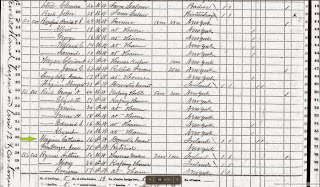
Catherine McGuire in 1870 census

So 1870's a hit! What about the next two censuses? In 1875 Elizabeth Reid is still running the hotel, although there's no record of George. (There is a George Reid, 19 years older than the one in 1875 and listed as a boarder. Perhaps the father?) Included with the household is our target Catherine, 21 years old, and now she's married. Her husband is Michael Farnan – not Barney! He's listed as a farmer and 42 years old. They also have a child, Joseph, 8 months old. In an exchange on Facebook recently, Aunt Phyllis said she thought that Elizabeth Farnham had a couple of brothers who'd died young. Apparently, this is one of them. In addition, the 1910 census notes that Kate had had four children, only one of whom had survived to that point.

In 1880 Michael and Kate have moved from the Reid household, but still in New Scotland. No sign of Joseph, but Elizabeth appears in the record. Now the census says that Michael is 39 years old: so in the passing of five years his age decreased by 3 years. Maybe he's our Benjamin Button? Occupations: he's a farm laborer, she keeps house. The surname in this record is spelled Farnaim. When I think about it, though, this spelling inconsistency shouldn't be surprising. If you can't read or write yourself, I don't suppose you'd care very much about how someone else chooses to spell your name, would you? So far, this is the last record I have of Michael (= Barney) Farnham. The next record of Kate doesn't appear for 20 years, in the 1900 national census.

So who was Kate's second husband, John Fitzpatrick? He was born in 1830 in Ireland, so he was 24 years older than Kate. He arrived in the U.S. in 1847, hot on the end of the Irish potato famine. It's very hard to trace single men in the records: they keep moving around as their work takes them, and having a common name like John Fitzpatrick just makes it next to impossible. John – I think it's the right one – appears in the 1892 census in New Scotland, but he's alone and not linked with Kate. John is a Civil War veteran: he served in the 91st Regiment of New York Volunteers, Company C. This regiment was recruited in 1861 and shipped out, first, to Governor's Island, then to Key West for four months of training. They then transferred to Pensacola, Florida and then to New Orleans. They eventually headed north and participated in the siege of Port Hudson, Louisiana which lasted from May 22 – July 9, 1863. The Ninety-first eventually came home in July, 1864, then was sent to participate in the closing battles of the war in Virginia. They were finally mustered out on July 3, 1865. John died on 9 Oct, 1911.

Apparently, in the following years Kate received a widow's pension, I presume on the basis of John's service in the Civil War. There is a newpaper article in 1928 in which some of the widows living in the Utica area receive an increase in their pension. Kate is mentioned by name, with her address given as 132 West Clark Street in Ilion. Her pension is increased to $50 per month. It's still a mystery to me why this address is given, when the censuses and newspapers indicate she was living in New Scotland.

So this is as far as I'd made it as of yesterday (Friday, 12 Sep 2014). Then I received a letter from the Herkimer County Historical Society. If you recall from the beginning of this post, the Schenectady paper said that in 1931 Kate was moving to live with her daughter. The 1930 census has her still living in New Scotland, as expected, and at that time she would have been 76 years old. She is not listed in the 1940 census nor in the 1936 directory of Ilion, Herkimer and surrounding towns. I did everything I could think of on fultonhistory.com, but could not find anything about her. So I wrote to the Historical Society asking if they could check their records of obituaries in the Herkimer Evening Telegram, looking for Kate sometime between 1931 and 1936. On Friday they responded that they'd found the obituary I was hoping for, dated 18 Mar, 1935. Here's the text:

Mrs. Fitzpatrick, 80, passes away in Ilion.

Ilion - Mrs. Catherine Fitzpatrick, 80, widow of John Fitzpatrick, died unexpectedly at her home, 132 West Clark street, on Sunday.

Dr. C.C. Whittemore, this village, coroner, who was called, said death resulted from complications.

Mrs. Fitzpatrick was born in Ireland, June 16, 1854, and came to this country 64 years ago. She had been a resident of Ilion for about 40 years and was a member of the Church of Annunciation. She leaves one daughter, Mrs. Elizabeth White, Ilion; five grandchildren and five great-grandchildren.

Funeral will be held Wednesday at 9 a. m. from the home, and at 9:30 from the Church of Annunciation.

I think the 40 years in Ilion is just incorrect. Maybe the reporter got mixed up with her daughter(?). It also looks like something got left out of the coroner's statement. The next step for me, I guess, is to write to the Ilion town clerk and request a copy of the death certificate. And let's count: the five grandchildren would have been Nellie, Lillian, Ed, Mary and Kaddie White. The five great-grandchildren would have been Nellie's children Alfred, Ed, Joe, Phyllis and Norman Johnson. I would also guess that Kate is buried in St. Agnes Cemetery, and I wouldn't be at all surprised if her grave is in the same area as that of her daughter, son-in-law and granddaughter. I probably looked right at it this spring without recognizing it. Something else to do next time I'm in the valley.

I need to give out a couple of prizes (sorry, no cash awards) as a result of responses to my last post. Bryan receives second prize for recalling – somehow – that Fitzpatrick was the surname of a female ancestor, although he came up one generation short. Maybe third prize should go to Michelle Keogh: she'd taken notes from conversations with Uncle Joe and had recorded that Grandma White's mother's name was Fitz.... gerald or ...patrick. But first prize goes to Aunt Phyllis who pointed out that Elizabeth's Farnham's mother's name was Fitzpatrick. Amazing what information we all have tucked away, if only someone would ask the right questions!

Sunday, August 31, 2014

The fading trail of the Whites

Today I'd like to focus a bit on my father's maternal grandparents, in other words the parents of my Grandma Nellie. This should have been, could have been a long discussion, for when Nellie's mother, Mary Elizabeth White, died in 1956, her obituary was full of the types of details needed to trace a family back in time.

Mary Elizabeth White – Grandma White, I've been told – was born July 23, 1878 in Albany, New York to Barney Farnham and Catherine McGuire. She married Luke White in Albany on September 19, 1899. Their first child, Grandma Nellie, whose full name was Ellen Theresa White, was born on June 25, 1900. The other children were Lillian (born September 4, 1902), Edward (born April 15, 1907), Mary (born March 8, 1911) and Kathryn (born April 17, 1913). I'm happy to say that I knew all of these kids, superficially of course. However, Grandma White died when I was about 2½ years old, so I have no recollection of her. Although it looks like the family started in the Albany area, by the time of her death Elizabeth had lived in Ilion for 45 years.

[A quick aside: the name Kathryn appears in the records with lots of different spellings. I really don't know how Aunt Kaddie spelled her name, either the name Kathryn or Kaddie. If anyone knows, please pass it on!]

Those kinds of details are real gold nuggets, providing solid evidence to build upon as we trace back through the historical records. In fact, though, the oldest record I've been able to find so far is from the 1900 national census. I've not been able to corroborate anything prior to that time, not her wedding date, birth date, or her parents. More on that a bit later.

Luke White was born on May 14, 1873 in Ireland, and he emigrated to the U.S. In 1892. In the 1900 census his occupation was recorded as a railroad track laborer, in 1910 he was a section head for the railroad, 1915 the section boss. Between those last two records the family had moved from Montgomery County to German Flatts. In 1920 he was working as a laborer in business equipment, which his obituary clarifies is that he worked for the Library Bureau. Both his daughter Nellie and her husband, Fred Johnson, also worked for the Library Bureau. This was not, as I had thought, a branch of Remington such as the typewriter company or the Rand. Rather, it was a separate company that built library and office equipment: files, desks, etc. Finally, Luke's death certificate (the information coming from his wife) says that he was a wood worker.

The death certificate raises another point of interesting inconsistency. Both it and the earliest census records say that Luke was born in Ireland, and one of the latter even specifies that he arrived in 1892. I have found a Luke White, aged 20, on the passenger list for the ship Germanica, which arrived in New York on 29 April, 1892 from Liverpool and Queenstown, Ireland. Queenstown was the old name for the port of Cobh (pronounced “cove”) in County Cork. The list says that this Luke White was from Dublin; I think we need to view that record with a bit of skepticism, as Dublin may only have been the last place he lived before emigrating and not the place where he was born. Actually, even more caution is probably needed: White is a very common surname, and the given name Luke isn't really that unusual either. That, plus the fact that the age is a little off (at that time Luke would have been just a month short of his 19th birthday, not 20) leads me to consider this record as a suggestive possibility, and not as anything solid.

Luke White died in 1928 at the age of 55. He had suffered for 14 months before finally succumbing to liver cancer. I have no picture of him, but in 1918 he registered for the draft in World War I (at the age of 44). On that document he is described as being of medium build, brown eyes, brown hair, height 5'4½” (under the tall category!). I'll bet that the signature at the bottom of the first page is his.

I don't know too much about Lillian (in picture with Grandma White outside their house at 132 West Clark Street in Ilion). She never married and suffered from ill health. I believe that I remember my dad telling me that because of her severe arthritis he would carry her from one room to another. I'm sure some of you have a better knowledge and memory of the facts; I'd love to learn what you know. The two things that stick out in my memory of Uncle Ed were that (1) he attended all of the Ilion home football games, and (2) he used to play semi-pro baseball. Mary ended up living in Watertown, where she was a clothing buyer for one of the local department stores. As I wrote those sentences, I was really hit by just how scanty my knowledge is. Please folks, help me fill in the gaps!

Luke and Elizabeth White are both buried in St. Agnes Cemetery, a small graveyard “nestled” between Route 5 and the New York Thruway just north across the Mohawk River from Ilion. As you drive up the hill to the cemetery, they're in the back in the eastern corner, where you can also find the grave of their daughter Lillian and son-in-law Fred Johnson (aka Arthur Westerlund). At the western end of the hill are the graves of their daughter Nellie, grandson Alfred, and Alfred's second wife Emma. During our visit to the Mohawk Valley in May I took a brush and water to the gravestones and was able to clear away most of the lichens that had grown on them. Emma's stone has sloughed over, I think because the cement slab on which it's set has cracked and broken, but otherwise everything looks in pretty good shape.

So for the White family, I feel like we have a fairly good handle on the basic facts from recent history, but I just haven't been able to break through from the 20th into the 19th century. Grandma White's parent's names are Barney Farnham (Farnum?) and Catherine McGuire. I can't find anyone in the greater Albany area by those names in the late 1870s. Is Barney a nickname for Bernard or something else, or just a nickname (like Butch)? I had hoped that Luke White's death certificate would provide clues on where to look for him in Ireland, but his wife didn't know where he was born, other than in Ireland, or what his parents' names were. I can find no record in the Albany newspapers for the marriage of Luke White and Mary Elizabeth Farnham in 1899. That's not too unusual for newspapers of that time, though. The Catholic Church has simply ignored my inquiry. My current hope is that their marriage license will provide some kind of breakthrough. The bride and groom are supposed to give the names of their parents, and this will have the advantage over, say, an obituary or a death certificate because Luke and Elizabeth would have provided the information themselves and not some grieving relative. I requested a copy of the license from Albany in July, and I'm checking the mail every day now in hopes that it arrives. But so far, no luck.

Thanks to Ron Johnson for copies of the photos of people in this post. I also understand that some of you are having problems adding comments to the blog. This I don't understand: the settings should allow anonymous commenters and the text should appear in-line. I'll continue to try to figure out what's wrong and hope to straightened it out. In the meantime, you can always email comments to me directly at baeus2-at-yahoo.com (substitute the @ symbol for -at-).

West Cork Update

This blog post comes to you from the city of Cork, Republic of Ireland. I had initially planned this trip to be tagged on to the end of th...