Showing posts with label California. Show all posts

Sunday, March 21, 2021

Shake, Rattle and Roll

I’ve spent much of the past year following leads on the Collins and Driscoll families from West Cork. As I was digging through the records, I’ve come across some interesting – and, for me, surprising – stories. I’d like to share the first of those in this post. It starts with my great great uncle, Jeremiah Driscoll. He was my second great grandfather’s brother, born (or at least baptized) in 1829.

The Patriarch

In a short biography of one of Jeremiah’s sons (Bartholomew), I learned some details about his early history. Jeremiah came to California in 1855 at the age of 25 or 26, about six years after the famous Gold Rush. Initially, he worked as a miner in the northern part of the state. He became an American citizen on 24 Sep, 1856, with the naturalization taking place in Shasta County. (The county seat is the town of Redding, a town we will revisit a bit later). He moved to Santa Cruz County in 1857 and settled on land along the Pajaro River, approximately 3–4 miles east of the modern town of Watsonville.

Map showing location of Jeremiah Driscoll property, 1889
Map of the Pajaro Valley. Watsonville is off the left side of the image, and Jeremiah Driscoll's property borders the river in the center of the screen. Map dated 1889.
Roadside view of the original Driscoll property.
A roadside view of the property once owned by Jeremiah Driscoll, looking toward the Pajaro River.

One of the first experiments in farming in the area around Watsonville – the first, that is, by the immigrants coming from the eastern part of the country – was to plant potatoes. This experiment turned out to be wildly successful, so much so that an oversupply of the crop caused the price to crash, and that led to the devastation of the farms. Recall, that this was in the time before the completion of the transcontinental railroad, and so the producers were limited to the local market. Following that crash, much of the land was planted in grain, including that owned by Jeremiah.

Jeremiah Driscoll married Johanna Hickey, another native of County Cork, and together they had nine children. He died on 11 Apr, 1884 at the age of 55 (reported in the newspapers as 53). In the account of his death, published in the Santa Cruz Sentinel, it was noted that “[b]y his own energy and industry Mr. Driscoll acquired one of the best farms in the county.” His estate included land holdings of 350 acres, valued at the time as $30,000. I’ve translated 1884 dollars into 2021 dollars, the equivalent being somewhere over $800,000. I don’t think simple calculations based on the rate of inflation adequately capture the value of land in California in today’s market. All told, I think we can agree that Jeremiah left an estate worth somewhere north of a million dollars.

Jeremiah’s legacy included more than valuable farmland. His children achieved fame that extended beyond the Pajaro Valley, and for the rest of this post, I’d like to focus on one of them, his daughter, Julia.

Mrs. Mayor

The first hint of what was to come, the first foreshock, came at 5:12 a.m. on the 18th of April, 1906: nineteen minutes before sunrise. Less than a minute later, the San Francisco Earthquake hit. The magnitude 7.7–7.9 quake and its aftermath of fire resulted in more than three thousand deaths, 225 thousand injuries, and an estimated $400 million dollars in damage. In today’s dollars, that’s roughly $11.6 billion.

San Francisco in flames following the 1906 earthquake.
The city of San Francisco in flames following the 1906 earthquake.

On the day of the quake, a proclamation was posted in the newspapers and around the city by the Mayor, Eugene E. Schmitz:

Schmitz Proclamation to shoot looters on sight.
Eugene E. Schmitz. Proclamation by the Mayor, broadside. April 18, 1906. (Gilder Lehrman Collection).

I’m not sure if anyone was actually shot on sight, but the aggressive, take-charge attitude earned Schmitz publicity around the country and around the world.

Portrait of Mayor Eugene E. Schmitz.
Mayor Eugene E. Schmitz. Original image from San Francisco History Center, San Francisco Public Library. www.sfpl.org

Schmitz was the son of a German father, Joseph L. Schmitz, and an Irish mother, Charlotte Hogan. He was born in 1864 in San Francisco, and he grew up to be a musician and composer, a violin player. That wouldn’t seem to be the typical route into politics, but in San Francisco at the turn of the 20th century labor relations were one of the hot topics. Gene Schmitz was elected to be President of the local Musicians’ Union.

Picture of political boss Abe Ruef of San Francisco.

As the leader of one of the city’s labor unions, not to mention his charisma and good looks, one of the local political “bosses,” Abe Ruef (1864-1936, photo at right), tapped Schmitz to run for mayor on the Union Labor Party ticket in 1901. In a three-way race, Handsome Gene won election to his first two-year term. He was then re-elected in both 1903 and 1905.

By this time of his third election, rumblings of trouble began to be heard: not the earthquake, but rumblings about political corruption. The pursuit of allegations was continually stalled at the local level, so the editor of a local newspaper appealed to President Theodore Roosevelt for help. Through Roosevelt’s intercession, the sugar baron Rudolph Spreckels helped to bankroll $100,000 for investigations. I know that I shouldn’t impose modern standards on the actions of people more than a century ago, but the idea of a private citizen providing money to the government to pursue criminal allegations sounds like a recipe for all sorts of shenanigans. Maybe the people with the deep pockets are just more discrete these days.

The investigation, led by William Burns of the Secret Service, was underway on the fateful day of the earthquake. The main thrust was corruption, and one of the more salacious elements of it concerned the so-called “French restaurants.” To be fair, these establishments did serve food to customers on the lower floors, but upstairs the world’s oldest profession was the real order of business. The restaurant proprietors needed to obtain a liquor license from the city, but would often find their applications denied. Denied, that is, until they could schedule a meeting with Boss Ruef and make a contribution of $5,000 to the cause. Then, amazingly, Mayor Schmitz would make an impassioned plea to the police, and the liquor license would be approved.

The intensity of the investigation waned in the immediate wake of the earthquake. After the city stabilized, Schmitz surprised everyone by leaving for a tour of Europe in October of 1906. His expressed purpose was to visit and consult in the capitals to develop ideas about how to rebuild from the ashes. You might think that he was just skipping town in order to avoid arrest and prosecution. But when the indictments did come down, he dutifully returned to San Francisco to face trial.

That was a tease. Before telling you about the outcome of the trial, let me explain you why I’ve included Mayor Schmitz in this story.

Newspaper article announcing marriage of Eugene Schmitz and Julia Driscoll.
Announcement of wedding of Eugene Schmitz and Julia Driscoll, published in The San Francisco Call, 17 Jun 1891.

It turns out that Mayor Schmitz, “Handsome Gene,” was married to the daughter of Jeremiah Driscoll, a young lady named Julia A. Driscoll. Newspaper reports tell us that Julia was educated in the public schools of Watsonville and San Francisco. The San Francisco Examiner described her in 1901: “She is eminently American – clear-headed, common, sensible, wide awake, unaffected, sincere, quick-witted, refined, practical. She is of the type that cannot be too many – the home-keeping, domestic woman, who is not swamped in her domesticity; that pleasant American type of woman who can look well to the ways of her household and still permit herself the wider range into the ways of the world.” (The San Francisco Examiner, 07 Nov 1901, page 2.)

Portraits of the Schmitz family.
Portraits of Mayor Schmitz's family, published following his election as Mayor of San Francisco in 1901. Julia is in the center, flanked by son Richard on the left, and daughters Eugenia and Evelyn on the right (Eugenia is the taller of the two). The San Francisco Examiner, 07 Nov 1901, page 2.

When Schmitz was first elected, the couple had three children: Eugenia Clara (born 1892), Evelyn Heller (born 1894), and Richard Ambrose (born 1896). In the interview published in The San Francisco Examiner in 1901, Julia explained why she had been certain that her husband would win the election:

"Somehow," she says, "I felt confident from the very first. Mr. Schmitz had never been in politics. He had gone along quite contentedly, never thinking of anything beyond success in his profession and in a business way, perhaps, yet, when the matter was first broached and the nomination offered to him, and he came home and told me about it I felt he would be elected, and through the campaign I never lost my belief. Through all his anxieties of the campaign I tried to keep up his confidence and hope with my own, for I never wanted him to feel for a moment that he wouldn’t win."
And what kind of a Mayor do you think Mr. Schmitz will make?
"Why," answered Mrs. Schmitz, "I have always felt that he had exceptional ability, that opportunity would bring it out, and," here Mrs. Schmitz smiled a smile of wifely pride, "if Mr. Schmitz makes as good a Mayor as he has made a husband, he'll make a very good Mayor indeed!"

Unfortunately, that didn't turn out as well as Julia had hoped. Abe Ruef "copped a plea" for which he received immunity from most of the charges against him in exchange for his testimony against Schmitz. On 14 Jun 1907, Mayor Eugene Schmitz was convicted of extortion. Ruef was convicted of bribery in 1908, and he was sentenced to 14 years in San Quentin, a sentence he finally began serving in 1911. Schmitz was down, but not out, though. He appealed his conviction and won. However, he was tried again, this time for bribery. At the second trial Ruef refused to testify against him again, and Schmitz was cleared.

Newspaper report of conviction of Mayor Schmitz on charges of extortion.
Front page story in the Stockton Daily Evening Record reporting the conviction of Mayor Eugene E. Schmitz of extortion. Published 14 Jun 1907.

Schmitz ran for the office of Mayor twice after his brush with the law, but he never regained the post. He was elected to the San Francisco Board of supervisors where he served from 1921 to 1925. He never gave up on his music. In 1912 he was working on the music for a operetta entitled "The Maid of San Joaquin." The Pacific Coast Musical Review wrote that "...its object is to depict the early California mining life in a manner more realistic and tasteful than has been done in the "Girl of the Golden West." In hindsight, it was probably asking a lot to outdo Giacomo Puccini whose La fanciulla del West" had premiered at the Metropolitan Opera in New York in 1910 with Enrico Caruso in the cast! The Review also stated, "There is no doubt that the work contains exceptional merit both from a musical and literary point of view, and in these days of comic opera stagnation, or even light opera famine, this work ought to find a place in the repertoire of the leading American companies." Apparently, producers on the East Coast were not as enthusiastic, and I could not find evidence that the operetta ever saw the light of day. However, in his obituary it was written that he had produced his own opera in New York. Perhaps it did have an audience, after all.

Eugene Schmitz died on 21 Nov, 1928, in San Francisco. He never regained the previous heights of his career, and in his later years he had shaved off the beard that gave him such a swashbuckling image. Eugene and Julia lost their son, Richard, in 1914 following an operation for appendicitis. Schmitz was in New York at the time, working on getting his opera staged. The two daughters lived long lives. Eugenia became a Dominican nun in 1914, taking the name Sister Mary Isabel. She retired as a secondary school teacher after 47 years of service, and was honored on the occasion of her 60th anniversary in the order. Evelyn lived to the age of 92. As far as I know she never married, and I have not found much information on her life. Julia, herself, passed in 1933 at the age of 68. It was reported that she took her husband's legal troubles very hard, and her health suffered for it.

I hate to end the post on such a sad note, so I would like to offer something to celebrate the life and liveliness of Julia (Driscoll) Schmitz and her daughter Evelyn. While researching for this post, I found some images of Eugene that had been posted on the web by the San Francisco Public Library. One of these showed him together with his wife and daughter Evelyn, apparently posing for photos during an election. The image on line is of only fair quality, but it inspired me to inquire at the library whether they had other pictures of Schmitz's family. They did! Not the greatest quality, but images that help to animate the facts that I was able to glean from newspapers and other sources. These images, apparently, have never been published before. I offer them with a nod of appreciation to the lives of Julia and Evelyn Schmitz.

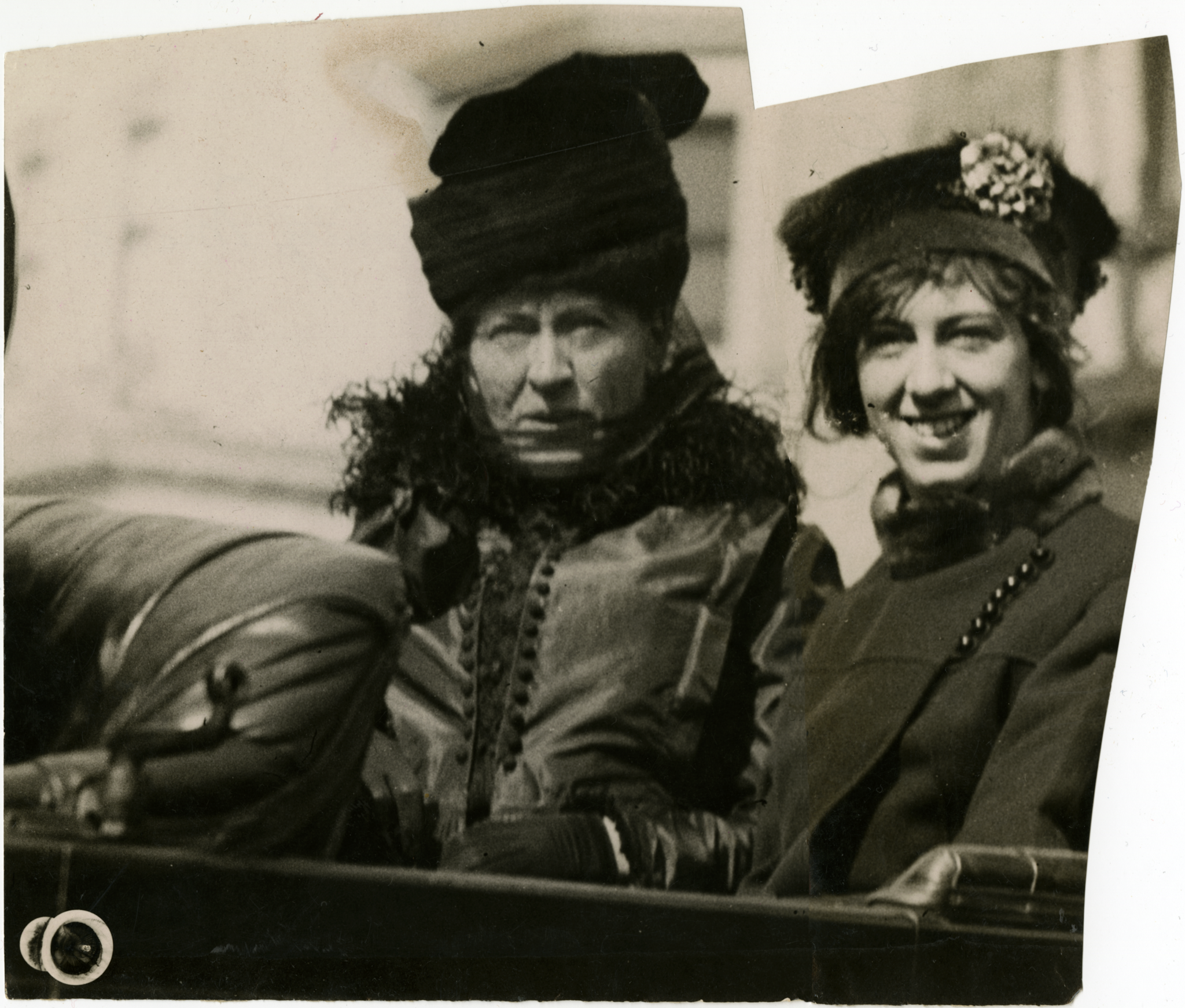
This is the lo-res image put online by the San Francisco Public Library, with Julia on the left, Evelyn in the middle, and Eugene Schmitz on the right.
Julia (left) and Evelyn Schmitz. Undated photograph. Credit: San Francisco History Center, San Francisco Public Library.
Evelyn Schmitz, photo dated 1938. Credit: San Francisco History Center, San Francisco Public Library.

I have another story about a descendant of Jeremiah Driscoll. But this post is already long enough, so I'll save it for next time. But here's a teaser: this child had an even greater influence than the Schmitz family, an influence that I think a good number of readers can identify with. Stay tuned.

Monday, February 1, 2021

The (lost) family of Tim Driscoll

We’ve all done it: you shake a can of your favorite carbonated beverage, pop the top, and… well, you know what happens next. This happened to me a few months ago when I tried to explore some of my DNA matches.

The number of DNA matches that you’ll get is overwhelming, literally thousands. Most of these, as you’d expect, are pretty remote. One of the rules of thumb is that any match of less than 7 cM has a pretty high chance of being just a random match. That’s 7 cM out of a total of something near 7,000, or 0.1%. Most of the names of my DNA matches are entirely meaningless, and I have to try to dig in deeper to discover how they’re related. My usual strategy is to start with matches that are associated with their own family trees, the bigger the tree, the better. The next criterion is to research matches that have “unusual” names. If all you have to work with is the name, and the name is something super common like, say, Mary Jones, you’re going to run into a lot of false leads.

All this is to explain how I popped the top on my can of soda. It was a match on 23andMe; I’m going to purposely be vague on identification of these users because, you know, this can be a touchy issue. My other little dirty secret is that, for living people, Facebook is simultaneously a blessing and a curse. Some folks are extremely reticent to post anything of a personal nature on Facebook, but others spill their guts! For this DNA match that I began to explore I was able to find his/her site on Facebook. Unfortunately, that didn’t really help me out very much, that is, until I started exploring one of their friends, a sibling. Pop!

It took about two weeks worth of work, but I was able to follow this lead back five generations before it ran dry. At the end of the line was a couple by the name of Daniel O’Brien and Mary Driscoll. Of course, the wife's surname caught my attention since that was the maiden name of my great grandmother.

View of the townland of Bawngare, home of Daniel O'Brien and Mary Driscoll.

Mary Driscoll married Daniel O’Brien on 24 Feb 1846 in the parish of Skibbereen and Rath in West Cork. They lived in Bawngare in the parish of Aughadown. In the 21 years between 1847 and 1868, Mary gave birth to eleven children. I’ve been able to trace 16 DNA matches to the descendants of the children of Mary and Daniel O’Brien so far: four to their son Daniel, six to their daughter Katherine, one to daughter Margaret, two to daughter Hannah, and two to daugher Mary. It was pretty clear to me that we’re related to Mary Driscoll, but the question is: how?

Husband Daniel O’Brien died in 1874 at the age of 57. Mary, however, lived until 06 Jan 1914, and at that time the civil registration of her death claimed that she was 88 years old (so, roughly, born in 1826). The description of her funeral that was published in the Skibbereen Eagle turned out to be the key to the job of piecing together her family. Here’s the beginning of the obituary:

Mrs. Mary O’Brien, Bawngare, Aughadown.

It is with feelings of deep regret we have to chronicle the death of this respectable inhabitant, which took place at her residence on Tuesday morning. She was greatly respected by all who knew her for her high person, worth, and character. Belonging to one of the oldest and most respected families in the neighbourhood, where her ancestors have settled for many generations past in the district. Her death is sincerely mourned by a wide circle of relations and friends. The funeral, which took place for the Abbey, was, notwithstanding the inclemency of the weather was one of the largest seen in the district for some time.

The officiating clergymen were Rev J O’Sullivan, P P, Aughadown; Rec T Hil, C.C., do.

Then, the important part:

The chief mourners were – Daniel O’Brien, R.D.C. (son) [RDC = Rural District Council], Mrs O’Brien (daughter-in-law), Mary, Kate, John, William, Ellie, Dan, Stephen, Denis, Bridie, Kathleen, Michael, (grand-children), Mrs. Collins (sister), Timothy Driscoll (nephew), Mrs. McCarthy, Mrs Holland, Margaret M Collins (nieces) ....

Aughadown Cemetery
Aughadown Cemetery, from the Skibbereen Heritage Centre. While Mary O'Brien lived in Aughadown Parish, I don't know in which graveyard she was buried.

Mrs. O’Brien, Daniel’s wife, was named Mary Anne Dwyer (1866 – 1952). The grandchildren listed were all the children of Daniel and Mary Anne. I still have not identified exactly who the nephew Timothy Driscoll was. After some digging, I was able to uncover that the sister, Mrs. Collins, was named Hanora. Margaret Mary Collins, as I expected, was her daughter. The other two nieces were more difficult to identify. I finally discovered that Mrs. McCarthy was another of Hanora’s daughters, Rebecca. The mysterious Mrs. Holland was more of a struggle. I will return to her shortly.

Five of the daughters of Daniel and Mary O’Brien – Mary, Margaret, Annie, Hannah, and Ellen – emigrated to the United States and settled in California, living in San Francisco and Alameda Counties or a bit farther south in the coastal farmlands of Monterey and Santa Cruz Counties. Knowing that, my interest was piqued when I started pursuing a new and different set of DNA matches, matches who lived in exactly the same area of California.

Panorama of Watsonville, California
Panorama of the city of Watsonville, California.

These new matches, as far as the records would take me, traced back to a couple named Jeremiah Driscoll and Johanna Hickey. The American records say that Jeremiah was born around 1830 and died in 1884. He originally went to northern California to work in the mines, and then moved south to settle in the Pajaro Valley of Santa Cruz County, near the modern town of Watsonville. He and Johanna had nine children together. I’ll have more to say about Jeremiah’s family in a subsequent post. I have three DNA links with Jeremiah’s descendants, both through his son Richard.

In the 1860 Federal Census Jeremiah, age 27, is recorded living with his wife Hannah and their newborn, first-born daughter, Mary. Also listed is a man named Daniel Driscoll, age 29, a farm laborer born in Ireland. On the basis of this record, I have seen some speculation that this Daniel was Jeremiah’s brother.

To briefly review, my 2nd great grandfather, Timothy Driscoll, was born sometime around 1836. Mary Driscoll, a relative of some sort, was born around 1826. She had a sister Hanora (Mrs. Collins). Jeremiah Driscoll was supposedly born in 1830. And, finally, Jeremiah may have had an older brother Daniel. How to reconcile all these facts? I suspected that all of these people – Timothy, Mary, Hanora, Jeremiah, and Daniel – might be brothers and sisters. But that guess was based only on the DNA matches and the rough similarity of their ages (born about 1826 to 1836).

The Mysterious Mrs. Holland

There was one more loose thread: the mysterious niece, Mrs. Holland, mentioned in Mary O’Brien’s obituary. Who was she? To resolve this I used the church and civil registrations of births and marriages in Ireland. The civil registrations began in 1864, and I presumed and hoped that a niece of Mary would likely have been married after that date. This was important because the church records usually would only show the names of the bride and groom and the names of the witnesses. They might also include the name of the officiant, and even less commonly where the couple came from. The civil records, in contrast, give all of that information, always with the homes of both bride and groom, and the names of the couple’s fathers as well. So there’s a lot more information to work with there.

Home page of IrishGenealogy.ie, a source for transcriptions and images of church and civil records in Ireland.

In the civil records (accessed through irishgenealogy.ie) I found that between 1890 and 1914 there were eight marriages recorded in the D.E.D. (District Electoral Division) of Skibbereen records and two in the D.E.D. of Schull in which the groom was named Holland. (Thank goodness for uncommon names!) I also assumed that when the newspaper reported that Mrs. Holland was a niece of the deceased Mary O’Brien they were being literal. That is, that Mrs. Holland was either the daughter of one of Mary’s siblings, or she was the daughter of one of Daniel O’Brien’s siblings. Therefore, if Mrs. Holland was the daughter of a brother or sister of Mary, then her maiden name would either have been Driscoll (if she were the daughter of a brother) or her mother’s maiden name would have been Driscoll. I could get this information from Mrs. Holland’s marriage record or from the marriage record of her mother. Similarly, if Mrs. Holland were the daughter of one of Daniel O’Brien’s siblings, then either her maiden name was a variant of O’Brien or her mother’s maiden name was. Finally, the civil registration of the marriage of Mrs. Holland would tell me the name and residence of her father.

Civil registration of the marriage of Patrick Holland and Annie Driscoll.

The only marriage that fit these criteria occurred on 19 Feb 1903 in Rath Church in which Patrick Holland and Annie Driscoll were wedded. Annie was recorded to be living in Ardagh at the time of her marriage, and her father’s name was Patrick Driscoll. I then checked the civil birth records for an Annie born to father Patrick Driscoll in the years 1864 – 1883 (so that Annie would have been at least 18 when she married). There were three such cases, but all born in Cork City. I then expanded my search into the church records, and found a baptism for a Nancy Driscoll, 15 Jun 1865, in the parish of Rath and The Islands. The parents of this child were Patrick Driscoll and Margaret Driscoll. Now while there is a townland called Ardagh a good distance east of the area of my focus, there were also two others in the immediate area: Ardagh North and Ardagh South. If you enlarge the image of the registration of their marriage, you'll see that one of the witnesses has a familiar name: Margaret Mary Collins. Therefore, this lead seemed very promising, and so this is where I concentrated my attention.

In the 1901 Census of Ireland for the D.E.D. of Tullagh there is a record for an Annie Driscoll (age 28) living in the home of her brother Michael (age 36) and his wife Mary in the townland of Ardagh South. I could not confidently recognize either of Annie’s parents, Patrick or Margaret, anywhere in this census. In a search of the civil death records I found one Patrick Driscoll of about the right age in the period from 1865 – 1901. This man died in 1877 at the age of 62 (therefore, born around 1815). I failed to find a Margaret, at least one that I could confidently identify as the mother of Annie. There were several possibilities, but with little information to distinguish them.

I went back and searched the birth records for children born of parents Patrick and Margaret Driscoll. I found seven, Annie being the youngest. Five of these children emigrated from Ireland and lived in either Santa Cruz or Monterey Counties in California. Coincidence? I think not! I have one DNA match with a descendant of Patrick and Margaret (and six additional matches with the descendants of that match). This reassured me that I’d been lucky enough to find the right Mrs. Holland!

Now I have another potential sibling of my 2nd great grandfather, but was it Patrick or Margaret? Both had the surname Driscoll. All told, I had six potential brothers and sisters. The next step was to try to pull all these threads together, and if they were siblings, who were their parents?

Pulling the Threads Together

For years I had despaired of learning more about the ancestry of my great-great-grandfather Tim Driscoll. Both his given name and his surname are very common in the area of West Cork. I could find lots of Tim Driscolls in the records, but I had no way of knowing which one was the right one. The same is true for all of the rest of the names I’d uncovered: Patrick, Daniel, Jeremiah, Mary, Hanora, Margaret, and Johanna. Then the thought occurred to me that even if I couldn’t confidently associate an individual with a specific record, perhaps I could make some progress if I looked at this as a family. My question, therefore, became: how many families in West Cork had children with all of the names Mary, Jeremiah, Timothy, and Hanora? I didn’t include Daniel in this list because the evidence was pretty slim that he was actually Jeremiah’s brother. Also, I didn’t know if it was Patrick or Margaret who was a member of this group.

I have a long list of reasons why this search strategy could fail. But basically, here’s what I did. I tabulated the parents and the baptismal date for all the Driscoll children with these names who were born between 1820 and 1840 in the parishes of Aughadown, Caharagh, Muintervara, Rath and The Islands, Schull East, Schull West, and Skibbereen. A total of 479 families in these West Cork parishes had at least one child with the name Mary, Jeremiah, Hanora, or Timothy. But I was pleasantly surprised – no, ecstatic – to find that only one family had kids with all four of these names.

The parents in this family were named John Driscoll and Mary Hourihane. The baptismal dates for the four children where Mary, 15 Apr 1825; Jeremiah, 08 Feb 1829; Honora, 09 Jun 1833; and Timothy, 18 May 1835. This is exactly the same birth order that I’d gleaned from other records, and the dates are close. Remember, that in those days people were a lot more free and easy with this information than we are today. For two of the baptisms the townland is recorded: Ballymacrown. This is the same place that my 2nd great grandparents Tim Driscoll and Ellen Collins had lived. I then searched the baptismal records of Skibbereen to find any other children of that couple, and I came up with four more names: Daniel, baptized 04 Feb 1827 from Ballymacrown; John, 23 Jan 1831 also from Ballymacrown; Michael, 08 Apr 1837; and Johanna, 15 Jun 1840.

Registration of the baptism of Deniel Driscoll in the register of Skibbereen (Creagh and Sullon) parish.

The baptismal record for Daniel corroborates the interpretation of the 1860 U.S. census that Jeremiah had a brother by that name who was two years older. But there’s also something else interesting in that record: Daniel’s father’s name was recorded as John Bawn Driscoll. (Actually, the irishgenealogy.ie transcription was John Bacon Driscoll, but a look at the image of the original register entry led me to a different interpretation.) Now, it’s not unusual that when surnames are so common that they don’t adequately serve to distinguish people, then new names can be adopted. Such a name is referred to as an agnomen. Bawn or Bane is a fairly common agnomen in Ireland. The name is derived from the Irish word bán, which means white, and it commonly refers to a person or an ancestor who was blonde or fair-haired. I went back and searched for children of a couple named John Bawn and Mary Hourihane, and found yet another child, Cornelius, boaptized 24 Oct 1823 from Ballymacrown.

There’s one piece missing though: have you spotted it yet? Answer: there is neither a Patrick nor a Margaret in the list of children. (Remember, these were the parents of the mysterious Mrs. Holland.) However, I redid part of the search on another website, FindMyFamily, and there I found a Margaret. She, too, was born in Ballymacrown and baptized on 31 Jul 1821. Apparently, the transcribers for irishgenealogy.ie had missed this entry in the baptismal registers because instead of the record starting with the child’s name, it began with the name of the priest doing the baptism.

We may not be done yet: I searched the baptismal records for children of John Bawn from Ballymacrown and came up with yet another child: Catherine, baptized 19 Aug 1821. In this case, though, the mother is recorded as Catharine Sheehane. It’s difficult to be certain, but it’s at least plausible that Mary Hourihane was John (Bawn) Driscoll’s second wife.

To summarize, in the table below I’ve compared the potential brothers and sisters of Timothy Driscoll that I’ve found using DNA and later records, with the baptismal records of the children of John Driscoll and Mary Hourihane.

Information from later documentsBaptismal records of children of
John Driscoll and Mary Hourihane
Name
Year of Birth
Name
Year of Baptism
Patrick/Margaret
?
Margaret
1821
 
 
Cornelius
1823
Mary
1826
Mary
1825
Daniel
1827
Daniel
1827
Jeremiah
1830-1831
Jeremiah
1829
 
 
John
1831
Hanora
1833
Hanora
1833
Timothy
1836
Timothy
1835
 
 
Michael
1837
 
 
Johanna
1840

There were lots of assumptions that I had to make at each step in this research, but even so, I find the results to be compelling. The best test of these ideas will be to trace any descendants of these new members of the family – new to me at any rate – and see if we share any DNA. Much of this post has focused on the research process, but in the course of it I came across several interesting stories. My plan is to share those in the next few posts.

Sunday, January 12, 2020

Search for the One-Armed Man

Those of a certain age will remember the TV show The Fugitive, "...starring David Janssen as Dr. Richard Kimble, an innocent victim of blind justice. Falsely convicted for the murder of his wife ... reprieved by fate when a train wreck freed him en route to the death house ... freed him to hide in lonely desperation ... to change his identity ... to toll at many jobs ... freed him to search for a one-armed man he saw leave the scene of the crime ...."

My search for the one-armed man began with an email from a cousin Amie - 4th cousin once removed, to be precise - asking about a certain Catherine Collins. To orient you, we're on my mother's side of the family, all Irish. Specifically, it's Hannah Driscoll's side of the family (my maternal grandmother's mother). The focus of Amie's question, Catherine Collins, was Hannah's first cousin, the daughter of her uncle Peter Collins (1838-1923). Amie had had a hard time finding records for Catherine and was curious if I might be able to contribute.

My first concern was to verify that the information that I did have was accurate. I had been exploring the Oswego connections very early in my family history research and hadn't pursued it recently. To be frank, I wasn't entirely confident that what I thought I knew was really true. I had made the link from my 2nd great grandmother Ellen (Collins) Driscoll to Catherine's father, Peter, through a line in Ellen's obituary:

She is survived by four sons, Jeremiah, Timothy, Daniel and Michael of this city [Oswego, New York] and two daughters, Mrs. Patrick Cotter, Ireland, and Mrs. Frederick Bough; also a brother, Peter Collins of this city.

I was a bit concerned that the Peter Collins I'd latched on to wasn't actually Ellen's brother, but just another guy with the same common name. Actually, the fact the Amie found me should have been reassuring: it turns out that there's a DNA match between the two of us. With that independent confirmation of a relationship I was much more confident that I'd found the right Peter.

Catherine Collins was baptized on 20 Aug 1865, the child of Peter Collins and Bridget Heagerty, in Skibbereen, County Cork. I'm not sure when she emigrated to the U.S., but she married a man named Luther E. Church on 04 Dec 1885 in Fulton, New York. I also found her name mentioned in the obituary of her son, Thomas D. Collins, who died 20 Sep 1945 in Syracuse, New York. As a sharp-eyed reader, I'm sure that you've caught the fact that Thomas used his mother's maiden name Collins, and not Church.

Baptismal record for Catherine Collins from Skibbereen parish registers.
Baptismal record for Catherine Collins from the parish registers of Skibbereen parish.

So this was the state of my records when Amie contacted me, and that prompted me to dig a little deeper. I found conflicting stories about Luther Church and Katy Collins, and I thought that I would let you be the judge and decide which one you believe. Let's begin with Luther Church, as that's the side with the most detailed paper record.

Luther Church

Luther Church was born in Ohio in 1848 to Daniel Church and Sarah Anne Harvey. The family had moved to Ohio from New England (Massachusetts and Connecticut). He had 5 sisters and 2 brothers: Luke Ancil, Sarah Jane, Elizabeth, Adeline, Almina, Eli, and Sophia. In 1850 they were living in Scipio Township in Seneca County, Ohio. That's about an hour to the north of where I live in Columbus. On 03 Oct 1863 Luther and his brother Eli both volunteered to join Company I of the 9th Ohio Cavalry. A little arithmetic, and we see that Luther was not 18 years old as he claimed (and as Lieutenant Turner confirmed), but only 14!

Volunteer enlistment of Luther Church into Company I, 9th Ohio Cavalry.

Volunteer enlistment of Luther Church into Company I, 9th Ohio Cavalry.

Luther's army career was short-lived. Here is his account as related in a deposition in 1865 (with some punctuation and capitalization edited):

...while with and acting as a private in said Co & Rgt [Company I of 9th Ohio Volunteer Cavalry] at Decatur Alabama. Early in the morning of the first day of June 1864 they were attaked by Rebell Cavalry or an alarm given in the Union camp when hasty orders were given for his company to saddle. When he in attempting to get his saddle out from an old building said saddle having a carobine lashed to it in attempting to pick up or draw his said saddle to him the cock of said carobine ketched and drew it back so that when it come loos it caused the carobine to explode and sent its contents through his left arm near the shoulder nearly severing the arm from the shoulder. He was immediately taken to the General Hospital where his arm was amputated about one hour after the accident. That he was in line of duty and trying to obey his commanding officers at the time of the accident.

This account was corroborated by Sergeant Rush P. Baldwin later, interestingly using many of the same words:

"Rush P. Baldwin ... says that he is a sargent in Co. I of the 9th Ohio Volunteer Cavalry. That he was with and had command of a detachment from said Co. & Regt. on or about the first day of June 1864. They was then at Decatur in the State of Alabama and on or about said first day of June 1864 Luther E. Church, a private in said Co. & Rgt. was shot through the left arm near the shoulder by accident. Which happened as follows to wit - We camped over knight in a building. The next morning orders was given to saddle. When said Luther E. Church in attempting to pickup his saddle which had a carobine lashed to it, the cock of which kitched, and in picking up or drawing said saddle to him drawed the cock back and caused said carobine to explode and send its contents through the left arm of said Luther E. Church making a bad wound and rendering amputation necessary. He said Luther E Church being in line of duty at the time of the accident."

Deposition of Sgt. Rush Baldwin.
Deposition of Sgt. Rush Baldwin concerning accidental wounding of Luther Church.

Luther's arm was amputated in its upper third, leaving a stump that was not long enough for him to later be fitted with an artificial arm. He was moved from the General Hospital in Decatur to another one in Nashville; Tennessee; then on to Madison, Indiana; and finally to Camp Dennison in Ohio (near Cincinnati). There he was formally discharged on 29 Oct 1864, just a bit over a year since he volunteered.

After his discharge, Luther applied for and received a pension from the federal government. His justification was that he was an orphan (his father having died in 1858), his mother was in indigent conditions, and he was unable to work because of the loss of his left arm. The application was approved, and the pension began retroactively to his date of discharge at the princely sum of $8 per month. Most of these details are drawn from his pension file from the U.S. Archives, a file that is 101 pages long. That length is primarily due to the fact that Luther seemed to be constantly applying for an increase in the amount he received each month. As far as I can tell none of these requests were approved, but over the years Congress did raise veterans' pensions: In 1866 Luther's income was raised to $15/month; in 1872 to $18; in 1874 to $24; 1883 to $30, 1886 to $45; and, finally, in 1903 his payments were increased to $55 per month. During most of his life Luther lived in north central Ohio, in Seneca County in Tiffin and Republic. There is an interlude, though, when he was in central New York, at least from 1875 to 1889. I haven't been able to figure out what he was doing there, but this will be an important part of my tale.

The applications for pension increases became more plaintive over time. Luther truly suffered, of that I am sure. How much his ailments were the result of the loss of his arm is much less certain. Toward the end of his life he was restricted to a chair. Because of dropsy, he was even unable to lie down to sleep as his lungs would fill with fluid. He died on 30 Dec 1903 in Tiffin and was buried in Farewell Retreat Cemetery in the nearby town of Republic.

Farewell Retreat Cemetery in Republic, Ohio.

Farewell Retreat Cemetery in Republic, Ohio.


Headstone of Luther E. Church, Company I, 9th Ohio Cavalry.

The life of Luther Church was notable not only for his Civil War service, but for his married life as well... his marriages.

The Three Wives of Luther Church

In 1898 the Bureau of Pensions included an additional form to be completed by the pensioner in which information was requested concerning marriage status and children. The first question was "Are you married?" Luther dutifully reported that he was married to Pearl (Bidleman) Church, and that their marriage took place on 12 Jul 1894 in the Methodist Episcopal Church in Tiffin, presided over by the Rev. McKibbins. With the fourth question, the answers become even more interesting: "Were you previously married?" It turns out that Luther had plenty of information to pass on here. He reported that he had been married to "Maggie E. Church via Harding" in 1872, and that they divorced in 1877. Further, he had later married my cousin, Kate Collins, in 1886, and they divorced in 1887. Finally, concerning any children, Luther reported "One boy living, 2nd wife, 12 years old, July 4th in Oswego NY. With his grandmother Bridget Collins. Raised him for me until 16 years of age."

Bureau of Pensions questionnaire, 1898.

Questionnaire concerning family completed by Luther Church for the Bureau of Pensions.

That sounds straightforward, but in fact Luther's record with the wedded state was much more complicated. My first hint of this came when I found a document recording that in 1887 he had been sentenced to two years in the Onondaga County Penitentiary for the crime of ... bigamy. Apparently the report that he'd divorced first wife Maggie was a bit of wishful thinking. It took me some time to find any records of that first marriage. Luther married Margaret E. Harding (born 1861) in Dryden, New York on 08 Sep 1875. Dryden is a small town about 43 miles (69 km) south of Syracuse and 13 miles (22 km) to the east of the college town of Ithaca. Five years later, in the 1880 census, they were living in Barton, New York, a town 32 miles (52 km) south of Ithaca near the Pennsylvania border. The next record I have for Luther is his marriage to Kate Collins in Fulton, New York. This is another small town but on the opposite side of Syracuse, about 30 miles (48 km) to the northwest, and only 11 miles (17.5 km) southeast of the port city of Oswego.

Governor David B. Hill portrait
I'm not sure if a conviction of bigamy automatically comes with one or more divorces, but the date of his divorce from Kate corresponds to the beginning Luther's term in the Onondaga County Penitentiary. (I guess Oswego County didn't have an appropriate jail, so he was sent to the Syracuse area.) He didn't serve the full two year sentence, though. On 06 Feb 1889 his sentence was commuted to time served - 1 year, 4 months, and 16 days - by order of the Governor of New York, David B. Hill (that's his official portrait to the right). The commutation was made under one condition, that is that "Luther E. Church shall totally abstain from the use of intoxicating liquors for the period of five years...." Although the Governor has the power to commute or pardon, he also is obliged to state the reasons for his decision to the Legislature. Governor Hill's justification for Luther's commutation gives one side of the story:

The facts of this case, as reported to me, are, that some six years before the commission of the offense, prisoner's wife left him for another man with whom she has been living ever since. He was induced, while intoxicated, to marry the complainant, a woman of notoriously bad character, who, after living with him for two or three years, deserted him and became an inmate of a house of ill-fame, and, it is alleged, preferred a charge of bigamy against him, in order to rid herself of his importunities to return to him. His offense resulted in no private injury and the law has been fully vindicated by the time served.

Unpacking this, the information given to the Governor was that on or about 1879 (six years before he married Kate Collins and thereby committed bigamy) Luther's first wife, Maggie, left him. This is inconsistent with the 1880 census record, but it's within a year so it might be only a rounding error. I haven't yet been able to determine who this second man was. Hill's statement then gets into a bit of character assassination. He doesn't name names, but clearly the "woman of notoriously bad character" was Kate Collins, that she "induced" Luther into marriage, and then later became a prostitute. Nothing is said about the fact that there was a child involved: Tom was born on the Fourth of July, 1886. Thus, I find the assertion that the offense resulted in no private injury a bit hard to swallow.

So, was Luther Church the hapless victim of an evil woman and his love for the liquor? There are a few more items that might influence your opinion. These were gleaned from the newspapers in Oswego. Luther Church isn't a particularly common name, and in fact, there was another man by that name who lived in the area near Saratoga, New York at the same time. Identification of my target was made easier by the fact that the reporters often added a little bit of color to their story by referring to Luther's missing arm.

  • From the Oswego Palladium, 26 Jun 1886: "Luther E. Church, charged with using profane and obscene language in public, pleaded not guilty; over until 4.30."
  • From the Oswego Daily Times Express, 10 Sep 1886: "Luther E. Church was arranged [sic] on a charge of assault on his wife. He is a one armed man and frankly admitted committing the offence while intoxicated. Recorder Bulger asked him if he had reported around that he, Recorder Bulger, had given him $50 with which to buy votes for him and this charge Mr. Church indignantly denied, although his mother-in-law [Bridget Heagerty Collins], who was present, insisted that he had made the statement. There was quite a lively time in the court room until Recorder Bulger put and end to it by giving him a sentence of 59 days in the county jail."
  • From the Oswego Palladium, 08 Nov 1886: "Luther E. Church, charged upon complaint of his wife with non-support, pleaded not guilty. Convicted and held to $300 bail or six months in the county jail for the future maintenance of his wife and family. In default of bail he was sent to jail. Church, according to his own statement receives a pension of $45 per month from the government. His wife says he spends the most of it for rum. The charge of petit larceny made against Church was adjourned for six months."
  • From the Oswego Palladium, 28 Dec 1886: "Luther E. Church was arrested yesterday on complaint of his wife charged with being a disorderly person and failing to support herself and child. He pleaded guilty and was allowed to go on condition that he furnished board and paying to his wife three dollars a week.
That doesn't sound to me like a man importuning his wife to return to him. I've attempted to find out where the Governor got the information he cited in his decision to commute, but was informed by New York State Corrections and Community Supervision that "[m]aterial in the clemency file is considered confidential and will be made available only in the discretion of the Governor." It seems a little silly, 131 years after the fact, to assert that release of the information "would constitute an unwarranted invasion of personal privacy." I'm no lawyer, but it seems to me that the unsubstantiated allegations about Kate made by the Governor were the invasion of privacy. I do have the option to appeal this decision and will probably do so.

Unfortunately, that's where I have to leave the story of Kate Collins. I haven't been able to find anything else about her. She is not in the 1888 or 1899 city directories for Oswego (the ones available online to me), nor in the directories for 1903 and later in Fulton. She is not in the 1900 census that I can find. Her son is, though, under the name Thomas Church and living with his grandparents Peter and Bridget Collins. According to the website findagrave.com there is a Catherine Collins buried in St. Paul's Cemetery in Oswego, but no other information is provided other than her age of 66 years. I haven't been able to figure out who that person is. We were unsuccessful in our search for that grave when we visited St. Paul's in October, even though we knew it was in Section J. In sum, I guess I didn't succeed in helping Amie much to flesh out the life of Catherine Collins. There surely were a lot of interesting detours on the way though!

St. Paul's Cemetery in Oswego, New York

St. Paul's Cemetery in Oswego, New York, right on the shore of Lake Ontario.

NFJ gathering data

Gathering information in St. Paul's Cemetery. Unfortunately, these McCarthys turned out to be a false lead.

Detours

Luther Church's eldest brother, Luke Ancil Church (1831-1901) moved to California in 1851 where he worked as a prospector, miner, a stage driver, and a hotel owner. His hotel was in a place called Don Pedro Bar, an area that is now lost under the waters of Don Pedro Lake. He moved from there to Paradise, in the process taking the wood from his old hotel to build his house there. In 1870 he then moved that house to the new settlement of Modesto, the third house in the town. That house still stands to this day.

Portrait of Luke Ancil Church
The Church House in Modesto, California.

Top, portrait of Luke Ancil Church (1831-1901). Bottom, the Church House in Modesto, California.

Luther's other brother did not fare so well (if that's the right word). He volunteered for the Union cause at the same time as Luther, and so was also in Company I of the 9th Ohio Volunteer Cavalry. He died of typhus fever on 27 Apr 1864 in the Regimental Hospital in Nashville, Tennessee.

Sunday, November 2, 2014

The Butcher of Kansas City

Jack-o-lantern

This headline was too good to pass up for a Halloween post! My subject today is a follow on from the last post on the Barthelsons in New York City. As I noted then, I've been somewhat surprised at the number of people in the family that emigrated to the U.S. Not all of them stayed permanently, but since I started out knowing only about one or two, it's been quite a revelation. This line of inquiry was really instigated by a cousin's query. I'd been burrowing back through the records on Barthelsons, and as I did so I was recording what I found on ancestry.com (if you're interested, I think you can see what I've gathered: it's all under the Johnson Family tree, under the user name baeus2). Anyway, I then received an inquiry about one of the persons I'd recorded, Carl Victor Barthelson (b. 1849) that was mentioned in the last post. That query came from a direct descendant of Carl, Anne Meyer Nordström – so thanks to you, Anne!

The Carl Victor Barthelson in question was born in Västerås, Västmandland, in 1849, son of Per Barthelson and Kjerstin Persdotter. On 5 May 1872 he married Anna Christina Eriksson in Karlstad, a city in the province of Värmland (to the west of Västmanland). Together they had six children: ill-fated twins Anna Christina and Elin Maria (1872-1872), Victor Emanuel (1873?), Carl Johan (1875-?), Anna Viktoria (1877-1877) and Herman Mathias (1879-?). The question marks aren't meant to signify any great mystery, only that I haven't yet had the chance to follow up on those persons in the records. Carl Victor's profession is recorded as “slaktare,” Swedish for butcher or meat-cutter. I understand that this was the family business, and quite a number of Barthelsons have this as their profession in public documents. You may remember that when my great grandmother, Lottie, had her mother committed to the Brooklyn Home for the Aged, the document said that the mother's father was a butcher. Also that our poor lamented August Barthelson had been a well-to-do butcher in Sweden.

For reasons that are as yet unknown, in 1884 Carl Victor Barthelson left his wife and three children in Karlstad and emigrated to the U.S. As far as I know, he never returned. His wife, Anna, lived until 1922. Therein lies a tale, I'm sure. My focus in this posting, though, is was happened to Carl Victor in the States?

If you get on ancestry.com and search for that name, one of the early hits you'll find is a man named Carl Victor Barthelson, living in Kansas City, Missouri. Actually, the name varies a bit, but is still recognizable: Carl Victor, Karl Viktor, Charles V., Charles W. I won't bore you with all the permutations by which supposedly literate American recorders murdered the name Barthelson. Aside from the name itself, this gentleman is particularly attractive as a match for our Swedish emigre because he, too, was a butcher/meat cutter. I'll bet that there was a lot of work for that profession derived from the stockyards of Kansas City.

Kansas City stockyards

We're generally in good shape as far as the availability of records goes as well, because the state of Missouri has placed not only the data from their birth, death and marriage records online, but you can also download copies of the documents themselves! We can find, for example, a copy of the marriage license of Charles Barthelson, age 25, resident of Jackson Co., Missouri (= Kansas City) to Miss Emma Erickson, age 26, on 29 June, 1887. Charles/Karl/Carl appears in the KC city directories, beginning in 1886 and continuing uninterrupted until 1911. Barthelson is not such a common name, neither in the U.S. nor in Sweden. Combine that with the fact that Carl Victor in KC is also a butcher, the we have a match, right? Not so fast, my friend.

Charles Barthelson, Emma Erickson marriage license, 1887

The glaring inconsistency – undoubtedly noted by the math fiends – is that the Carl Victor in Kansas City was claiming to be substantially younger than the Carl Victor that left Sweden. The latter was born in 1849; the former – both on the basis of his marriage license as well as the censuses of 1900 and 1910 – was born around 1862, a difference of 13 years plus or minus. Now I can understand hedging your age (Jack Benny comes to mind!), but could you really pull off saying that you're 13 years younger than you actually are? Although I might say no, it's impossible to definitively say one way or the other.

As a result of this impasse, I just didn't know what to make of the Kansas City records. But I think I may have broken through the logjam. The break came when I was trying to write an earlier blog post about my 2nd great grandmother, Catharina Charlotta Barthelson. Her father had died and mother remarried, and I was having a bit of trouble trying to track her whereabouts after her father's death. I found her, eventually, in 1861 living in Västerås along with the focal point of this post, her brother Carl Victor. But then I noticed a couple of things in that record. First, above Carl Victor's name was the annotation “Fosterbarnet herren” (I think I've got that right), indicating that the names below were the foster children of those listed above. And above that, as head of the previous family, was a name I didn't recognize: Lars Persson Bartelsson. That surname was too close to be just a coincidence, don't you think?

parish record from Karlstad, 1861

A couple days of digging revealed that Lars was born the illegitimate son of Catharina's father Per, hence the Persson. I'm not sure how or if he was ever legitimized – yet another trail to follow – but it is clear that he was Catharina's uncle. Not only that, but as you can see in the record, one of the sons of Lars Persson Bartelsson was named Carl Victor Bartelsson. More than that, this Carl Victor was born on 4 September, 1862, and therefore was exactly the same age as the butcher in Kansas City. As with so many others in the family, Carl's father, Lars, was a butcher. Lars died young, a victim of alcoholism and delerium tremors. I haven't seen any record of this Carl being classified as a butcher in the Swedish records, though. He emigrated at the age of 19, unmarried, and destination unspecified other than North America.

What happened to the Carl Victor of Kansas City? Carl and Emma had two children (that I know of), a daughter Hildur born in 1888, and a son Harold born in 1897. Emma was committed to a state hospital in 1906, and she remained a ward of the state until her death of a stroke in 1920. As I noted earlier, Carl Victor is in the KC directories until 1911. A helpful contributor to ancestry from that area posted a transcription of the short notice from the Kansas City when he died at the age of 50 in 1912. Daughter Hildur never married. She was a music teacher in Kansas City until her death in 1942.

Harold served in the U.S. Army in World War I, in 1919 achieving the rank of Corporal, Company H, 63rd Infantry. He eventually settled down in the Bay Area of California, where he married Helen Joyce Holloway in 1921. Joyce was a prominent pianist, and the two met during a visit she made to an army camp where Harold was stationed. The couple divorced sometime between 1928 and 1936, but she retained the use of the name Barthelson for the rest of her career, even after remarrying. Joyce's career was a great success. She studied at the Oakland Technical High School in California, graduating in 1918. She attended the University of California, Berkeley; studied piano with Elizabeth Quaile, Helene Barere and Harold Bauer, composition with Julius Gold, Otto Cesana and Roy Harris, orchestration with Nicolas Flagello, and conducting with Antonia Brico. From 1922-1935 she toured with the Arion Trio, playing with Josephine Holub (violin) and Margaret Avery (cello). In the photo, Joyce is in the center, with Josephine on the left and Margaret on the right (I think!) She was staff pianist NBC radio San Francisco and KGO Oakland, and in 1936-1938 conductor of the Women's Symphony in New York. In 1944, she and Virginia Hoff Greenburg founded the Hoff-Barthelson Music School in Scarsdale, NY. In 1942 she married Benjamin Morris Steigman, but continued to use the name Barthelson through the rest of her life. She died in Scarsdale in 1986.

To briefly go back to Harold, in 1941 or 1942 he married Ardis Sara Olive Jones, a dental hygienist. He was a builder. They continued to live in the Bay Area for many years, and later moved to Magalia, California. Harold died in 1983, and Ardis in 1993. As far as I know, neither had any children.

I've probably digressed too far. To summarize, I've pretty much concluded that the butcher of Kansas City probably isn't the Carl Victor Barthelson we'd been searching for. He's likely a relative, but not the target. I would really love to see his death certificate in the hope that his parents' names are listed. He died in a hospital in Kansas City, Kansas, but the state has no documentation for him. They suggested that I check in Kansas City, Missouri where he lived. But the death certificate isn't in their on-line records. I suppose there's a chance that they have the document but, for some reason, it wasn't digitized and placed online. So I'm pretty much back at square one. There is still the unidentified brother of Johan August who was living on West Twenty-sixth Street in Manhattan to find, and that seems like the best bet for progress.

One thing that I've learned from this exercise is that coincidences occur more commonly that I'd thought. We started out looking for a butcher from Sweden named Carl Victor Barthelson. Well, we found one, but it turns out that he wasn't the right one. And I learned that he's not the only one: there was another Carl Victor Barthelson, butcher, who moved from Sweden to Chicago (and later to New York). I'm pretty sure that this isn't the one I'm after, either, since he had a child born in 1882, the same year that the Swedish records say that my Carl left Karlstad for the U.S. The lesson is to get as much corroborative evidence as possible, but still always leave open the possibility that your conclusions will turn out to be wrong!

West Cork Update

This blog post comes to you from the city of Cork, Republic of Ireland. I had initially planned this trip to be tagged on to the end of th...