Showing posts with label Johnson. Show all posts

Sunday, September 25, 2022

You Can't Always Get What You Want

The Search for Lottie’s Father

For several months, now, my research time has been consumed with several cases of unknown parents. I started with one case from Ireland, on my maternal grandmother’s Driscoll/Collins side of the family, and this has now grown into four intertwined cases of adoption. There’s also an interesting question for me from Sweden, and this is to try to discover the father of my great grandmother, Lottie Barthelsson. Lottie – Johanna Charlotta – was born on 27 Dec 1861 in the small town of Hallstahammar, in Västmanland. Her birth and baptism can be found in the parish book, and while the name of her mother was recorded, there was nothing identifying her father. Figuring out who he might have been, now over 160 years later, is clearly impossible to do if we have to rely only on the documentary record. With the coming of DNA testing, though, we have a whole new line of evidence of relationships available. So, with the bravado that comes with ignorance, I thought that I would see how much I could learn about the identity of this mysterious great great grandfather – let’s call him Oskar.

Lottie Barthelsson (right) and her daughter Wilma. Photo courtesy of Hans Malmkvist.

As a bit of background, each of us inherits a more-or-less random half of our DNA from each parent. Each of my grandparents contributed about one-fourth of my DNA, and each great grandparent about one-eighth. That means that the mystery man passed on to me roughly one-sixteenth of my DNA. If I could find other people who also shared pieces of that DNA, then I might be able to home in on the answer to my question.

Although this sounds reasonable in theory, let’s look at how much DNA I’m talking about. If I convert the amount of shared DNA from fractions to a measure of size called centimorgans (cM), then I should share 3485 cM with each of my parents; This quantity, approximately, drops by half with each generation. So, the amount of DNA I would expect to share with Oskar would be about 443 cM. That’s not a whole lot of DNA to work with. I could increase the amount of DNA, though, by including DNA from other descendants of Oskar.

Where could this DNA come from? Let’s review what we know about Oskar’s descendants. Lottie’s mother had only the single child. Lottie herself had only two children that survived to adulthood, and only one of them, Fred Johnson (aka Arthur Westerlund) had descendants. We “know” that Fred had five children: Alfred (born 1920), Eddie (born 1924), Joe (born 1928), Phyllis (born 1931), and my dad, Norman (born 1933). Phyllis was the last surviving child of the family, and, fortunately, she took a DNA test before she passed. Therefore, she is the closest descendant of Oskar (4 generations away) for whom we have this genetic information. We would expect that she had 887 cM that she inherited from Oskar. That’s the average amount; in the real world the known range in the amount of DNA shared with a great grandparent runs from 485–1486 cM (data from the Shared Centimorgan Tool at the DNA Painter website).

My grandmother, Nellie Shipman, surrounded by her children. Standing in the back, left to right: daughter-in-law Betty, Joe, Alfred. Middle: stepson Bruce Shipman, Nellie, Eddie. Bottom: Norman, Phyllis.

Phyllis’s brother Alfred had no children of his own, as far as I know. But Eddie, Joe, and Norman did, and those children would have inherited different pieces of DNA from Oskar. There’s almost certainly some overlap in Oskar’s DNA among the children, but likely each will have inherited some unique chunks of their own. Taken all together, then, we can increase the amount of Oskar’s DNA available, and therefore increase our chances of finding matches out there in the rest of the world that are also somehow related to him.

I’ve taken a couple of different DNA tests, and I recruited my brother and sister to do so as well. Therefore, we had DNA from the lines of two of Fred Johnson’s children, Phyllis and Norman. To get representation from his other two children, I asked my cousins RWJ (son of Eddie) and MBJ (daughter of Joe) if they would be willing to take the DNA test from Ancestry.com. I’m very grateful that they consented: thanks again for that! When the results would come in, we’d have DNA from all of Fred’s children (except Alfred, of course). The search for Lottie’s father could then continue with a better, larger sample of Oskar’s DNA.

Be Careful What You Ask For

The companies offering DNA tests for genealogical use – Ancestry, MyHeritage, 23andMe, Family Tree DNA, etc. – always caution you that the results they report may not be what you expect. Please take that into consideration before you read any further. What was my expectation? These two new tests were for first cousins, so let’s look at the overall picture of RWJ’s results. According to the Shared Centimorgan Tool, first cousins will share, on average, 866 cM of DNA, and the actual range that’s been observed goes from 396 to 1397 cM. RWJ shares 845 cM with me, 713 cM with my brother, and 1041 cM with my sister. All these values fall in the expected range. He also shares 1732 cM with his Aunt Phyllis, very nearly the average (1741 cM) for an aunt-nephew relationship (range 1201–2282 cM). No surprises there at all.

Graph showing the frequency of amounts of DNA shared between documented first cousins. The average amount that first cousins share is 866 cM; higher and lower amounts have been observed, but the greater the difference from the average, the less often that is observed. Total number of first cousins: 3,337. Chart from DNA Painter.

This is the point where everything went sideways. RWJ’s results came in first, and then MBJ’s came in a few weeks later. She was the one that first noticed something odd about the results: where were all the Swedish relatives? In her list of Ancestry.com matches, the first one with a possible Swedish name (Johnson) was 81st on the list (ranked by amount of shared DNA) at 43 cM. On MyHeritage, a database more widely used by Europeans, I found a Carlson match in position number 22 (54 cM). To compare with my own test, the first Swedish match was number 40 (67 cM) on Ancestry and number 13 on MyHeritage (74 cM). Further, I couldn’t find any of the Swedish matches that I know are my relatives in her list of matches.

The discrepancies in the match lists seemed unusual, and then I looked at the amounts of DNA involved. MBJ shares 313 cM of DNA with me, 402 cM with my brother, and 296 cM with my sister. Recall from above, that the minimum amount of DNA that has been recorded between first cousins in the Shared Centimorgan Tool is 396, and so the values for both my sister and me are too low. MBJ shares 723 cM with her Aunt Phyllis, 478 cM less than the empirically observed minimum! What’s going on?

With a closer look at MBJ’s shared match list, that is, people with whom she shares DNA, there were several names that I recognized. All of these are related to our grandmother, Ellen (Nellie) White, Fred Johnson’s wife. But none of them are related to both Fred and Nellie. The only possible conclusion is that while Nellie was MBJ’s grandmother, Fred was not her grandfather. In other words, Joe had a different father than his siblings Eddie, Phyllis and Norman. We can probably throw Alfred into that group as well, since there’s something of a physical resemblance between him and Fred.

From a Mystery Great Great Grandfather to a Mystery Father

If Joe’s father wasn’t Fred, then who could it have been? My research question had shifted from trying to discover who Oskar might have been to trying to suss out who this father was. The strategy for answering the questions, though, remained the same. The idea is to look at the people in the list of shared DNA matches, then look at their family trees, and find where their family trees overlap. Ideally, there would be a single lineage that all the shared matches have in common, and it’s in that lineage that I would then be looking to find one or more men who were in the right place at the right time and of the right age to have been Joe’s father. This was made a bit more difficult in practice because I haven’t worked out the family tree of MBJ’s mother, Elizabeth Smith, to any depth. Therefore, a lot of the unfamiliar name are related to this Smith line, and not to Joe’s mysterious father.

When MBJ pointed out to me the lack of Swedish names in her shared match list, there was one thing that did jump out to me: there seemed to be a surprising number of French names. In particular, these names were of French Canadian origin. In fact, number 6 of MBJ’s shared matches on MyHeritage is a young lady with French Canadian ancestry and quite a large amount of shared DNA, 118.5 cM. This match also had a fairly decent family tree worked out, with 108 people in it. This seemed like a good place to begin my research. I’m also a bit skeptical, so where shared matches had family trees available, I did my best to find the evidence myself, rather than just trust that their work was correct. I did find some significant errors in this process, and so I think my jaundiced eye was worthwhile. In many cases, though, the shared match did not have a family tree available, and so I had to work that out for myself from scratch.

To cut a long story short, I found 16 people that shared DNA with MBJ. I was able to work out their family trees and did discover a single point where all these trees tied together. This is the couple of Antoine Plante (born 1793) and Marie Marguerite Ouellet (born 1794). They were both born in Saint-Cuthbert in the province of Québec, roughly 55 miles (88 km) northeast of Montréal and 137 miles (220 km) southwest of Québec City, on the north side of the Saint Lawrence River. They had a total of 16 children! I didn’t trace the descendants of all of them, though, just those that linked up to the DNA matches.

The next problem, now that I had a “master tree” of the descendants of Antoine and Marguerite, was to figure out where MBJ best fitted into that tree. To do this I used another tool available at the DNA Painter website, one called WATO. The acronym WATO stands for What Are The Odds. We start with the question of who was MBJ’s paternal grandfather, and we have a tree built with her shared DNA matches. Importantly, we not only know that they match, but we know how much DNA each of those matches shares with her. The tool then uses information from the Shared Centimorgan Tool to calculate the probability that, say, a person that shares 244 cM of DNA is MBJ’s first cousin, first cousin once removed, second cousin, and so on through all the list of possible relationships. It does that simultaneously for all the DNA matches in the tree, and then shows where in the tree our subject – MBJ in this case – could possibly fit. The cool part is that it compares the chances of different scenarios and ranks them. Some of these hypotheses can then be eliminated with other evidence.

Results from the WATO tool. The names of living persons have been removed. The green boxes are people who lived in or near Ilion. The brown boxes are the living persons. Possible positions that MBJ could fit in this tree are labeled as Hypothesis. The value of the score for each hypothesis reflects the chance that the hypothesis could be true given the amount of shared DNA. The individual values themselves are meaningless, but the comparison between two scores is a measure of how much on hypothesis is more likely than the other. The strongest is Hypothesis 9 (score 50,918).

The most likely scenario found by the WATO tool is that MBJ is the grandchild of a man named William Peltier. This hypothesis is about twice as likely as the next set of four hypotheses, all of which are that she is the grandchild of one of Peltier’s siblings. Two of those we can eliminate, since they were William’s sisters, and we know that the missing grandparent was a man. That leaves us with three possibilities for Joe’s father: William, Daniel, and Fred Peltier. Actually, there is another brother, Joseph (for some reason called Tim!), but we have DNA for two of his great grandchildren and one great great grandchild, and the amount is too small for this to be as likely a scenario.

So, who might have been in the right place at the right time and of the right age? William was born in 1899, Daniel in 1898, and Fred in 1903, and so they would have been from 25–30 years old when Joe was born in Ilion, New York. Therefore, they were all of the “right age”: Nellie was 28 when Joe was born. Daniel Agustus Peltier was a transfer baggage man at the Richland, New York station of the New York Central Railroad. He died in 1932 in Richland and had never married or had any known children. He was born in Little Falls (11 miles east of Ilion), but had been living in Richland (72 miles northwest from Ilion) for 15 years.

Frederick Philip Peltier (1903–1957) was born in West Albany, New York. Early in life his parents moved west to Frankfort, the village abutting Ilion on the west. We find records of him there in the 1905, 1910, and 1915 censuses. He was a “chef;” I use the term with some caution, since the establishments he worked in would seem to call more for a short-order cook than a chef of haute cuisine. For a while in and around 1932 he was the manager of Central Square Lunch in Ilion. He married Mary Whalen in 1924, and together they had a son also named Frederick who was born in 1925. The couple must have divorced fairly shortly afterward, because Mary married Frank DeMola in 1935. (To make the story more complicated – and who doesn’t love a good complication – Frank was the widower of Fred’s sister Delia.) Fred served time in Sing Sing Prison for grand larceny. He was convicted of stealing a car valued at $200 in a parking lot at night in Ilion while intoxicated. Interestingly, his accomplice was a Jerry Whalen. I hadn’t noticed that Jerry had the same surname as Fred’s wife. Interesting. To wrap this up, Fred died in Miami in 1957, and he was unmarried at the time. Conclusion: the evidence is all consistent with the possibility of Fred being the unknown father.

Advertisement for Central Square Lunch during the period in which it was managed by Fred Peltier. Published in the Utica Daily Press, 14 May 1932.

Finally, we turn to William Joseph Peltier (1898–1967). Remember, he is the most likely parent of Joe according to the WATO tool. William was born in Colonie, near Albany, but then lived from at least 1905 to 1915 in Frankfort. In 1919 he married Blanche Irene Cavanaugh, who was from Pulaski in Oswego County. They had three children, Ethel May (born 1924), Alice Louise (born 1929), and William John (born 1931). In 1930 the family is recorded in the census from Lyons, New York in Wayne County, 118 miles west of Ilion. He was a machinist at the Rome Manufacturing Company and the General Cable Corporation. He died in 1967 in Rome, New York.

I’ve left out one important detail. In the 1925 Census for the state of New York, William, Blanche, and their first child Ethel were living in Ilion. Helpfully, the census also gives their street address: 131 West Clark Street. I didn’t notice this at first, but once I did the alarm bells started going off in my head. Recall that we’re searching for the father of the child born to Nellie (White) Johnson. In 1925, Nellie was living with her father (Luke White), mother (Elizabeth White née Farnham), husband (Fred Johnson) and two boys (Alfred and Edward) directly across the street from William at 132 West Clark!

The house at 132 West Clark Street, Ilion. In 1925 it was occupied by Luke and Elizabeth White, Fred and Nellie Johnson, and their sons Alfred and Edward. William Peltier lived in the house on the opposite side of the street. Image taken in 2021 by Google.

Unfortunately, there’s a gap of two full years between the official date of the census (01 June 1925) and conception of Joe, sometime around June of 1927. William’s obituary, published on 26 December 1967 in The Palladium-Times in Oswego states that he had arrived “here” 28 years earlier, so roughly in 1939. The 1940 Federal census records that William was living in Ilion on 01 April 1935. I’ve not been able to find any city directories for the critical period of 1925–1927 to establish where William might have been living at the time. Conclusion: as with Fred, the evidence is consistent with the hypothesis that William was Joe’s father, and there is the additional factor of physical proximity with Nellie.

I will admit that it is very, very tempting to decisively conclude that William was the father of my Uncle Joe. That is my tentative conclusion, but I would urge a bit of caution. William did live right across the street at about the right time. But he had another brother, Fred, also living in Ilion at the time, and it’s reasonable to suspect that Fred might have been at the home on West Clark Street on occasion. William’s middle name was Joseph. However, Nellie’s mother had a brother also named Joseph, who had died as a young child. One way to possibly resolve the question is to see how much DNA the living descendants of Fred share with MBJ. I’ve tried to initiate contact with them, but so far I’ve not gotten any response. Of course, there’s the other brother, Daniel, but since he has no known descendants, we’ll probably never be able to eliminate him as a possibility.

It’s a Small, Small World

As a young boy my dad lived with Joe and Betty in town to go to school while his mother and stepfather lived on a farm in the country. My Uncle Joe was a prominent figure in my life after my family moved back to Ilion in 1967. We went fishing (I was no end of frustration for tangling the fishing line on the reel); he gave me a couple of pairs of work gloves and a polka-dot hat when I worked summers at the Cranberry Lake Biological Station in the Adirondacks; and when I left to go to college in Syracuse he put a Syracuse University sticker on his backhoe. He died in 2008 and Aunt Betty passed in 2011. There was a ceremony in Union Cemetery when the urns containing their ashes were placed there, and afterwards everyone went to Donna’s Diner on Route 5 in East Herkimer to eat, talk, share…. The Donna of Donna’s Diner was Donna Marie Krouse (1946–2016), wife of Thomas James Graham (1942–2021). Joe and Tom were good friends. Tom had lost an arm in a hunting accident, and the story my mother told me is that Joe would help out at the restaurant, for example, in unloading deliveries. The funny thing I stumbled across is that, if we assume that Joe was the son of William Peltier, then Tom was his first cousin once removed. Was this coincidental, a case of similar personalities gravitating to one another? Or did they know something that none of us were in on. I wonder.

Notes

  1. Those of us of a certain age will recall the rest of that chorus: You can’t always get what you want, but if you try sometime, you just might find you get what you need.
  2. I used the name Oskar to refer to the unknown father of Lottie because that was the name she gave for her marriage certificate in 1886.
  3. I did consult with Joe's daughters to be sure that they had no objections to sharing the story with you. I have not used my cousins' names here, but I doubt that is fooling many readers!
  4. The picture of Joe Johnson comes from the wedding photo of my parents.

Sunday, November 7, 2021

The ABCs: Abandonment, Bigamy, and Concealment

In one of my earliest posts on this blog, “From Johnson to Westerlund (and back)”, I recounted the discovery that the name Johnson is not at all an old family name, but one that was adopted in the late 1910s by my grandfather Fredrick Arthur Johnson (1888-1937). To recap very briefly, my grandfather was born on Long Island, and he and his family lived in Brooklyn. But in 1917 he turned up living in central New York, in the village of Ilion. Along the way he had changed his name from Arthur Johan Alfred Westerlund to Fred Johnson. (I will be bouncing back and forth with his names: just remember that Arthur and Fred are the same person). I ended that blog post with several unanswered questions: Why did he change his name? Why did he choose the name Fred Johnson? Why, on his marriage license in 1919, did he list his father’s name as Alfred Johnson and his mother as Charlotte Rumstrom? I still can’t completely answer these questions, but some new evidence has come to my attention that, I think, go some way in shedding some light on the issue. Before I explain what I’ve found, the old warning comes to mind: “Be careful what you ask for, you just might get it.”

Fred Johnson aka Arthur Westerlund. Photo courtesy of Marcia Robbins.

In that old post I described my pet theory: he changed his name in order to avoid the anti-German sentiments that were common in the U.S. during the years of the First World War. Those sentiments were real enough, but I no longer believe that that was his reason.

Where is this coming from? For several months now, I’ve been following the trail of the families of the mother of my maternal grandmother, the Driscolls and the Collins from West Cork in Ireland. One of the intriguing – and frustrating – parts of this has been trying to figure out how some DNA matches fit into the family. These matches involve three adopted children, two of which are connected (the same mother), but the third somehow is a separate story. Last week I was looking at some folks from Bayonne, New Jersey (yes, Jersey!). Anyway, one of them was born on Long Island. That led me to remember my grandfather. His draft record said that he had been born in East Hempstead, but I had been unable to obtain a birth certificate. But that was before I knew his original name, and maybe in my earlier searches I hadn’t used the name Arthur Westerlund. So I ran another search.

What I found was a marriage record. We know that Fred Johnson married Nellie White in 1919, but this wasn’t Nellie. This was a 1914 marriage between Arthur Westerlund and a person named Helen Agnes Tucker! Coincidence? No: the father of the groom was named Alfred and the mother was named Hannah Bottleson. My Fred/Arthur’s parents were Gustaf Alfred Westerlund and Johanna Charlotta Barthelsson. There was also a small notice published in a Brooklyn paper called “The Chat” listing marriage licenses issued in which the address of Arthur Westerlund, age 25, was given as 494 Elton Street. I have several records that confirm that this was where my Westerlunds were living.


Transcript of the marriage license for Arthur Westerlund and Helen Agnes Tucker, 1914, in Brooklyn>
Listing of marriage licenses issued, published in The Chat in Brooklyn, 25 Apr 1914.

It is at this point that alarm bells started going off in my head. What do we know about Helen Tucker? In the transcription of the marriage license (I haven’t gotten a copy of the original yet), her parents are cited as Elom Leroy Tucker and Mary Delany. Further investigation showed that her father’s name was actually Alvin Leroy Tucker. This marriage record gives Helen’s age as 18. This is not true: Helen Tucker was born on 27 Feb 1898, in the Bronx. Therefore, she was only 16 years old when she married Arthur.

That prompted me to try to do a little research on the question of the minimum legal age at which a woman (a girl?) could marry. What I found was, frankly, disturbing. Leave aside for the moment the question of what the laws were in 1914. Today, in the year 2021, the minimum age at which a girl can marry in the state of Massachusetts is 12, yes, twelve, years old. Prior to 2017, the minimum age in New York was 14. Looking back to the 19th century, the age of consent in the state of Delaware in 1880 was … wait for it … seven. I have tried to avoid applying 21st century morals to people living centuries earlier, but I must admit that this pushes me close to my limits.

Let's continue following the timeline. In the 1915 New York state census, we find Helen listed as Helen Westerlund, but living with her parents at 373 Cleveland Street in Brooklyn, about 3 ½ blocks from the Westerlund home on Elton Street. But there’s no Arthur living there. In fact, the Westerlunds seem to be entirely missing from that census. I worked through the records, page by page, following the census taker as he walked the blocks: he goes straight from 492 Elton to 496 Elton. I guess that either no one answered the door when he knocked, or he didn't even recognize it as a separate dwelling.


The Westerlund and Tucker homes in Brooklyn. The Westerlunds lived in the small brick house at 494 Elton (on the left, the home with the air conditioner in the upstairs wind), and the Tuckers lived at 373 Cleveland (on the right). In the center is a map of the routes between the two, only a short 8 minute walk today.

The next record of Arthur Westerlund/Fred Johnson is in the 1917 WWI draft registration. He was then living on Railroad Street (now Central Ave) in Ilion under his new name. A year later he is in the army, in the Syracuse Recruit Camp, in 1918, Fred then married Nellie on 01 Nov 1919 in Ilion. As I mentioned earlier, Fred listed his parents as Alfred Johnson and Charlotte Rumstrom. Alfred was, indeed, his father’s name; Swedes often go by either their first, second, or even third given names in everyday life. Charlotte Rumstrom is a mangled form of his mother’s name. Although her real maiden name was Barthelsson, her mother in 1888 had married a private detective in New York named Herman Maleus Eugene Olausson Rundström. I suppose that if we squint a bit, Fred didn’t really falsify the names of his parents.

If the names of his parents were reasonably close, though, what about his own name change? There is, and was at the time, a legal process for changing one’s name. All this involves is filing a form with a court and paying a fee. That filing then becomes a public record. I haven’t actually done the research, but I doubt that Fred bothered to go through with this. I’ll explain why in the next paragraph. But if you think about the times, Fred had never traveled abroad (to my knowledge), and I’m not even sure how widely passports were in use at the time. In the 1910 Federal census Arthur’s occupation is said to be a driver for a private family. Whether he drove a motorcar or some sort of horse-drawn conveyance is not clear. But driver’s licenses were not mandated in New York City until 1919. So, I’m left wondering what kind of personal identification people would generally be using at the time. I suspect that there was none at all. I can easily imagine that if you moved from one place to another, your name was what you said it was, no questions asked.

On Jan 26, 1920 in Portsmouth, Virginia, Helen Westerlund divorced Arthur on grounds of desertion. I’m sure you’ve done the arithmetic in your head already: that leaves a period of nearly three months in which Arthur Westerlund aka Fred Johnson is legally married to two different women. To me, then, a likely scenario is that Arthur married Helen and almost immediately abandoned her. He then scuttled north to central New York under a new name, presumably to avoid being discovered. When his father died in 1923 (his mother had died the year earlier) Fred returned to Brooklyn to sign away any claim to the estate. Thus, it seems likely that at least his sister Wilma (the only other heir) knew where he was living so that he could return to Brooklyn to take care of the paperwork.


Record of the divorce of Arthur Westerlund and Helen Tucker, 20 Jan 1920.

To wrap up some loose ends, Arthur Westerlund and Helen Tucker – to the best of my knowledge – had no children together. After divorcing Arthur in January of 1920, Helen married Charles Aloysius Angley on 18 Jun 1920. Angley’s father had died when he was only 8 years old. This is another ugly story, with charges of his father regularly beating his mother showing up in the local papers. His mother subsequently remarried to a man named John James Campbell. As a result, Charles appears in the records under both the name Angley and Campbell. By 1930 Helen and Charles Angley/Campbell were divorced, and she then married Jacob Stelling sometime before 1940. They stay together until he passed in 1969 and she died in 1986. Helen apparently never had any children of her own. I have found her nephew on Ancestry.com, and, in a biography of his grandfather, he wrote that Helen and Jacob raised a grand-niece from the time she was a baby. I have reached out with a message to this nephew, but he is now in his mid 80s, and I haven’t heard back from him yet.

By the time that I discovered the Westerlund to Johnson name conversion, only one of the children of Fred and Nellie Johnson was still living, my aunt Phyllis Dickenson. I had a chance to chat with her about the name change, and she somewhat wryly said that she suspected that her family was being suspiciously secretive and that there might have been something untoward or illegal going on (gasp!). Maybe her intuition was right all along. I’m also reminded that Nellie’s sister, Kathryn (Kaddie) Squire, was extraordinarily reluctant to talk about family history. I wonder if this story of abandonment and bigamy was involved. I also shudder to think that that is only the tip of this particular iceberg. Obviously, I haven’t answered all the questions with which I began this post, but I think we’ve taken a few steps toward in that direction. I wonder where the path will lead us.

Sunday, July 19, 2015

Share and share alike

The purpose of this blog is to share the discoveries I've made in researching family history with other members of the family. As I was writing that sentence, it struck me that I need to emphasize that many - most - of these "discoveries" are only new to me. It turns out that many of these stories and facts were already known by one person or another. So in the interest of humility, I will stipulate that I am more of the vehicle through which this information is shared rather than the actual source of anything new. And it struck me recently that through the generosity of family members, I've been privileged to be able to accumulate a bit of a store of images from the past. These aren't my images, so while pondering my next blog post, I thought that sharing those pictures of past generations would be appropriate. So this entry is more of a picture gallery than one based on a story. I hope you find the images as interesting as I have!

I'm breaking this post into four separate parts, corresponding to my four grandparents' families, Harrigan, Burns, White (these three being the Irish side of the family) and Johnson (the Swedish quarter). And don't forget: you should be able to click on each picture in order to get an enlarged view.

Harrigan.

Denis Horgan (1819-1891)

Dennis Horgan (1819-1891)

This is my great great grandfather, Dennis. Choose the spelling of his name that you prefer! This one is what I found on his gravestone in old St. Mary's Cemetery in Little Falls, NY. His year of birth is a little sketchy: the gravestone says that he was 74 years old when he died, but his death certificate says 72. So that would make it either 1817 or 1819 (plus or minus). Dennis's children were the Harrigan family's emigrants to the U.S. As you can see the photographer of this portrait was W. H. Abbott of Little Falls. The picture was taken only shortly before Dennis's death since he was in the U.S. only one year. There is no record of his wife, Julia O'Connell, either in the newspaper account of his death or in the death certificate. Presumably, she had passed away prior to his trip across the Atlantic. I can't say whether this was just a visit to his children and their families or he was planning on staying permanently. The image comes from the ancestry.com website of Mike Sciortino.

To go with that formal portrait, here is a picture of two of the nine children of Dennis Horgan and Julia O'Connell:

John Harrigan, Denis Horgan

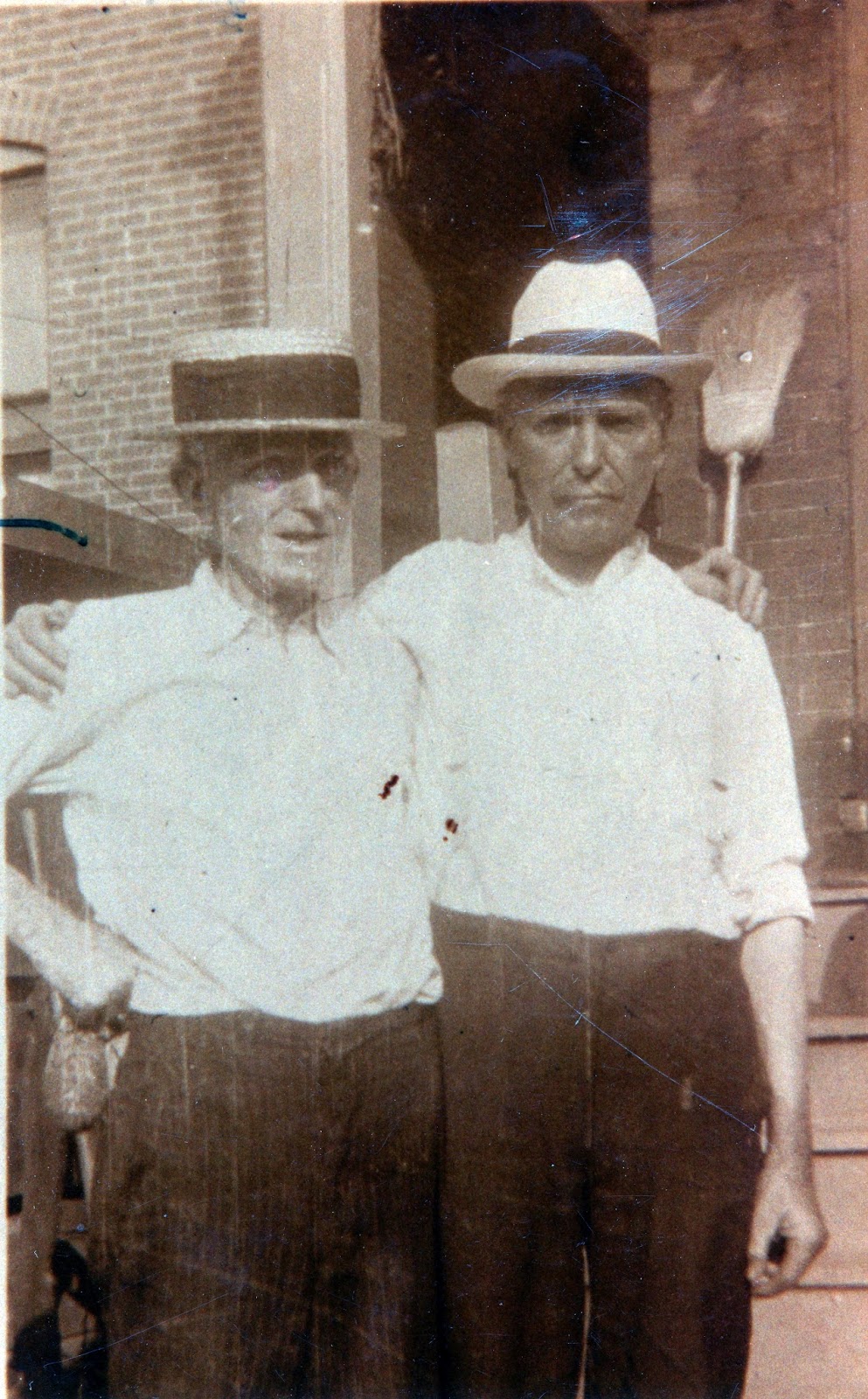
This picture comes from John Burrell, a 3rd cousin that I got in contact with through a DNA test. On the left is John Harrigan (1853-1927) and on the right his brother, Denis Horgan (1866-1933). When the Horgans came to the U.S. they seemed to gravitate first to the Little Falls region. Afterwards, several of them continued west to Missouri. John lived in Monett, in the southwestern part of Missouri, and he passed away in St. Louis. Denis stayed in the central New York area, living in Utica and working for the New York Central Railroad.

Burns.

This is another great great grandfather, Patrick Connel Burns (1839-1893). The framed portrait seems clearly to be derived from the other picture. I presume that the woman in the picture is Patrick's second wife, Mary Elisabeth Gallagher (1852-1910). They lived in the area of Grand Rapids, Michigan, and both are buried in St. Mary's Cemetery in Marne, MI. The pictures come from Jack Kelley, another third cousin who lives in Utah. He tells me that the framed picture is hanging in the house of his sister, Colleen.

White.

From right to left: Luke White (1873-1928), Mary Elizabeth Farnham (= Grandma White, 1887-1956), Lillian White (1902-1952). Oh, and Spunk on the far right.

Since my earlier post, The fading trail of the Whites last year, I think things might just be opening up a bit. The break came from Kay Pfister. I wrote to her, via Facebook, asking if she had any family information and she came through big-time. Not only did she have pictures like the one above and the one below, but she also sent me copies of correspondence from the 1980's to her mother, Mary Kirby, and to Mary's sister Kaddie. The letter came from a gentleman in the Washington, DC area - let's call him Mr. D (I'm reluctant to put his name "out there" on the Internet), and he was searching for the family of Luke White who lived in Ilion, New York. It turns out that Mr. D's grandmother was Luke White's sister! I've since begun a snail mail correspondence with Mr. D and have made contact with a 3rd cousin 1x removed who lives in New York City. More to come on this soon!

Kate Fitzpatrick (1854-1935)

Although a bit worse for wear, this is a precious image of my great great grandmother, Kate (McGuire) Fitzpatrick, holding her great grandson, Alfred Johnson!

Johnson.

This one is from yet another 3rd cousin, Hans Malmkvist from Sweden. This quaint little house is likely the birthplace of my great grandfather, Gustaf Alfred Westerlund *1855-1923) and his brother Gottfrid Theodor (1863-1919). Unfortunately, there was no one at the house at the time to ask about its history.

I hope that everyone finds a little something of interest here. I want to stress that all of this comes from the generosity of family, and I sincerely thank all for sharing these treasures.

Friday, July 3, 2015

The Name on the Stone

Westerlund-Ö marker in Evergreens Cemetery

Just about a year ago we visited Evergreens Cemetery in Brooklyn/Queens in the hope of learning more about the family of Alfred and Lottie Westerlund. We know they had two children that grew to become adults: Arthur (later Fredrick Johnson) and Wilma. But apparently there were a few other kids as well. I have a birth certificate for Eric born in 1897, and the federal census of 1900 lists two others (and doesn't include Eric): Harry and May. In New York I was hoping to find some data for these children that would help me to track down their births and deaths.

Alas, no luck on that score. As you can read in more detail in my earlier post, Westerlunds in NYC, the plot where Alfred and Lottie are buried has no headstones or dates to help. But there was the one marker with two surnames: Westerlund and Östergren. I was left with the mystery, who are or were the Östergrens?

Dennis and NFJ in Evergreens Cemetery

So this post is to update you on what I've been able to discover about the mystery family. I must admit that I don't have all the answers yet, but what I have been able to find adds a bit of color to an otherwise dry story of names and dates. It begins with a simple question, so simple that it took me more than six months to think to ask it. I wonder what the cemetery records can tell me about the people buried in Grave #16642 along with the Westerlunds? I turns out that they do know the answer to that question: there's only one other person there: Gustava Ostengren [sic].

The New York Death Index 1862–1948 has a record for the passing of a Gustava M. Ostengren (that same misspelling!) on 27 Dec 1903, age 72. This was a good 20 years before the deaths of Alfred and Lottie. The record put her date of birth as 1831 plus or minus. This is only an index record, so it contains none of the information that would be recorded on a death certificate. A 1903 death means that the latest census in which I might find a record of Gustava would be the national census in 1900. The search of those records came up entirely empty. I did eventually find a possible record, though, “Wilhelmina Ostergreno.” This woman was recorded as the mother-in-law, living in the household of John and Anna Johnson at 33 Cornelia Street in Brooklyn. John and Anna had three children: Elin, Gorden, and Maple. Wilhelmina immigrated to the U.S. In 1895 and spoke only Swedish.

But is this the right person? Although the age, Swedish origin, and surname are correct (once you verify by looking at the actual record), the first names don't match. I quickly concluded that this was the person I was looking for because the names of her daughter and grandchildren rang a bell. You see, in looking for records of Westerlunds in the local Brooklyn newspapers I'd come across an article published in The Daily Standard in 1911, a short notice of a party that had been held. You can see the article in the image, but here's a quick transcription, with important names highlighted:

Westerlund Anniversary story

A pretty wedding anniversary was celebrated recently at the home of Mr. and Mrs. J. Westerlund, on Fulton street, when a reception was given to their East New York friends. The Rev. Mr. Borgendald, who officiated at the wedding of the couple, was among the guests. Others present were: Gordon Johnson, Arthur Westerlund, Mrs. A. Johnson, Mr. and Mrs. S. Goldberg, Mr. and Mrs. H. Thorne, G. Thorne, Richard Bender, Mr. and Mrs. F. Quillan, Mr. and Mrs. J. P. Williams, Mr. and Mrs. J. Harrar, Mr. and Mrs. J. Anderson, Miss Wilma Westerlund, Miss Emily Harrar, Mr. and Mrs. P. Werner, Mr. and Mrs. J. Duffy, Mrs. Rundstrom, Miss Wilma Folk, Miss Thekla Field, Miss Marie Donaldson, Miss Juliette Karr, Miss E. Karr, Miss Ella Johnson, Miss Lisa Petterson, Miss Mabel Johnson, Miss May Harrar, Miss Ella Quillan and Miss Mildred Thornex.

There you see the names of my grandfather (Arthur Westerlund), his sister (Wilma), and their maternal grandmother, Mrs. (Charlotte) Rundstrom. We also see the names of four of the people listed in that census record: Mrs. A. (Anna) Johnson, Gordon, Ella, and Mabel. (I've learned that you have to be flexible with spellings!) I took this as evidence that the Johnsons and the Westerlunds were travelling in the same circles and corroborated my interpretation that Wilhelmina from the census could be the same person as Gustava.

Let's take a slight detour here from my original purpose of trying to figure out who the Östergrens were. Several of the people attending the anniversary party were familiar to me, but who in the world were Mr. and Mrs. J. Westerlund? One possibility was that they were another branch of the family that had emigrated. However, in none of my records have I found a J. Westerlund who fit the profile - no Jan, Johan, Jonas, etc.. Census records in New York have a few John Westerlunds in the general area, but none living at or anywhere near Fulton Street in Brooklyn. There's always the possibility of coincidence, that these Westerlunds had no relationship to my farfars far (paternal grandfather's father).

Basil Rathbone as Sherlock Holmes

Well, I think I've resolved this, and it reminded me of one of the clues that helped Sherlock Holmes solve the case of a stolen racehorse and the death of the trainer in the story Silver Blaze: the case of the dog that didn't bark. At the anniversary party we have the son and daughter of Alfred Westerlund; we have his mother-in-law, Mrs. Rundstrom. The Johnsons are, I think, clearly friends of the family (if not more). Finally, we have the name of the anniversary couple themselves, Mr. and Mrs. J. Westerlund. So what's missing? Why didn't the dog bark? The rest of the family of Alfred and Lottie were at the party; why weren't they? I think it's because the newspaper made one further error in reporting or writing the story. The couple being honored was not Mr. and Mrs. J. Westerlund, but Mr. and Mrs. G. Westerlund (Alfred's first name was Gustav). A quick check revealed that in 1911 they'd been married for 25 years: a nice number to have a “pretty wedding anniversary.”

Back to the basic question: were the Östergrens and Johnsons merely friends of the Westerlunds, or is there some family relationship hiding there. That question remains open. I've followed the Östergrens back to Sweden. As the census record of 1900 indicates, Gustava-Wilhelmina Östergren came to the U.S. In 1895. The Emigrant Database shows that she embarked, alone, from Göteborg on May 3, 1895 bound for New York. Her full name was Gustafva Magdalena Wilhelmina Saltgren. On 22 Nov 1863 she married Anders Fredrick Östergren, who was an artilleryman. He died in 1870 of a lung inflammation. Together Anders and Gustava had only one child who survived to adulthood, Anna Wilhelmina. Anna left for the U.S. On 10 Sep 1889, again from Göteborg. This, by the way, is one of the major ports of departure from Sweden, located on the west coast with direct access to the North Sea. In English it goes by the name of Gothenburg (although the Swedish pronunciation is nothing like that!).

Johnson-Östergren marriage license part 1
Johnson-Östergren marriage license part 2

Anna married John Alfred (or Albert?) Johnson on 20 Aug 1892. John Johnson was also Swedish. The censuses of 1900 and 1910 say that he arrived in the U.S. in 1875 at the age of 18. There's no record of an emigrant with that specific name and about that age arriving in 1874 or 1875; in 1876 a young man from the county of Östergötland named John A. Johnsson did arrive. This might be him, and I'll be pursuing that possibility, but with the name of John Johnson – and its several Swedish variants – I'm not too confident that I'll be able to positively identify him. One interesting note about their marriage: I've posted a copy of it below. Note who the witnesses are: Alfred and Lottie Westerlund! Convincing evidence that I've got the right Östergrens, now Johnsons.

At this point I've found no evidence that the Östergrens and the Westerlunds are connected in anyway back in Sweden. I haven't been able to confidently find or follow John Johnson's lineage either. Perhaps if we go forward in time there will turn up a link between the families.

John Johnson's occupation on his marriage license was listed as sailmaker. This job was probably on its way out even in the 1890s; more commonly he's listed as an awningmaker. He worked for John Boyle & Co., tent and awning makers in Manhattan, for 38 years. His obituary in 1919 confirms that he was born in Sweden, but does not provide the city, parish or county he came from. The three children listed in the 1900 census – Elin, Gordon, and Mabel – were all for whom I've found any records.

Story about sendoff party for Gordon Johnson

Gordon William Johnson was born on 29 Aug 1895 in New York, presumably Brooklyn. In 1914 he graduated from Public School 85, now in Astoria, Queens. He enlisted in the Army in 1917. There was a short notice published in the Brooklyn Daily Eagle on 9 Dec 1917, marking a farewell party held for him by his friends:

Dec 1 a farewell party was given in honor of Gordon W. Johnson at his residence, 730 Halsey street, by his numerous friends.

Mr. Johnson is leaving for Camp Joseph Johnston, Jacksonville, Fla., to serve in the Quartermaster's Department. He is the only son of Mr. and Mrs. John A. Johnson, a resident of Brooklyn all his life.

A pleasant evening passed in interesting and amusing games and dancing.

Three tableaus were presented by Frederick Meyer, assisted by Bert Thompson, with Gordon Johnson acting as announcer.

Several operatic selections were also rendered by Mr. Meyer, a Brooklyn tenor, assisted by William Templeton, pianist.

Supper was served at midnight, the decorations being the colors of the Allies.

Among the guests were: Miss Mabel Johnson, Miss Irene Hoblin, Miss Julia McCormick, Miss Marie Shuldiner, Miss Marjorie Brown, Miss Edna Pullman and Miss Etta Kaiser, Bert Thompson, Gus Elstrom, Harry Kharrs, William Templeton, Harold Ward, Willworth Delaney and Frederick Meyer.

Many gifts were received by Mr. Johnson for use when “Somewhere in France.”

Athough this was a gay sendoff, the aftermath was tragic. Pfc Gordon shipped down to Jacksonville for training on 11 Jan 1918, and from there he went to overseas on 6 Jun 1918. In France he died of pneumonia on 9 Oct 1918.

Back to the other children of John and Anna Johnson, the two daughters Mabel and Ellen. I haven't been able to round out my story of Mabel. She married Harry Howard Hulse in 1926 when she was 27 years old. Harry had been a sailor in WWI and worked for International Printing Ink Co. in Brooklyn during the World War II years. As far as I know they had no children, but that may not be the full story. For some reason I haven't found Mabel in the 1940 census, even though I Harry is listed, married, living with his parents. In 1942 he and Mabel are living at the same address, so it seems that they hadn't split up. Perhaps she was out shopping when the census taker came around.

Ellen married Harry C. Keiner on 17 Oct 1915. They had three children, Harry Jr., Dorothy and Margery. I was able to get in contact with Ellen's grandson, and asked him if he had any knowledge of where John Johnson had come from in Sweden. Unfortunately, he didn't know, but he did say that he would consult the family Bible. It's the Keiner family Bible, though, so I don't have really high hopes that it will have information on Harry Keiner's father-in-law.

There are still lots of avenues of exploration open for the Östergren/Johnson clan. Nothing at this point, though, suggests that the relationship between them and the Westerlunds was anything other than that of friends. The two families emigrated from different parts of Sweden and came to live near one another and attend the same church in Brooklyn. The fate of Gordon is a sad one, but that was really a drop in the bucket in the context of the Spanish flu epidemic of 1918 and the carnage of World War I. The newspaper accounts, both of his farewell party and the reports of his passing, go a little way toward bringing that time in our history back to life.

West Cork Update

This blog post comes to you from the city of Cork, Republic of Ireland. I had initially planned this trip to be tagged on to the end of th...