Showing posts with label Santa Cruz County. Show all posts

Sunday, March 21, 2021

Shake, Rattle and Roll

I’ve spent much of the past year following leads on the Collins and Driscoll families from West Cork. As I was digging through the records, I’ve come across some interesting – and, for me, surprising – stories. I’d like to share the first of those in this post. It starts with my great great uncle, Jeremiah Driscoll. He was my second great grandfather’s brother, born (or at least baptized) in 1829.

The Patriarch

In a short biography of one of Jeremiah’s sons (Bartholomew), I learned some details about his early history. Jeremiah came to California in 1855 at the age of 25 or 26, about six years after the famous Gold Rush. Initially, he worked as a miner in the northern part of the state. He became an American citizen on 24 Sep, 1856, with the naturalization taking place in Shasta County. (The county seat is the town of Redding, a town we will revisit a bit later). He moved to Santa Cruz County in 1857 and settled on land along the Pajaro River, approximately 3–4 miles east of the modern town of Watsonville.

Map showing location of Jeremiah Driscoll property, 1889
Map of the Pajaro Valley. Watsonville is off the left side of the image, and Jeremiah Driscoll's property borders the river in the center of the screen. Map dated 1889.
Roadside view of the original Driscoll property.
A roadside view of the property once owned by Jeremiah Driscoll, looking toward the Pajaro River.

One of the first experiments in farming in the area around Watsonville – the first, that is, by the immigrants coming from the eastern part of the country – was to plant potatoes. This experiment turned out to be wildly successful, so much so that an oversupply of the crop caused the price to crash, and that led to the devastation of the farms. Recall, that this was in the time before the completion of the transcontinental railroad, and so the producers were limited to the local market. Following that crash, much of the land was planted in grain, including that owned by Jeremiah.

Jeremiah Driscoll married Johanna Hickey, another native of County Cork, and together they had nine children. He died on 11 Apr, 1884 at the age of 55 (reported in the newspapers as 53). In the account of his death, published in the Santa Cruz Sentinel, it was noted that “[b]y his own energy and industry Mr. Driscoll acquired one of the best farms in the county.” His estate included land holdings of 350 acres, valued at the time as $30,000. I’ve translated 1884 dollars into 2021 dollars, the equivalent being somewhere over $800,000. I don’t think simple calculations based on the rate of inflation adequately capture the value of land in California in today’s market. All told, I think we can agree that Jeremiah left an estate worth somewhere north of a million dollars.

Jeremiah’s legacy included more than valuable farmland. His children achieved fame that extended beyond the Pajaro Valley, and for the rest of this post, I’d like to focus on one of them, his daughter, Julia.

Mrs. Mayor

The first hint of what was to come, the first foreshock, came at 5:12 a.m. on the 18th of April, 1906: nineteen minutes before sunrise. Less than a minute later, the San Francisco Earthquake hit. The magnitude 7.7–7.9 quake and its aftermath of fire resulted in more than three thousand deaths, 225 thousand injuries, and an estimated $400 million dollars in damage. In today’s dollars, that’s roughly $11.6 billion.

San Francisco in flames following the 1906 earthquake.
The city of San Francisco in flames following the 1906 earthquake.

On the day of the quake, a proclamation was posted in the newspapers and around the city by the Mayor, Eugene E. Schmitz:

Schmitz Proclamation to shoot looters on sight.
Eugene E. Schmitz. Proclamation by the Mayor, broadside. April 18, 1906. (Gilder Lehrman Collection).

I’m not sure if anyone was actually shot on sight, but the aggressive, take-charge attitude earned Schmitz publicity around the country and around the world.

Portrait of Mayor Eugene E. Schmitz.
Mayor Eugene E. Schmitz. Original image from San Francisco History Center, San Francisco Public Library. www.sfpl.org

Schmitz was the son of a German father, Joseph L. Schmitz, and an Irish mother, Charlotte Hogan. He was born in 1864 in San Francisco, and he grew up to be a musician and composer, a violin player. That wouldn’t seem to be the typical route into politics, but in San Francisco at the turn of the 20th century labor relations were one of the hot topics. Gene Schmitz was elected to be President of the local Musicians’ Union.

Picture of political boss Abe Ruef of San Francisco.

As the leader of one of the city’s labor unions, not to mention his charisma and good looks, one of the local political “bosses,” Abe Ruef (1864-1936, photo at right), tapped Schmitz to run for mayor on the Union Labor Party ticket in 1901. In a three-way race, Handsome Gene won election to his first two-year term. He was then re-elected in both 1903 and 1905.

By this time of his third election, rumblings of trouble began to be heard: not the earthquake, but rumblings about political corruption. The pursuit of allegations was continually stalled at the local level, so the editor of a local newspaper appealed to President Theodore Roosevelt for help. Through Roosevelt’s intercession, the sugar baron Rudolph Spreckels helped to bankroll $100,000 for investigations. I know that I shouldn’t impose modern standards on the actions of people more than a century ago, but the idea of a private citizen providing money to the government to pursue criminal allegations sounds like a recipe for all sorts of shenanigans. Maybe the people with the deep pockets are just more discrete these days.

The investigation, led by William Burns of the Secret Service, was underway on the fateful day of the earthquake. The main thrust was corruption, and one of the more salacious elements of it concerned the so-called “French restaurants.” To be fair, these establishments did serve food to customers on the lower floors, but upstairs the world’s oldest profession was the real order of business. The restaurant proprietors needed to obtain a liquor license from the city, but would often find their applications denied. Denied, that is, until they could schedule a meeting with Boss Ruef and make a contribution of $5,000 to the cause. Then, amazingly, Mayor Schmitz would make an impassioned plea to the police, and the liquor license would be approved.

The intensity of the investigation waned in the immediate wake of the earthquake. After the city stabilized, Schmitz surprised everyone by leaving for a tour of Europe in October of 1906. His expressed purpose was to visit and consult in the capitals to develop ideas about how to rebuild from the ashes. You might think that he was just skipping town in order to avoid arrest and prosecution. But when the indictments did come down, he dutifully returned to San Francisco to face trial.

That was a tease. Before telling you about the outcome of the trial, let me explain you why I’ve included Mayor Schmitz in this story.

Newspaper article announcing marriage of Eugene Schmitz and Julia Driscoll.
Announcement of wedding of Eugene Schmitz and Julia Driscoll, published in The San Francisco Call, 17 Jun 1891.

It turns out that Mayor Schmitz, “Handsome Gene,” was married to the daughter of Jeremiah Driscoll, a young lady named Julia A. Driscoll. Newspaper reports tell us that Julia was educated in the public schools of Watsonville and San Francisco. The San Francisco Examiner described her in 1901: “She is eminently American – clear-headed, common, sensible, wide awake, unaffected, sincere, quick-witted, refined, practical. She is of the type that cannot be too many – the home-keeping, domestic woman, who is not swamped in her domesticity; that pleasant American type of woman who can look well to the ways of her household and still permit herself the wider range into the ways of the world.” (The San Francisco Examiner, 07 Nov 1901, page 2.)

Portraits of the Schmitz family.
Portraits of Mayor Schmitz's family, published following his election as Mayor of San Francisco in 1901. Julia is in the center, flanked by son Richard on the left, and daughters Eugenia and Evelyn on the right (Eugenia is the taller of the two). The San Francisco Examiner, 07 Nov 1901, page 2.

When Schmitz was first elected, the couple had three children: Eugenia Clara (born 1892), Evelyn Heller (born 1894), and Richard Ambrose (born 1896). In the interview published in The San Francisco Examiner in 1901, Julia explained why she had been certain that her husband would win the election:

"Somehow," she says, "I felt confident from the very first. Mr. Schmitz had never been in politics. He had gone along quite contentedly, never thinking of anything beyond success in his profession and in a business way, perhaps, yet, when the matter was first broached and the nomination offered to him, and he came home and told me about it I felt he would be elected, and through the campaign I never lost my belief. Through all his anxieties of the campaign I tried to keep up his confidence and hope with my own, for I never wanted him to feel for a moment that he wouldn’t win."
And what kind of a Mayor do you think Mr. Schmitz will make?
"Why," answered Mrs. Schmitz, "I have always felt that he had exceptional ability, that opportunity would bring it out, and," here Mrs. Schmitz smiled a smile of wifely pride, "if Mr. Schmitz makes as good a Mayor as he has made a husband, he'll make a very good Mayor indeed!"

Unfortunately, that didn't turn out as well as Julia had hoped. Abe Ruef "copped a plea" for which he received immunity from most of the charges against him in exchange for his testimony against Schmitz. On 14 Jun 1907, Mayor Eugene Schmitz was convicted of extortion. Ruef was convicted of bribery in 1908, and he was sentenced to 14 years in San Quentin, a sentence he finally began serving in 1911. Schmitz was down, but not out, though. He appealed his conviction and won. However, he was tried again, this time for bribery. At the second trial Ruef refused to testify against him again, and Schmitz was cleared.

Newspaper report of conviction of Mayor Schmitz on charges of extortion.
Front page story in the Stockton Daily Evening Record reporting the conviction of Mayor Eugene E. Schmitz of extortion. Published 14 Jun 1907.

Schmitz ran for the office of Mayor twice after his brush with the law, but he never regained the post. He was elected to the San Francisco Board of supervisors where he served from 1921 to 1925. He never gave up on his music. In 1912 he was working on the music for a operetta entitled "The Maid of San Joaquin." The Pacific Coast Musical Review wrote that "...its object is to depict the early California mining life in a manner more realistic and tasteful than has been done in the "Girl of the Golden West." In hindsight, it was probably asking a lot to outdo Giacomo Puccini whose La fanciulla del West" had premiered at the Metropolitan Opera in New York in 1910 with Enrico Caruso in the cast! The Review also stated, "There is no doubt that the work contains exceptional merit both from a musical and literary point of view, and in these days of comic opera stagnation, or even light opera famine, this work ought to find a place in the repertoire of the leading American companies." Apparently, producers on the East Coast were not as enthusiastic, and I could not find evidence that the operetta ever saw the light of day. However, in his obituary it was written that he had produced his own opera in New York. Perhaps it did have an audience, after all.

Eugene Schmitz died on 21 Nov, 1928, in San Francisco. He never regained the previous heights of his career, and in his later years he had shaved off the beard that gave him such a swashbuckling image. Eugene and Julia lost their son, Richard, in 1914 following an operation for appendicitis. Schmitz was in New York at the time, working on getting his opera staged. The two daughters lived long lives. Eugenia became a Dominican nun in 1914, taking the name Sister Mary Isabel. She retired as a secondary school teacher after 47 years of service, and was honored on the occasion of her 60th anniversary in the order. Evelyn lived to the age of 92. As far as I know she never married, and I have not found much information on her life. Julia, herself, passed in 1933 at the age of 68. It was reported that she took her husband's legal troubles very hard, and her health suffered for it.

I hate to end the post on such a sad note, so I would like to offer something to celebrate the life and liveliness of Julia (Driscoll) Schmitz and her daughter Evelyn. While researching for this post, I found some images of Eugene that had been posted on the web by the San Francisco Public Library. One of these showed him together with his wife and daughter Evelyn, apparently posing for photos during an election. The image on line is of only fair quality, but it inspired me to inquire at the library whether they had other pictures of Schmitz's family. They did! Not the greatest quality, but images that help to animate the facts that I was able to glean from newspapers and other sources. These images, apparently, have never been published before. I offer them with a nod of appreciation to the lives of Julia and Evelyn Schmitz.

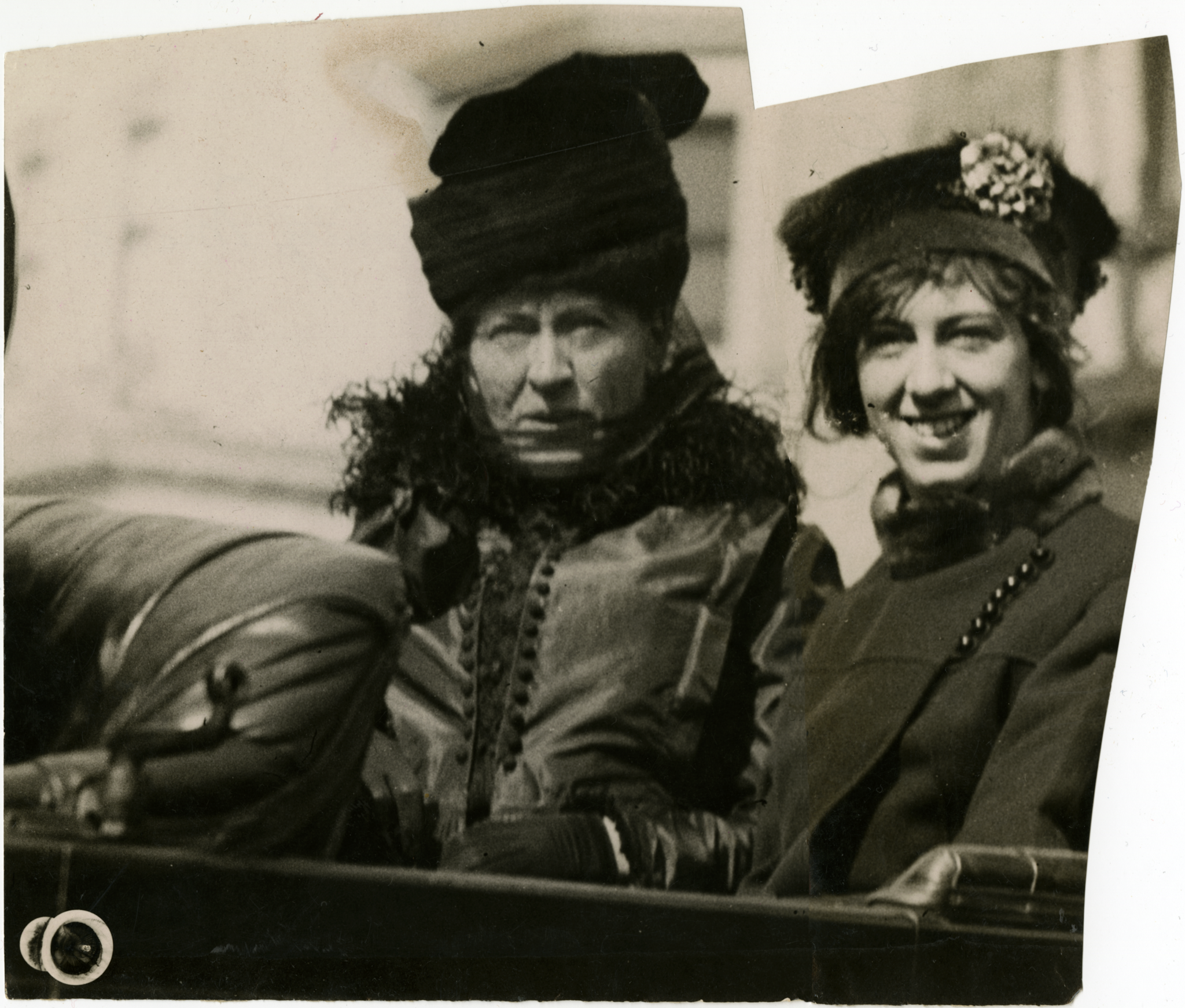
This is the lo-res image put online by the San Francisco Public Library, with Julia on the left, Evelyn in the middle, and Eugene Schmitz on the right.
Julia (left) and Evelyn Schmitz. Undated photograph. Credit: San Francisco History Center, San Francisco Public Library.
Evelyn Schmitz, photo dated 1938. Credit: San Francisco History Center, San Francisco Public Library.

I have another story about a descendant of Jeremiah Driscoll. But this post is already long enough, so I'll save it for next time. But here's a teaser: this child had an even greater influence than the Schmitz family, an influence that I think a good number of readers can identify with. Stay tuned.

Monday, February 1, 2021

The (lost) family of Tim Driscoll

We’ve all done it: you shake a can of your favorite carbonated beverage, pop the top, and… well, you know what happens next. This happened to me a few months ago when I tried to explore some of my DNA matches.

The number of DNA matches that you’ll get is overwhelming, literally thousands. Most of these, as you’d expect, are pretty remote. One of the rules of thumb is that any match of less than 7 cM has a pretty high chance of being just a random match. That’s 7 cM out of a total of something near 7,000, or 0.1%. Most of the names of my DNA matches are entirely meaningless, and I have to try to dig in deeper to discover how they’re related. My usual strategy is to start with matches that are associated with their own family trees, the bigger the tree, the better. The next criterion is to research matches that have “unusual” names. If all you have to work with is the name, and the name is something super common like, say, Mary Jones, you’re going to run into a lot of false leads.

All this is to explain how I popped the top on my can of soda. It was a match on 23andMe; I’m going to purposely be vague on identification of these users because, you know, this can be a touchy issue. My other little dirty secret is that, for living people, Facebook is simultaneously a blessing and a curse. Some folks are extremely reticent to post anything of a personal nature on Facebook, but others spill their guts! For this DNA match that I began to explore I was able to find his/her site on Facebook. Unfortunately, that didn’t really help me out very much, that is, until I started exploring one of their friends, a sibling. Pop!

It took about two weeks worth of work, but I was able to follow this lead back five generations before it ran dry. At the end of the line was a couple by the name of Daniel O’Brien and Mary Driscoll. Of course, the wife's surname caught my attention since that was the maiden name of my great grandmother.

View of the townland of Bawngare, home of Daniel O'Brien and Mary Driscoll.

Mary Driscoll married Daniel O’Brien on 24 Feb 1846 in the parish of Skibbereen and Rath in West Cork. They lived in Bawngare in the parish of Aughadown. In the 21 years between 1847 and 1868, Mary gave birth to eleven children. I’ve been able to trace 16 DNA matches to the descendants of the children of Mary and Daniel O’Brien so far: four to their son Daniel, six to their daughter Katherine, one to daughter Margaret, two to daughter Hannah, and two to daugher Mary. It was pretty clear to me that we’re related to Mary Driscoll, but the question is: how?

Husband Daniel O’Brien died in 1874 at the age of 57. Mary, however, lived until 06 Jan 1914, and at that time the civil registration of her death claimed that she was 88 years old (so, roughly, born in 1826). The description of her funeral that was published in the Skibbereen Eagle turned out to be the key to the job of piecing together her family. Here’s the beginning of the obituary:

Mrs. Mary O’Brien, Bawngare, Aughadown.

It is with feelings of deep regret we have to chronicle the death of this respectable inhabitant, which took place at her residence on Tuesday morning. She was greatly respected by all who knew her for her high person, worth, and character. Belonging to one of the oldest and most respected families in the neighbourhood, where her ancestors have settled for many generations past in the district. Her death is sincerely mourned by a wide circle of relations and friends. The funeral, which took place for the Abbey, was, notwithstanding the inclemency of the weather was one of the largest seen in the district for some time.

The officiating clergymen were Rev J O’Sullivan, P P, Aughadown; Rec T Hil, C.C., do.

Then, the important part:

The chief mourners were – Daniel O’Brien, R.D.C. (son) [RDC = Rural District Council], Mrs O’Brien (daughter-in-law), Mary, Kate, John, William, Ellie, Dan, Stephen, Denis, Bridie, Kathleen, Michael, (grand-children), Mrs. Collins (sister), Timothy Driscoll (nephew), Mrs. McCarthy, Mrs Holland, Margaret M Collins (nieces) ....

Aughadown Cemetery
Aughadown Cemetery, from the Skibbereen Heritage Centre. While Mary O'Brien lived in Aughadown Parish, I don't know in which graveyard she was buried.

Mrs. O’Brien, Daniel’s wife, was named Mary Anne Dwyer (1866 – 1952). The grandchildren listed were all the children of Daniel and Mary Anne. I still have not identified exactly who the nephew Timothy Driscoll was. After some digging, I was able to uncover that the sister, Mrs. Collins, was named Hanora. Margaret Mary Collins, as I expected, was her daughter. The other two nieces were more difficult to identify. I finally discovered that Mrs. McCarthy was another of Hanora’s daughters, Rebecca. The mysterious Mrs. Holland was more of a struggle. I will return to her shortly.

Five of the daughters of Daniel and Mary O’Brien – Mary, Margaret, Annie, Hannah, and Ellen – emigrated to the United States and settled in California, living in San Francisco and Alameda Counties or a bit farther south in the coastal farmlands of Monterey and Santa Cruz Counties. Knowing that, my interest was piqued when I started pursuing a new and different set of DNA matches, matches who lived in exactly the same area of California.

Panorama of Watsonville, California
Panorama of the city of Watsonville, California.

These new matches, as far as the records would take me, traced back to a couple named Jeremiah Driscoll and Johanna Hickey. The American records say that Jeremiah was born around 1830 and died in 1884. He originally went to northern California to work in the mines, and then moved south to settle in the Pajaro Valley of Santa Cruz County, near the modern town of Watsonville. He and Johanna had nine children together. I’ll have more to say about Jeremiah’s family in a subsequent post. I have three DNA links with Jeremiah’s descendants, both through his son Richard.

In the 1860 Federal Census Jeremiah, age 27, is recorded living with his wife Hannah and their newborn, first-born daughter, Mary. Also listed is a man named Daniel Driscoll, age 29, a farm laborer born in Ireland. On the basis of this record, I have seen some speculation that this Daniel was Jeremiah’s brother.

To briefly review, my 2nd great grandfather, Timothy Driscoll, was born sometime around 1836. Mary Driscoll, a relative of some sort, was born around 1826. She had a sister Hanora (Mrs. Collins). Jeremiah Driscoll was supposedly born in 1830. And, finally, Jeremiah may have had an older brother Daniel. How to reconcile all these facts? I suspected that all of these people – Timothy, Mary, Hanora, Jeremiah, and Daniel – might be brothers and sisters. But that guess was based only on the DNA matches and the rough similarity of their ages (born about 1826 to 1836).

The Mysterious Mrs. Holland

There was one more loose thread: the mysterious niece, Mrs. Holland, mentioned in Mary O’Brien’s obituary. Who was she? To resolve this I used the church and civil registrations of births and marriages in Ireland. The civil registrations began in 1864, and I presumed and hoped that a niece of Mary would likely have been married after that date. This was important because the church records usually would only show the names of the bride and groom and the names of the witnesses. They might also include the name of the officiant, and even less commonly where the couple came from. The civil records, in contrast, give all of that information, always with the homes of both bride and groom, and the names of the couple’s fathers as well. So there’s a lot more information to work with there.

Home page of IrishGenealogy.ie, a source for transcriptions and images of church and civil records in Ireland.

In the civil records (accessed through irishgenealogy.ie) I found that between 1890 and 1914 there were eight marriages recorded in the D.E.D. (District Electoral Division) of Skibbereen records and two in the D.E.D. of Schull in which the groom was named Holland. (Thank goodness for uncommon names!) I also assumed that when the newspaper reported that Mrs. Holland was a niece of the deceased Mary O’Brien they were being literal. That is, that Mrs. Holland was either the daughter of one of Mary’s siblings, or she was the daughter of one of Daniel O’Brien’s siblings. Therefore, if Mrs. Holland was the daughter of a brother or sister of Mary, then her maiden name would either have been Driscoll (if she were the daughter of a brother) or her mother’s maiden name would have been Driscoll. I could get this information from Mrs. Holland’s marriage record or from the marriage record of her mother. Similarly, if Mrs. Holland were the daughter of one of Daniel O’Brien’s siblings, then either her maiden name was a variant of O’Brien or her mother’s maiden name was. Finally, the civil registration of the marriage of Mrs. Holland would tell me the name and residence of her father.

Civil registration of the marriage of Patrick Holland and Annie Driscoll.

The only marriage that fit these criteria occurred on 19 Feb 1903 in Rath Church in which Patrick Holland and Annie Driscoll were wedded. Annie was recorded to be living in Ardagh at the time of her marriage, and her father’s name was Patrick Driscoll. I then checked the civil birth records for an Annie born to father Patrick Driscoll in the years 1864 – 1883 (so that Annie would have been at least 18 when she married). There were three such cases, but all born in Cork City. I then expanded my search into the church records, and found a baptism for a Nancy Driscoll, 15 Jun 1865, in the parish of Rath and The Islands. The parents of this child were Patrick Driscoll and Margaret Driscoll. Now while there is a townland called Ardagh a good distance east of the area of my focus, there were also two others in the immediate area: Ardagh North and Ardagh South. If you enlarge the image of the registration of their marriage, you'll see that one of the witnesses has a familiar name: Margaret Mary Collins. Therefore, this lead seemed very promising, and so this is where I concentrated my attention.

In the 1901 Census of Ireland for the D.E.D. of Tullagh there is a record for an Annie Driscoll (age 28) living in the home of her brother Michael (age 36) and his wife Mary in the townland of Ardagh South. I could not confidently recognize either of Annie’s parents, Patrick or Margaret, anywhere in this census. In a search of the civil death records I found one Patrick Driscoll of about the right age in the period from 1865 – 1901. This man died in 1877 at the age of 62 (therefore, born around 1815). I failed to find a Margaret, at least one that I could confidently identify as the mother of Annie. There were several possibilities, but with little information to distinguish them.

I went back and searched the birth records for children born of parents Patrick and Margaret Driscoll. I found seven, Annie being the youngest. Five of these children emigrated from Ireland and lived in either Santa Cruz or Monterey Counties in California. Coincidence? I think not! I have one DNA match with a descendant of Patrick and Margaret (and six additional matches with the descendants of that match). This reassured me that I’d been lucky enough to find the right Mrs. Holland!

Now I have another potential sibling of my 2nd great grandfather, but was it Patrick or Margaret? Both had the surname Driscoll. All told, I had six potential brothers and sisters. The next step was to try to pull all these threads together, and if they were siblings, who were their parents?

Pulling the Threads Together

For years I had despaired of learning more about the ancestry of my great-great-grandfather Tim Driscoll. Both his given name and his surname are very common in the area of West Cork. I could find lots of Tim Driscolls in the records, but I had no way of knowing which one was the right one. The same is true for all of the rest of the names I’d uncovered: Patrick, Daniel, Jeremiah, Mary, Hanora, Margaret, and Johanna. Then the thought occurred to me that even if I couldn’t confidently associate an individual with a specific record, perhaps I could make some progress if I looked at this as a family. My question, therefore, became: how many families in West Cork had children with all of the names Mary, Jeremiah, Timothy, and Hanora? I didn’t include Daniel in this list because the evidence was pretty slim that he was actually Jeremiah’s brother. Also, I didn’t know if it was Patrick or Margaret who was a member of this group.

I have a long list of reasons why this search strategy could fail. But basically, here’s what I did. I tabulated the parents and the baptismal date for all the Driscoll children with these names who were born between 1820 and 1840 in the parishes of Aughadown, Caharagh, Muintervara, Rath and The Islands, Schull East, Schull West, and Skibbereen. A total of 479 families in these West Cork parishes had at least one child with the name Mary, Jeremiah, Hanora, or Timothy. But I was pleasantly surprised – no, ecstatic – to find that only one family had kids with all four of these names.

The parents in this family were named John Driscoll and Mary Hourihane. The baptismal dates for the four children where Mary, 15 Apr 1825; Jeremiah, 08 Feb 1829; Honora, 09 Jun 1833; and Timothy, 18 May 1835. This is exactly the same birth order that I’d gleaned from other records, and the dates are close. Remember, that in those days people were a lot more free and easy with this information than we are today. For two of the baptisms the townland is recorded: Ballymacrown. This is the same place that my 2nd great grandparents Tim Driscoll and Ellen Collins had lived. I then searched the baptismal records of Skibbereen to find any other children of that couple, and I came up with four more names: Daniel, baptized 04 Feb 1827 from Ballymacrown; John, 23 Jan 1831 also from Ballymacrown; Michael, 08 Apr 1837; and Johanna, 15 Jun 1840.

Registration of the baptism of Deniel Driscoll in the register of Skibbereen (Creagh and Sullon) parish.

The baptismal record for Daniel corroborates the interpretation of the 1860 U.S. census that Jeremiah had a brother by that name who was two years older. But there’s also something else interesting in that record: Daniel’s father’s name was recorded as John Bawn Driscoll. (Actually, the irishgenealogy.ie transcription was John Bacon Driscoll, but a look at the image of the original register entry led me to a different interpretation.) Now, it’s not unusual that when surnames are so common that they don’t adequately serve to distinguish people, then new names can be adopted. Such a name is referred to as an agnomen. Bawn or Bane is a fairly common agnomen in Ireland. The name is derived from the Irish word bán, which means white, and it commonly refers to a person or an ancestor who was blonde or fair-haired. I went back and searched for children of a couple named John Bawn and Mary Hourihane, and found yet another child, Cornelius, boaptized 24 Oct 1823 from Ballymacrown.

There’s one piece missing though: have you spotted it yet? Answer: there is neither a Patrick nor a Margaret in the list of children. (Remember, these were the parents of the mysterious Mrs. Holland.) However, I redid part of the search on another website, FindMyFamily, and there I found a Margaret. She, too, was born in Ballymacrown and baptized on 31 Jul 1821. Apparently, the transcribers for irishgenealogy.ie had missed this entry in the baptismal registers because instead of the record starting with the child’s name, it began with the name of the priest doing the baptism.

We may not be done yet: I searched the baptismal records for children of John Bawn from Ballymacrown and came up with yet another child: Catherine, baptized 19 Aug 1821. In this case, though, the mother is recorded as Catharine Sheehane. It’s difficult to be certain, but it’s at least plausible that Mary Hourihane was John (Bawn) Driscoll’s second wife.

To summarize, in the table below I’ve compared the potential brothers and sisters of Timothy Driscoll that I’ve found using DNA and later records, with the baptismal records of the children of John Driscoll and Mary Hourihane.

Information from later documentsBaptismal records of children of
John Driscoll and Mary Hourihane
Name
Year of Birth
Name
Year of Baptism
Patrick/Margaret
?
Margaret
1821
 
 
Cornelius
1823
Mary
1826
Mary
1825
Daniel
1827
Daniel
1827
Jeremiah
1830-1831
Jeremiah
1829
 
 
John
1831
Hanora
1833
Hanora
1833
Timothy
1836
Timothy
1835
 
 
Michael
1837
 
 
Johanna
1840

There were lots of assumptions that I had to make at each step in this research, but even so, I find the results to be compelling. The best test of these ideas will be to trace any descendants of these new members of the family – new to me at any rate – and see if we share any DNA. Much of this post has focused on the research process, but in the course of it I came across several interesting stories. My plan is to share those in the next few posts.

West Cork Update

This blog post comes to you from the city of Cork, Republic of Ireland. I had initially planned this trip to be tagged on to the end of th...