Sunday, September 4, 2016

Retracing Steps: Stockholm

Although three of my four grandparents were Irish, I feel like I've invested most of my efforts over the past few years on the history of my Swedish grandfather, Fred Johnson. Primarily that's because there is so much documentation available from Sweden, records that extend back to the late 1600s. In these documents you not only see the names of people, lots of names (!), but also the names of places: church parishes, towns, cities, and farms where relatives lived and worked. In the process I've also been able to link up over the Internet with Swedish relatives with similar interests. These next blog posts, then, could be subtitled: “What I did during summer vacation” because we decided to throw caution to the wind and to travel to Sweden. I had two goals, neither of which was to do any family history research. Rather, I wanted to see and visit the places I'd been reading about, to convert words on pages into reality. The second goal was to meet at least some of the contacts I'd been so fortunate to make. So, Luciana and I took the plunge: our itinerary was to visit Stockholm for one week, then drive on about an hour west for a week in the city of Västerås, and finally travel another three hours west to explore the small towns in the county of Värmland. Since this blog is supposed to be focused on family history, I´ll do my best to not turn this into a travelog.

Stockholm

The earliest records that I've found so far for a family member living in Stockholm is for Axel Westerlund (1784-1840). There is a household record that shows him and his family living in Europa Quarter in 1819, and his occupation is ”Police Gewaldigern” which, I think, is translated as a bailiff. I'm not sure exactly what that job entailed in Stockholm in the early 1800's, but bailiffs certainly had a bad name in earlier times. They were the ones that would wring taxes out of the populace for the government.

A map of modern Stockholm showing churches that figure in family history (click on the image to open in a new window at full size). 1) Stockholm Cathedral (Storkyrkan); 2) Sankt Jakob; 3) Hedvig Eleonora; 4) Sankt Johannes; 5) Adolf Fredrik; 6) Sankta Klara; 7) Maria Magdalena; 8) Katarina.

There is a record of the baptism of Axel's daughter, Mathilda Eleonora, in 1815 in the cathedral in Gamla Stan. The church is also known as Storkyrkan (the big church), Domkyrkan, or Sankt Nikolai (number 1 in the lowermost red dot on the map). A little geography is in order. The oldest records for the city of Stockholm date from the mid 13th Century. Today the city sprawls over 14 islands as well as the mainland, but it originated on a small central island. That part of the city today is known as Gamla Stan, the old city. Here's a link to an interesting website where you can see maps of Stockholm at different periods in history. It opens with a map of Stockholm today (that's idag in Swedish), but if you click on the work Idag a drop-down menu will appear from which you can see the city in earlier times. Try selecting 1885: that's the most useful one I've found when looking for old addresses. Many of the classic images of Stockholm are pictures of the medieval buildings of Gamla Stan. And standing high above the houses are a couple of church towers: one is the cathedral, and the other is the German Lutheran Church, Saint Gertrude. Gamla Stan is not only home of the main cathedral, but also the Royal Palace and the Nobel Museum. Although the streets have names and the street-level entrances to buildings have numbers, the area is organized into quarters, and in this part of the city the quarters are basically the individual buildings. Outside of the old city, quarters are typically made up of a number of buildings, and street addresses there become more useful. The quarters in Gamla Stan are almost all named after mythological characters: Achilles, Cepheus, Cybele, etc. On that 1885 map I mentioned, the names of the quarters are written in red letters. Europa Quarter, where the Westerlund family is first recorded, is a sprawling area that directly faces the palace to the north and Storkyrkan right next to the Palace. Axel later moved farther south to the quarter of Cupido.

Stockholm Cathedral Stockholm Cathedral interior
Stockholm Cathedral: St. George Baptismal font in Stockholm Cathedral
Stockholm cathedral inside and out. In the second row is the famous sculpture of Saint George (in Swedish, Sankt Göran) slaying the dragon. The statue was consecrated in 1489, and is made of wood and moose antler. It commemorates the victory of the Swedes over the invading Danes at the battle of Brunkeberg in 1471. St. George represents Sten Sture the Elder (the guide said that the sword is the actual one that he wielded in the battle). Off to the side is a small statue of a princess, Sweden, being saved from Christian I of Denmark. At the lower right a picture of the baptismal font, very likely the same one used for the baptism of Axel Westerlund's daughter Mathilda Eleonora.
Europa Quarter, Gamla Stan Cupido Quarter, Gamla Stan
Gamla Stan
Streets of Gamla Stan. The upper two pictures are buildings where Axel Westerlund lived in the early 1880s: on the left is Europa Quarter and on the right is Cupido Quarter.

In 1815 Axel married Catharina Ulrika Hempel in the church of Sankta Klara (#6 in green on the map). Klara is just to the north and a touch west of Gamla Stan. Quite a few other churches in the area figure in family history. I've labelled those on the map. The most prominent of these were Hedvig Eleonora (#3 in red) in Östermalm; Adolf Fredrik (#5 green) and Klara in Norrmalm; and Maria Magdalena (#7 blue) and and Katarina (#8 blue) in Södermalm. The map is a little deceiving: from our hotel in Gamla Stan you can easily walk to all of these, although I wouldn't want to try to get to all of them in a single day!

Families, and it seems particularly families led by widows, moved around quite a bit in the city. One reason for this might be that they simply went where the jobs were. In those pre-industrial times, being a servant was one of the few jobs available to widows with no near relatives. I can imagine lots of reasons for a widow to move from job to job, and house to house, from one year to the next. In the household records for these women their title would be simply ”widow,” while a man's title would generally tell what his occupation was. So for now, I have no facts, only speculation.

Jakob Church Hedvig Eleonora Church
Churches of Stockholm. Left: S:t Jakob Church, with bust of famous Swedish operatic tenor Jussi Björling. Right: Hedvig Eleonora Church in Östermalm.
Johannes Church Adolf Fredrik Church
Churches of Stockholm. Left: S:t Johannes Church. Right: Adolf Fredrik Church. The assassinatd Swedish Prime Minister, Olof Palme, is buried in the churchyard.
Klara Church Maria Magdalena Church
Churches of Stockholm. Left: Interior of S:ta Klara Church in Norrmalm. Right: Maria Magdalena Church in Södermalm, entirely closed for renovation.
Katarina Church
Churches of Stockholm: Interior of Katarina Church in Södermalm.

One other place to note, although we didn't go there: just below the word “Stockholm” on the map is an island called Långholmen. This island used to have a prison on it, and it was here that Axel's second son, Frans Daniel, died as a prisoner in 1881. I hope to explore that story in more detail soon.

Monday, July 4, 2016

In the Midst of the Big Woods

In my last post I concentrated on the brothers John and Louis Thompson who came to North America in 1882 and settled on adjoining 40-acre parcels of land north of Buffalo, Minnesota. However, John and Louis were not the first members of the family to form part of the massive Swedish emigration to the New World, nor were they the first to settle in Wright County, Minnesota.

Henrik Mattsson was born on the 9th of April, 1843, the son of Matts Persson and Karin Hindriksdotter. He had four sisters and two brothers, and we'll come back to those brothers in another post. The family lived on a small farm known as Snipa, in the parish of Vitsand in Värmland. This is the central western area of Sweden which saw a lot of immigration from Finland in the 17th Century. If I've interpreted the maps correctly (perhaps that's a big assumption) Snipa was a farm somewhere in or around Snipberget, i.e., Snipa Mountain, and wasn't all that close to the village of Vitsand itself. This is a fairly remote, wooded area, where making a living by farming would have been a difficult way to survive.

Birth record for Henrik Mattsson from parish archives in Vitsand. The columns, from left to right, show that (1) he was the 22nd birth recorded that year; (2) born on 9 April; (3) baptized on 12 April; (4) nameed Henrik and living in Snipa; (5) his parents' names, Mattes Persson, Karin Hindriksdotter; and (6) witnessed by Nils Jonsson and Vallborg Persdotter.

The years 1867–1869 were particularly difficult in Sweden. According to the website www.european-emigration.com, this period saw “a series of catastrophic famines … caused first by too much rain, then drought and finally epidemics [that] led to crop failures.” In March of 1869, Henrik, his new bride Wallborg Pålsdotter (in English, Paul´s daughter), and their young daughter Anna Cajsa, emigrated to North America. Wallborg came from Noppen, a tiny settlement just SSE of Snipberget.

I haven´t yet been able to find any documents from the port of Göteborg, from which they probably sailed, nor from New York, their likely arrival point in the U.S. The book, `The Immigrants´ that I mentioned in the last post describes the trials that would be involved in the passage across the Atlantic in a sailing ship. Henrik and family, however, came a bit later, and likely made the crossing on a steam ship, and as a result the voyage was a bit more predictable and relatively quick. Nevertheless, you can imagine pulling up roots, and trying to take everything you´d need in order to make a new life for yourself. The painting The Emigrants by Knut Ekwall gives the artist's impression of what the voyage may have been like, with people huddled on deck, covered to stay warm, while packed in with cattle and horses. And this was on deck, I shudder to think of the conditions below decks where most of the time was spent.

Henrik, Wallborg, and Anna Cajsa emigrated from Vitsand in early 1869. Already in the 1870 census the family – now with the addition of a new daughter Emma – are recorded in the national census in the town of Cokato, Minnesota. So they must have headed here pretty directly, perhaps on the basis of an advertising campaign, perhaps by word of mouth.

In my last post I described by brief visit to Buffalo, Minnesota. At the end of that day, I drove another half hour west to drop into Cokato. The ostensible purpose was to try to track down a reference I´d found to an "obituary" published in the local paper for Henrik, under the name Henrik A. Mattson. By the time I left Buffalo it was already mid-afternoon in November, so it was already growing dark. I stumbled my way into the Cokato Museum near closing time, and the folks there couldn't have been more kind and helpful. They not only helped me to find the (minimally useful) death notice that had been published in the paper, but we also located a tract of land owned by Henrik, and they gave me some guidance on where he probably had been buried.
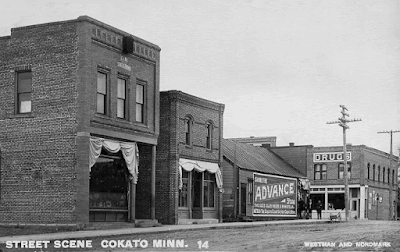
A short digression here about names, as this has become a point of confusion in the story I'm trying to tell. The name Henrik (also variously spelled Hinrik, Henric, Hindrik, Hindrick, etc.) is fairly straightforward, and it's usually been anglicized as Henry. Also, the surname Mattsson is not such a foreign beast, and is usually recognizable in its many American forms: Mattson, Matson, Madsen, Madison, Mattison …. But for reasons unknown to me, our Henrik also adopted the surname Hult. There is a small village of Hult located just off the southern end of the map above, and perhaps this is the reason he took on that name. But it wasn't simple a one-and-done deal: in some records I can find him as Mattson, in others as Hult, and it seems to go back and forth depending on the whim at the time. Maybe there's a logic to it, but I haven't figured it out yet. So we find members of the family subsequently using the name Mattson (or a variant spelling) as well as Hult (and, later, the spelling Holt). It does get confusing, doesn't it?

The first settlers in the area now occupied by Cokato began to arrive in 1858. The townships of Cokato and Stockholm were established in July of 1868. The St. Paul & Pacific Company, later the Great Northern Railroad, built a line from Howard Lake to Willmar in 1869, and built stations along the way. One of these developed into a small settlement known as Smith Lake (named for the water body nearby). More on Smith Lake in a bit. The name Cokato (pronounced “Co-kay-toe”) is, according to the Cokato Museum, a word from the Dakota language, meaning “in the midst of” and presumably refers to the fact that the town was located within The Big Woods, near the westernmost extension of the hardwood forests before the land transitions into the Great Plains and prairie habitat.

Henrik Mattson, now known as Henry M. Hult (the “M”, I presume, stands for Mattson) managed to acquire two 40-acre parcels of land on either side of the township lines between Cokato and Stockholm just to the west of Smith Lake and to the east of the village of Cokato. Google Maps gives a good idea of the topography of the area: a gently rolling terrain; most of the woods are gone now, replaced by grain fields. The image I copied is just about where I think Henry's lands were located and the road is the boundary between the two townships. The 1880 census reveals gains and loss in the family: daughter Emma (b. 1869) disappears from the records, but her place is taken by Hilma (b. 1873) and another daughter Emma (b. 1879).

Property owned by Henry M. Hult indicated in light blue, to the southwest of Smith Lake. This map is dated 1901, after Hult's death in 1887. It seems that the northern 40 acres was sold to O. Olson by this time.

In Minnesota, the Federal censuses of 1870, 1880, etc. are supplemented by state censuses that were taken in 1875, 1885, 1895, 1905, and 1915. I haven't yet been able to find a record for the family in 1875, but in 1885 they are living in Cokato and have another daughter, Mathea S. Anna Cajsa is now gone: in 1884 she married Mattes Matteson Hult. Now, Mattes is not a relative, at least not as far as I've determined. He may have adopted the name Hult in the same way as Henry, or perhaps he did it as a consequence of marrying into the Hult family. In later years the name morphed from Hult to Holt.

At this point both Henry and Wallborg disappear from the census records. In 1895 the three girls, Hilma Hult (now 21 years old), Emma Hult (16), and Martha Hult (12, yes, Martha, the spelling is quite clear), are living together and are listed in the records for Stockholm. Five years later in the 1900 Census for Stockholm we find Hilma Mattson listed as head of household and her 16 year old sister Marta (yet another spelling). But the trail then turned completely cold for me, and this was the point I was at when I dropped into Cokato last year. We could find no records for any of the family beyond 1900, nor any records that might account for Henry or Wallborg since 1885.

This week I got a bit of a break, though, first with a death record on the FamilySearch website for a Hilma E. Mattson. This Hilma passed away on 13 January, 1901 in Stockholm, Minnesota, age 27, with father's name recorded as Henry and mother's name Welber. All this agrees with the Hilma I was trying to trace, with the exception that the mother's name was really Wallborg. Close enough, don't you think? I've found some pretty creative spellings for that name, including one that listed her as Walter! With this record in hand, I was then able to find the case file for her in the probate court in 1901. The file was for the assignment of letters of administration for her estate after her death. The letters of administration were eventually given to a Henry P. Holt – there's that name again. This Henry Holt, however, was not related to the Henry Hult we started with. The new Henry was married to a Jennie Holt, and that's her maiden name. Actually, her Swedish name was Gertrude Jansson. Jennie was the daughter of Annika Pålsdotter and Jan Olsson, and now we can close the circle with the confusion of names. It turns out that Annika was one of Wallborg's sisters. By the way, our new Henry P. Holt, it seems, did not take on the name Holt out of the blue. His original name was Henrik Persson (hence the initial P.), and he was his wife's first cousin once removed.

Back to Hilma: upon her death the value of her personal estate was a total of $47.02: she left cooking utensils worth $3.00, miscellaneous articles valued at an additional 85¢, $4.95 of wearing apparel, 50 bushels of wheat worth $27.50, sacks valued at $1.25 and chickens valued at $1.50. I know that only totals to $39.05, but that's all that's listed in the documents. The real value, though, and undoubtedly the only reason that all of this legal documentation was undertaken, was in her shares of the two plots of land owned by her father. Her share of these, a one-third interest, was worth $900.00. Seeing the value of things in 1901, this sounds like real money! Two persons were deemed to be entitled to inherit this estate. To quote the case file: “And it further Appearing That the following named persons are the persons entitled to said estate by law, viz: Matea S. Matson and Anna Holt.” Anna is Anna Cajsa Holt; Matea S. Matson was Hilma's other sister.

So this leaves a few questions: what happened to Emma, Henry, and Wallborg? The probate records solve two of those. Emma M. Mattson had died a few years earlier, specifically on 3 December, 1897. Interestingly, the application for letters of administration was made the same time as for Hilma's estate in 1901, and Henry P. Hult was given the job of administrator. No cause of death is given for either Hilma or Emma in these case files. And browsing back a little further through the probate records, I found the case file for Henry Mattson. He died intestate in 1887, and his designated heirs were his daughters Helma E. Mattson, Emma M. Mattson and Martha S. Mattson. Two interesting points there: Anna Cajsa is not designated as an heir in these records, although she is in the records for Emma and Hilma. Secondly, not a word in the documents about Wallborg, so apparently she died sometime in the period from 1885–1887.

The listing of Henry's possessions at the time of his passing is interesting: they included a sewing machine, a looking glass, two flat irons, one Bible, and two lace curtains. As for the farm animals, he owned two cows, one that was 8 years old and the other 7; three heifers; one steer; two sheep and two lambs; a hog; and four turkeys. This was topped off by 232 bushels of wheat. The grand total for his personal possessions was $421.89.

Henry's final resting place, and that of his wife and daughters, is unknown. A possibility is that they were buried in the nearby cemetery of the town of Smith Lake. The town was on the north side of the shallow lake from which it got its name, and Henry's properties were just to the southwest of the lake. You may have noticed the use of the past tense there: Smith Lake as a populated place no longer exists. The town was founded between 1865 and 1869, and initially it grew into a bustling little community. However, in 1910 the Church of God burned down, and in 1914 the post office moved out. It seems to have been all downhill after that, and most people had left by the late 1920s. After the church burned and moved to Howard Lake, the cemetery was abandoned and gradually fell into disrepair. Eventually, it disappeared under the plow as the land under cultivation gradually expanded to engulf the graveyard. Grave markers were moved, but the cemetery itself was not relocated. So with any paper records up in flames and markers gone, the identities of the persons buried there are likely more or less lost to history. There is an article published in the local paper in 2010 on the loss and rediscovery of the cemetery. The Cokato Historical Society received a small grant in 2011 from the Minnesota Historical and Cultural Grants Program to erect a marker alongside the road marking the position of the cemetery.

Now, what of the remaining two daughters, Matea and Anna? My searches for Matea have largely turned up empty. The only small step forward came by playing a hunch. When sister Hilma died, Matea would have been alone and still a minor. Where did she go to live? I found nothing to indicate she went to live with her sister. The other option was her cousin Henry, the administrator for her sisters' estates. In the 1905 census, after the listing of Henry's family there is an entry for a Sophy Mattson. This, I believe, is Matea, so her full name was Mathea Sophia Mattson. In fact, she has a first cousin, one of Annika Pålsdotter's children, who was also named Mathea Sophia, so I suspect if we look a little farther afield in the family of the two Pålsdotter girls, Annika and Wallborg, we'll find that these names were used more widely in the family. However, after 1905 I have been unable to find any records of Matea. My next step will be to try to track down records associated with the two 40-acre plots of land that she inherited. By 1916 ownership had been transferred to a J. Olson and a Marg. Olson. I hope that these records will give some hint of Matea's fate.

Anna Cajsa's subsequent life is much better documented. She married Mattes Mattson Hult in 1884. Together they had five children: Mathilda Josefina (1885–??), Alfred O. (1889–1974), Amanda Christin (1893–1956), Emily Cecilia (1896-1971), and Walter (1900–1905). As is obvious from the question marks I haven't been able to run down all the details, but I have made some progress. Anna Cajsa lived until 1932, and her husband Mattes died a year later in 1933. Both are buried in Cokato, as is their daughter Amanda. The name Holt is prominent in the area. Alfred's son Ralph Melford Holt founded Cokato Transportation, “...the oldest family-owned school bus contractor in Minnesota.” You can read about that history in two stories published in the Cokato Herald Journal at the newspaper's website (Part 1 and Part 2). The local Ford dealership is owned and operated by the same family. Yes, I've reached out to the ownership by email but, so far, no response.

As you can tell, the frequency of my posts has declined. This is not because I've been totally stymied in finding information. Rather, the reason is that there are so many loose ends! I feel pretty safe in assuming that a data dump of names, dates, and places would be of limited interest, so my goal has been to find the stories behind all of that. Even writing this post, because I go back and double-check my facts and assumptions, has led me on a couple of detours through history. Anyway, we have not heard the last of the family of Henrik Mattsson (later Henry Hult). Henry's brothers also have a story to tell, and writing that up is my next goal. Until then, all comments, suggestions, and corrections are gratefully received. Happy Fourth of July!

In the Midst of the Big Woods

In my last post I concentrated on the brothers John and Louis Thompson who came to North America in 1882 and settled on adjoining 40-acre parcels of land north of Buffalo, Minnesota. However, John and Louis were not the first members of the family to form part of the massive Swedish emigration to the New World, nor were they the first to settle in Wright County, Minnesota.

Henrik Mattsson was born on the 9th of April, 1843, the son of Matts Persson and Karin Hindriksdotter. He had four sisters and two brothers, and we'll come back to those brothers in another post. The family lived on a small farm known as Snipa, in the parish of Vitsand in Värmland. This is the central western area of Sweden which saw a lot of immigration from Finland in the 17th Century. If I've interpreted the maps correctly (perhaps that's a big assumption) Snipa was a farm somewhere in or around Snipberget, i.e., Snipa Mountain, and wasn't all that close to the village of Vitsand itself. This is a fairly remote, wooded area, where making a living by farming would have been a difficult way to survive.

Birth record for Henrik Mattsson from parish archives in Vitsand. The columns, from left to right, show that (1) he was the 22nd birth recorded that year; (2) born on 9 April; (3) baptized on 12 April; (4) nameed Henrik and living in Snipa; (5) his parents' names, Mattes Persson, Karin Hindriksdotter; and (6) witnessed by Nils Jonsson and Vallborg Persdotter.

The years 1867–1869 were particularly difficult in Sweden. According to the website www.european-emigration.com, this period saw “a series of catastrophic famines … caused first by too much rain, then drought and finally epidemics [that] led to crop failures.” In March of 1869, Henrik, his new bride Wallborg Pålsdotter (in English, Paul´s daughter), and their young daughter Anna Cajsa, emigrated to North America. Wallborg came from Noppen, a tiny settlement just SSE of Snipberget.

I haven´t yet been able to find any documents from the port of Göteborg, from which they probably sailed, nor from New York, their likely arrival point in the U.S. The book, `The Immigrants´ that I mentioned in the last post describes the trials that would be involved in the passage across the Atlantic in a sailing ship. Henrik and family, however, came a bit later, and likely made the crossing on a steam ship, and as a result the voyage was a bit more predictable and relatively quick. Nevertheless, you can imagine pulling up roots, and trying to take everything you´d need in order to make a new life for yourself. The painting The Emigrants by Knut Ekwall gives the artist's impression of what the voyage may have been like, with people huddled on deck, covered to stay warm, while packed in with cattle and horses. And this was on deck, I shudder to think of the conditions below decks where most of the time was spent.

Henrik, Wallborg, and Anna Cajsa emigrated from Vitsand in early 1869. Already in the 1870 census the family – now with the addition of a new daughter Emma – are recorded in the national census in the town of Cokato, Minnesota. So they must have headed here pretty directly, perhaps on the basis of an advertising campaign, perhaps by word of mouth.

In my last post I described by brief visit to Buffalo, Minnesota. At the end of that day, I drove another half hour west to drop into Cokato. The ostensible purpose was to try to track down a reference I´d found to an "obituary" published in the local paper for Henrik, under the name Henrik A. Mattson. By the time I left Buffalo it was already mid-afternoon in November, so it was already growing dark. I stumbled my way into the Cokato Museum near closing time, and the folks there couldn't have been more kind and helpful. They not only helped me to find the (minimally useful) death notice that had been published in the paper, but we also located a tract of land owned by Henrik, and they gave me some guidance on where he probably had been buried.

A short digression here about names, as this has become a point of confusion in the story I'm trying to tell. The name Henrik (also variously spelled Hinrik, Henric, Hindrik, Hindrick, etc.) is fairly straightforward, and it's usually been anglicized as Henry. Also, the surname Mattsson is not such a foreign beast, and is usually recognizable in its many American forms: Mattson, Matson, Madsen, Madison, Mattison …. But for reasons unknown to me, our Henrik also adopted the surname Hult. There is a small village of Hult located just off the southern end of the map above, and perhaps this is the reason he took on that name. But it wasn't simple a one-and-done deal: in some records I can find him as Mattson, in others as Hult, and it seems to go back and forth depending on the whim at the time. Maybe there's a logic to it, but I haven't figured it out yet. So we find members of the family subsequently using the name Mattson (or a variant spelling) as well as Hult (and, later, the spelling Holt). It does get confusing, doesn't it?

The first settlers in the area now occupied by Cokato began to arrive in 1858. The townships of Cokato and Stockholm were established in July of 1868. The St. Paul & Pacific Company, later the Great Northern Railroad, built a line from Howard Lake to Willmar in 1869, and built stations along the way. One of these developed into a small settlement known as Smith Lake (named for the water body nearby). More on Smith Lake in a bit. The name Cokato (pronounced “Co-kay-toe”) is, according to the Cokato Museum, a word from the Dakota language, meaning “in the midst of” and presumably refers to the fact that the town was located within The Big Woods, near the westernmost extension of the hardwood forests before the land transitions into the Great Plains and prairie habitat.

Henrik Mattson, now known as Henry M. Hult (the “M”, I presume, stands for Mattson) managed to acquire two 40-acre parcels of land on either side of the township lines between Cokato and Stockholm just to the west of Smith Lake and to the east of the village of Cokato. Google Maps gives a good idea of the topography of the area: a gently rolling terrain; most of the woods are gone now, replaced by grain fields. The image I copied is just about where I think Henry's lands were located and the road is the boundary between the two townships. The 1880 census reveals gains and loss in the family: daughter Emma (b. 1869) disappears from the records, but her place is taken by Hilma (b. 1873) and another daughter Emma (b. 1879).

Property owned by Henry M. Hult indicated in light blue, to the southwest of Smith Lake. This map is dated 1901, after Hult's death in 1887. It seems that the northern 40 acres was sold to O. Olson by this time.

In Minnesota, the Federal censuses of 1870, 1880, etc. are supplemented by state censuses that were taken in 1875, 1885, 1895, 1905, and 1915. I haven't yet been able to find a record for the family in 1875, but in 1885 they are living in Cokato and have another daughter, Mathea S. Anna Cajsa is now gone: in 1884 she married Mattes Matteson Hult. Now, Mattes is not a relative, at least not as far as I've determined. He may have adopted the name Hult in the same way as Henry, or perhaps he did it as a consequence of marrying into the Hult family. In later years the name morphed from Hult to Holt.

At this point both Henry and Wallborg disappear from the census records. In 1895 the three girls, Hilma Hult (now 21 years old), Emma Hult (16), and Martha Hult (12, yes, Martha, the spelling is quite clear), are living together and are listed in the records for Stockholm. Five years later in the 1900 Census for Stockholm we find Hilma Mattson listed as head of household and her 16 year old sister Marta (yet another spelling). But the trail then turned completely cold for me, and this was the point I was at when I dropped into Cokato last year. We could find no records for any of the family beyond 1900, nor any records that might account for Henry or Wallborg since 1885.

This week I got a bit of a break, though, first with a death record on the FamilySearch website for a Hilma E. Mattson. This Hilma passed away on 13 January, 1901 in Stockholm, Minnesota, age 27, with father's name recorded as Henry and mother's name Welber. All this agrees with the Hilma I was trying to trace, with the exception that the mother's name was really Wallborg. Close enough, don't you think? I've found some pretty creative spellings for that name, including one that listed her as Walter! With this record in hand, I was then able to find the case file for her in the probate court in 1901. The file was for the assignment of letters of administration for her estate after her death. The letters of administration were eventually given to a Henry P. Holt – there's that name again. This Henry Holt, however, was not related to the Henry Hult we started with. The new Henry was married to a Jennie Holt, and that's her maiden name. Actually, her Swedish name was Gertrude Jansson. Jennie was the daughter of Annika Pålsdotter and Jan Olsson, and now we can close the circle with the confusion of names. It turns out that Annika was one of Wallborg's sisters. By the way, our new Henry P. Holt, it seems, did not take on the name Holt out of the blue. His original name was Henrik Persson (hence the initial P.), and he was his wife's first cousin once removed.

Back to Hilma: upon her death the value of her personal estate was a total of $47.02: she left cooking utensils worth $3.00, miscellaneous articles valued at an additional 85¢, $4.95 of wearing apparel, 50 bushels of wheat worth $27.50, sacks valued at $1.25 and chickens valued at $1.50. I know that only totals to $39.05, but that's all that's listed in the documents. The real value, though, and undoubtedly the only reason that all of this legal documentation was undertaken, was in her shares of the two plots of land owned by her father. Her share of these, a one-third interest, was worth $900.00. Seeing the value of things in 1901, this sounds like real money! Two persons were deemed to be entitled to inherit this estate. To quote the case file: “And it further Appearing That the following named persons are the persons entitled to said estate by law, viz: Matea S. Matson and Anna Holt.” Anna is Anna Cajsa Holt; Matea S. Matson was Hilma's other sister.

So this leaves a few questions: what happened to Emma, Henry, and Wallborg? The probate records solve two of those. Emma M. Mattson had died a few years earlier, specifically on 3 December, 1897. Interestingly, the application for letters of administration was made the same time as for Hilma's estate in 1901, and Henry P. Hult was given the job of administrator. No cause of death is given for either Hilma or Emma in these case files. And browsing back a little further through the probate records, I found the case file for Henry Mattson. He died intestate in 1887, and his designated heirs were his daughters Helma E. Mattson, Emma M. Mattson and Martha S. Mattson. Two interesting points there: Anna Cajsa is not designated as an heir in these records, although she is in the records for Emma and Hilma. Secondly, not a word in the documents about Wallborg, so apparently she died sometime in the period from 1885–1887.

The listing of Henry's possessions at the time of his passing is interesting: they included a sewing machine, a looking glass, two flat irons, one Bible, and two lace curtains. As for the farm animals, he owned two cows, one that was 8 years old and the other 7; three heifers; one steer; two sheep and two lambs; a hog; and four turkeys. This was topped off by 232 bushels of wheat. The grand total for his personal possessions was $421.89.

Henry's final resting place, and that of his wife and daughters, is unknown. A possibility is that they were buried in the nearby cemetery of the town of Smith Lake. The town was on the north side of the shallow lake from which it got its name, and Henry's properties were just to the southwest of the lake. You may have noticed the use of the past tense there: Smith Lake as a populated place no longer exists. The town was founded between 1865 and 1869, and initially it grew into a bustling little community. However, in 1910 the Church of God burned down, and in 1914 the post office moved out. It seems to have been all downhill after that, and most people had left by the late 1920s. After the church burned and moved to Howard Lake, the cemetery was abandoned and gradually fell into disrepair. Eventually, it disappeared under the plow as the land under cultivation gradually expanded to engulf the graveyard. Grave markers were moved, but the cemetery itself was not relocated. So with any paper records up in flames and markers gone, the identities of the persons buried there are likely more or less lost to history. There is an article published in the local paper in 2010 on the loss and rediscovery of the cemetery. The Cokato Historical Society received a small grant in 2011 from the Minnesota Historical and Cultural Grants Program to erect a marker alongside the road marking the position of the cemetery.

Now, what of the remaining two daughters, Matea and Anna? My searches for Matea have largely turned up empty. The only small step forward came by playing a hunch. When sister Hilma died, Matea would have been alone and still a minor. Where did she go to live? I found nothing to indicate she went to live with her sister. The other option was her cousin Henry, the administrator for her sisters' estates. In the 1905 census, after the listing of Henry's family there is an entry for a Sophy Mattson. This, I believe, is Matea, so her full name was Mathea Sophia Mattson. In fact, she has a first cousin, one of Annika Pålsdotter's children, who was also named Mathea Sophia, so I suspect if we look a little farther afield in the family of the two Pålsdotter girls, Annika and Wallborg, we'll find that these names were used more widely in the family. However, after 1905 I have been unable to find any records of Matea. My next step will be to try to track down records associated with the two 40-acre plots of land that she inherited. By 1916 ownership had been transferred to a J. Olson and a Marg. Olson. I hope that these records will give some hint of Matea's fate.

Anna Cajsa's subsequent life is much better documented. She married Mattes Mattson Hult in 1884. Together they had five children: Mathilda Josefina (1885–??), Alfred O. (1889–1974), Amanda Christin (1893–1956), Emily Cecilia (1896-1971), and Walter (1900–1905). As is obvious from the question marks I haven't been able to run down all the details, but I have made some progress. Anna Cajsa lived until 1932, and her husband Mattes died a year later in 1933. Both are buried in Cokato, as is their daughter Amanda. The name Holt is prominent in the area. Alfred's son Ralph Melford Holt founded Cokato Transportation, “...the oldest family-owned school bus contractor in Minnesota.” You can read about that history in two stories published in the Cokato Herald Journal at the newspaper's website (Part 1 and Part 2). The local Ford dealership is owned and operated by the same family. Yes, I've reached out to the ownership by email but, so far, no response.

As you can tell, the frequency of my posts has declined. This is not because I've been totally stymied in finding information. Rather, the reason is that there are so many loose ends! I feel pretty safe in assuming that a data dump of names, dates, and places would be of limited interest, so my goal has been to find the stories behind all of that. Even writing this post, because I go back and double-check my facts and assumptions, has led me on a couple of detours through history. Anyway, we have not heard the last of the family of Henrik Mattsson (later Henry Hult). Henry's brothers also have a story to tell, and writing that up is my next goal. Until then, all comments, suggestions, and corrections are gratefully received. Happy Fourth of July!

Monday, April 4, 2016

Unto a Good Land

My research strategy over the past several months has been to work through the records directly back from the present-day relatives as far back in time as I can, documenting the names, dates, and major lifetime events in my direct family. Then, once I've gone back as far as I can, I start with those distant ancestors and move forward in time, looking beyond immedate ancestors to include all of their children, those children's children, and so on. In this way I work my way back toward the present. The records from Ireland are, in my humble opinion, so far pretty nearly hopeless. Problems include privacy laws that cut off access to most of the records of the 20th Century; document losses in the Irish Civil War; the fact that there are very, very few records available for “normal” folk prior to the mid 1800's; and finally just the quality and availability of those records that do survive all make this a very difficult task. The Swedish records contrast starkly with this, and, as a result, that's where I've had the most success. For this blog post, I thought I'd begin sharing a little adventure involving the Swedish part of the family.

A few months ago I was working on the family of my great grandmother, Johanna Charlotta Barthelsson. My cousin Marcia Robbins just last week sent me a copy of a photo of Lottie and her two grown children (my grandfather Fred Johnson and his sister Wilma Westerlund). This is the first picture I've ever seen of her, and even though the photo is taken from a fair distance, it does a lot to bring her to life. In the picture you see below an anonymous annotator marked with X's the people that were known: Fred Johnson's on the left in the straw hat, his sister Wilma is in the middle at the top of the stairs, and next to her is their mother Lottie. The other two people in the picture are unidentified. I have no idea who the young sailor on the far left might be. I'm trying my best to resist the temptation to jump to the conclusion that the bearded man in the hat is Fred and Wilma's father Alfred. Lottie died in 1922 and the sailor's uniform looks exactly like those I saw on the Internet from World War I, so that gives a rough idea of the time frame. From the pose, I infer that this is Lottie's house, which would have been in Queens, NY.

Lottie Westerlund home in Queens

Lottie is three generations back in time from me, and the people I'm going to tell you about are related to me by a husband and wife that are four generations before that. These are Thomas Bertilsson (1745-1821) and his wife Karin Persdotter (1748-1820). I'll try not to belabor the lines of descent, because I think that that will probably just confuse things, but Thomas and Karin are the point where these lineages converge.

Thomas and Karin had 7 children, 3 boys and 4 girls. I want to focus on one of the daughters, Annika Thomasdotter (1789-1855). She and her husband Lars Olsson (1796-1883) had only three children: a daughter Maret, and two sons, Olof and Thomas (1826-1903). The son Thomas, in turn, had four children with his wife Maret Persdotter (1820-1887): Per (who died at the age of 2), Gertrude, Jon, and Lars. The family lived in the parish of Fryksände in Värmland, the area in central Sweden near the Norwegian border that I've mentioned in an earlier post.

View of Fryksande, Värmland, Sweden

In the household record book for 1881-1882, we find the Thomas Larsson family living on the farmstead of Wadje in Fryksände parish. On the left-hand side of the page you can see their names, but the parish priest has put a line through all of them. On the far right-hand side you see why: under the column labelled “Flyttat” (meaning “moved”), all the members of the family have left Sweden for North America. The two brothers Jon and Lars left first in 1881, and then the parents and sister followed just over a year later.

Household record for Thomas Larsson, 1881

History of Buffalo, Minnesota, USA
This was the earliest record I'd found of a branch of the family that moved from Sweden to North America. But where in North America did they end up? To make a long story short, the family turns up living in Wright County, Minnesota, near the town of Buffalo. Somewhere along the way their names were Anglicized: Lars Thomasson became Louis Thompson, his brother Jon became John, and mother Maret became Mary. (Father Thomas and sister Gertrude didn't need a name change, I guess.) A brief history of the Louis Thompson family in the U.S. was published in a book entitled Buffalo: from trading post to star city. It seems that he didn't come directly to Buffalo, but first worked as a cook on a Mississippi riverboat. Remember, the Mississippi arises in Minnesota and separates the twin cities of Minneapolis and St. Paul. Later he and his brother settled on adjacent 40 acre farms north of Buffalo. Here's a map showing the location of their homesteads (colored in blue in the northwest corner of the map) and, below that, an aerial image from Google Maps showing it today. I tried to get an image from Google's camera car, but apparently it hasn't taken images down that road quite yet.

Map of properties near Buffalo, MinnesotaGoogle-eye view of Thompson homesteads today

Between records that were available on the Internet and in the book on Buffalo, I was able to gather a fair amount of information. At that point, though, there was still an element of doubt as to whether Louis and John corresponded to Lars and Jon. So I needed more corroborating evidence.

As it turned out, I was making these discoveries and coming to some preliminary conclusions just about two weeks before I was scheduled to head off to our annual professional meeting, that of the Entomological Society of America. (For those that might not know, I study insects for a living.) This convention rotates around the country: the year before it was in Portland, Oregon; other cities have included Louisville, Cincinnati, San Diego, Fort Lauderdale, etc., etc. This year though, the meeting was being held in Minneapolis. A quick online query told me that Buffalo, Minnesota was only about 40 miles away from Minneapolis. So then I knew what I had to do: rent a car and head west to check out Buffalo!

My goals were, I admit, a little sketchy. I knew that Louis Thompson, his wife, and his parents were buried in the Zion Lutheran Cemetery. So that was a stop for sure. I'd also tried to look up obituaries published in local papers, but I couldn't find any that were accessible online. So, my second goal was to stop in at the local library to look through their microfilm copies of the local paper, the Wright County Journal-Press.

Buffalo, MinnesotaBuffalo Lake, Minnesota
I suppose I should count my blessings. I was travelling in Minnesota in November. By all rights there could have been two feet of snow on the ground. Thankfully, that wasn't the case, but it was a miserable day to go exploring. Temperature in the low 40's, rain, and a strong wind. After a few wrong turns getting out of downtown Minneapolis and avoiding the rush hour traffic, I got to Buffalo sometime around 9 a.m. Buffalo's a small town, population 15,453 in 2010, located on the shore of Buffalo Lake. It seems that despite the town's adoption of the bison as it's symbol (they're all over town!), it's actually named for the buffalo carp that were so common in the lake.

The Zion Lutheran Cemetery is located a few miles south of town, and it's a small graveyard. I hadn't bothered to write ahead to find out any details of burial plots or the like, I was just planning to wander around to see what I could find. I wasn't planning on that kind of weather, though. My targets were Louis and Karen Thompson, Louis's parents who would have had the surname Larson, and Louis's sister Gertrude. Gertrude had married a man named Andrew Olson. Therefore, I was on the lookout for monuments with the names Thompson, Larson, or Olson.

Thompson, Olson markers in Zion Lutheran Cemetery, Buffalo, Minnesota
I parked the car in the graveyard and climbed out into the wind, rain, and cold. Almost immediately a pair of monuments caught my eye, one with the name Thompson, the other Olson. Could I be so lucky? Not really: neither stone had any other names or dates on them, and there were no markers around them at all.

Disappointed at that, I began to try to do a thorough search of the graveyard, starting from one end and going to the other. As I said, it's a small cemetery. I did find the graves of one part of the family, Louis's son Walter and Walter's wife Florence. Other than that, I found nothing. Then the battery on my phone gave out, and I couldn't take any more pictures. Besides that, my shoes were soaked from walking in the wet grass. It seemed that the time had come to do my library work, dry out, and warm up.

I did have some dates to work with in searching through the old newspaper records, so that turned out to be pretty successful. The obituaries confirmed that Louis and John were born in Värmland and their dates of birth matched those I'd found from the Swedish records. So I was feeling a lot better that Louis was really Lars, and that these really were relatives. I spent a few hours looking through the microfilms and making copies of pages with family history. I stumbled on one article about a surprise birthday party for Louis's 40th (did I mention that Buffalo is a small town?). The staff in the Buffalo library were very friendly and helpful, somewhat amused at having a visitor from central Ohio, and interested that I apparently had family in the area.

After drying out shoes and socks (I won't go into the details) and recharging my phone fully, I decided to take another shot at looking for the graves in the Zion cemetery. It was quite possible that there were no gravestones to be found at all. In my searches through Old St. Mary's Cemetery in Little Falls I did ask for information about the location of graves of family members. I was directed to an area where there were several people buried, but there were markers for only a small number of them. So, I was prepared to not find anything.

I went back to look at those two monuments that I'd found the very first thing: one with the name Olson and one with the name Thompson. I mentioned that it was a windy day in mid November. As you might be able to see in the pictures all the leaves had fallen from the trees and the wind hand basically blown the ground clear of them. But not entirely clear, and then I noticed something a bit odd: there were a number of small clusters of wet leaves in small depressions and those clusters seemed to form a straight line. I swept away the leaves, pushed and kicked the overgrown grass back, picked off the earthworms, and there they were. I found markers for the entire family. They were fairly small, about 4x10 inches, and they'd sunk into the ground several inches. This made the depressions in which the leaves collected. The first stone I found was for the patriarch of the family, Thomas Larson. My hands were shaking too much from the cold to make it a good picture, so I've shown you here the stone for Louis.

Louis Thompson headstone
I didn't find the graves for brother John Thompson. From his obituary I learned that he'd left the Lutheran congregation for the Covenant church and was buried in the Swedish Mission cemetery. I'll have to make another trip to Minnesota – this time in the summer! - to track down that lead.

There is more, but I think I'll save it for another post. I have all the material in hand, but I didn't want to make this one drag on to long. So look forward to more information about our Swedish family immigrating to the U.S. The title of this post “Unto a Good Land” is actually the English title of the second book of a four-part series written by the Swedish author Vilhelm Moberg. The Swedish title is Invandrarna. This tetralogy – sometimes called the Emigrant suite – tells the story of a fictional family leaving Sweden and settling in Minnesota in 1850. I've just finished the second book in the series and starting the third tonight. The first two books (the Emigrants and Unto a Good Land) were the basis of a 1971 movie, The Emigrants, that starred Max von Sydow and Liv Ullman. It was nominated for the Best Foreign Film and, the following year, for four other Oscars including Best Picture, Best Director, and Best Actress. In the near future, I plan to write up some new posts talking about some of our Swedish immigrants to North America.

Saturday, August 15, 2015

From DNA start to Finnish

In my research in the university we deal with DNA all the time, using it as a clue to untangle the evolutionary history of the wasps we study. Therefore, I was pretty comfortable with the idea of DNA “testing” to help in with discovering more about family history.

There are quite a number of different tests (and prices!) available on the market from which to choose, and I decided to go with two of the most common: AncestryDNA and 23andMe. For the user, the test procedure is really simple: they send you a plastic vial and mailing envelope; you drool or spit into the vial; close the cap and shake; send it back to them in the envelope; and then sit back and wait a few weeks for your results. The testing service will compare your results with that others have submitted and report back to you the degree of similarity, possible relationship (e.g., 4th – 6th cousins), and a link to contact those persons if you want. They can also compare your results with those from people living in different parts of the world and suggest areas from which your ancestors came. Here are my results produced by AncestryDNA:

This is their “ethnicity” estimate, with fully two-thirds of my “ethnicity” linked to Ireland; another 14% to Great Britain; and a final 14% from Scandinavia. There's some variation in all of this, but it generally confirmed what I thought I knew simply from the ethnicity of my grandparents, three of whom were Irish and one Swedish.

ArkivDigital is a Swedish company that provides access to the thousands and thousands of pages of Swedish documents. About 16 months ago they ran a small promotion in which they offered to have one of their experts help possible users to find where their ancestral emigrants came from in Sweden. I was then very unsure about my great grandmother, Johanna Charlotta Barthelsson. Just to help you get oriented, she was the mother of my grandfather Fredrick Johnson. Their expert, Kathy Meade, got back to me with records from her birth to her emigration to the U.S. in 1882. With that toehold I've been able to dig backwards and forwards through the records, in the process discovering (for me, anyway) a whole new part of the family that I never knew about.

As I've mentioned before, when you add records to ancestry.com their software searches in the background for additional sources of information that correspond to the data you've saved. In addition to official documents, another source of hints are the family trees of other users. You have to treat these user-trees with a good deal of caution: often they're completely undocumented, they might just be old, inaccurate family stories, and it's very, very easy to either make mistakes or jump to wrong conclusions. I will admit to occasionally having committed all of these sins myself, and I'm trying to learn and put into use best practices for documenting genealogies.

As I was entering church records from the Barthelsson family, I began to find something a bit strange in the other family trees. When I followed the family back a few generations, I found some trees in which the last name was a bit different. I don't mean the typical spelling variants: Barthelson, Barthelsson, Bertilsson, Bartelsson, etc. No, these records had an additional word, for example, Bertil Henriksson Lehmoinen. This added word didn't seem to show up anywhere in the records, it's not a Swedish word … what was it? To find an answer I sent an email to the person who maintains one of the more extensive of those trees. His answer opened up a whole new world that I never knew existed.

It turns out that Lehmoinen is a family name, and specifically it is a Finnish family name. Records in the archives for this family go back to the 1430's! The family turns out to be part of a group known as the Forest Finns. Here's the story as I understand it. In the sixteenth and seventeenth century the empire of Sweden included not only the country we know today, but also Finland and part of northwestern Russia. The peoples of eastern Finland farmed using a form of slash-and-burn, or swidden agriculture. When a family group moved into a new area of forest, they would cut down the trees, girdle the larger ones, and allow the trees to die and dry out over the course of the next year. Then, shortly before rains came, all of the accumulated wood would be burned, the ashes worked into the soil, and then the field would be sown with rye. For the rest of the year the rye would grow along with other grasses and plants that invaded the now opened areas. Livestock would be allowed to graze during this time. The next year, though, things would get serious, livestock excluded, and the rye grain would be harvested. This form of agriculture quickly depletes the nutrients in the soil, and in a short time the family would have to move on and repeat the cycle in a new forested area. This means that the land can only support relatively small numbers of people, and this part of Finland eventually became overpopulated.

Here is a painting made in 1893 by the Finnish artist Eero Järnefelt called “Under the Yoke” that illustrates part of this process.


"Raatajat rahanalaiset" by Eero Järnefelt - 1. Hannu Aaltonen (photo)2. 4.bp.blogspot.com5. The Bridgeman Art Library, Object 476513. Licensed under Public Domain via Wikimedia Commons - https://commons.wikimedia.org/wiki/File:Raatajat_rahanalaiset.JPG#/media/File:Raatajat_rahanalaiset.JPG

I also found a video, dating from 1937, on YouTube that illustrates this. It runs for about thirteen and a half minutes. I presume – but am not positive – that the language is Finnish. But I think you'll be able to follow it. I especially like the guy that makes a pair of shoes out of birch bark! Notice that these are the same style as the girl in the center of the Järnefelt painting.

To ease the population pressure, a good number of the people from central Finland, particularly the area of Savolax (or Savonia), migrated west, across the Gulf of Bothnia, to settle in central Sweden. In particular, the migrants from our family settled in northern Värmland in the western part of central Sweden, almost directly west of Stockholm and near the Norwegian border. At first the Swedish government encouraged the migration as it increased the population in the border region, thus contributing to its security. As the mining sector grew, though, the need for wood to make charcoal increased, and the practice of simply burning down parts of the forest became unacceptable. The Forest Finns were then forced to become more traditional farmers, miners, or enter other suitable occupations.

The Forest Finns moved into Värmland around the 1640's. They seem to have retained much of their culture and language before eventually being absorbed into Swedish culture. The language survived until the early part of the 20th century, and I understand that in that part of Sweden many placenames are still Finnish. The names of the people that you can find in the household examination records of the church are only the Swedish versions. There is one book for Östmark parish, however, in which the Finnish names are also recorded.

Anyone looking into Forest Finn history quickly comes across the name of Carl Axel Gottlund (1796–1875). Gottlund grew up in Finland, in Savonia, the son of a Finnish father and Swedish mother. He became one of the great proponents of Forest Finn culture, both in Sweden and Norway. In fact his political agitation eventually led to his exile. He first travelled to Dalarna in 1817 and then to Värmland in 1820–1821. He published a diary of his travels in Värmland in which he not only describes what he sees, but names names and places. The diary is online at www.nordvarmland.com/istid/ Of course, it's in Swedish. You can use the Google translate function and get a bit of an idea of what he says, but the translation is pretty dodgy.

I mentioned the diary because in one part of it it gets pretty personal. Here we're back to the Lehmoinen family. Gottlund describes a double wedding on November 4, 1821, the first pair being Hindrik Hindriksson Lehmoinen and Maria Bengtsdotter Manninen; the second couple was Pehr Hallesson and Maria Hindriksdotter Lehmoinen. For context, Hindrik and the two Marias all are my 2nd cousins 5x removed. Here's my translation (apologies in advance!) of a section from Gottlund's diary describing the scene:

"After I had eaten a little, I went to church and sat on a bench with some farmers at the door. Frychius preached, after the sermon, I went to him in the sacristy, the door of which was behind the altar, much as in Fryksände. The township was mostly Finns. As there was no Communion, the service was almost over. As it ended, two Finnish peasant boys began playing an old march at the altar rail. During the sermon, they had been in the sacristy and tuned their violins. It so happened that there were two brides in the church. They sat in the nearest benches to the choir. They were both from Finnskoga, the most repectable farmsteads in the township and also the richest in Finnskoga. The wedding, which I thought to attend uninvited, would tonight be in Kronskoga.

One couple was Hindrik Hindriksson Lehmoinen, the son of the farmstead, and the bride Mari Bengtsdotter Mammoinen from Rattsjöberg. The second couple was the daughter of the farmstead, Mari Hindriksdotterr Lehmoinen and the groom a Swedish boy from Häckfalle. It was therefore, son and daughter, now to be married at the same time. The brides, who were sitting next to each other, were truly magnificently arrayed. They were dressed in white silk, on which were sewn several rows of roses and other flowers, glistening a little here and there, and looking very charming. Then they had black skirts, with red patches under the breast as a breastplate, which were studded with tufts of ribbon roses, flowers and glitter of all kinds. The grooms were dressed like complete dandies, the Finnish boy had his gray Finn coat, the other his black Värmland shirt, and then both had red [pale] bands that were sewn on the back, shoulders and chest, a red ribbon bow on the shoulder, on the arms, etc., all of which made them more like a Harlequin, and into the bargain there hung three pieces shiny riksdalrar [coins], one from each of the red ribbons, one behind each shoulder and in the middle of the back. Furthermore, their hair was powdered and doctored so that they were complete dandies."

The couple in the picture are wearing what was advertised on the Web as traditional wedding clothes for Värmland. Although it's not exactly as Gottlund described, I think you can probably get an idea of what he was talking about. As the text continues he describes the ceremony, wedding meal: fish, meat, capercaillie roast, salty cabbage soup, beer, and schnapps.

“Eventually, I became acquainted with the host, we became fairly good friends. My recommendation from the priest helped, as well as my flutes, and most important was my Finnish language. Nearly everyone was Finnish, except some Swedes from Häckfalle, 3 or 4 in number. And Finnish was spoken everywhere.... The priest confessed that he thought the Finns never used their mother tongue as much as now. In particular, after they had a few glasses of acquavit, he never heard a Swedish word.”

Afterwards the dancing began, and, interestingly, while the brides danced, the two grooms did not. But the priest's sister did, reportedly the best polka dancer of them all. Actually, Gottlund only got part of the story of interrelationships right. Pehr Hallesson was only half-Swedish, his mother was Finnish. Maria Hindriksdotter was not the daughter from the farm, but a niece who seems to have been raised in the family of her aunt and uncle. Hindrik and Maria Bengtsdotter were first cousins, and Maria had lost her mother in the past year (her father had died some 14 years earlier). Hindrik and Maria went on to have four children. Pehr and his Maria never had any children.

Back to the modern day. This year cousin Ann Meyer Nordström and her husband travelled to the old family stomping grounds in and around the town of Östmark. The colors on the map suggest that much of the land is forested, and Anne gave me permission to share some of the pictures of the landscape in the area. It reminds me so much of central New York that I immediately felt at home.

This next clip from YouTube is a Finnish father and son (I assume), Sigurd (the father) and Bernt Ruotimaa (the son). The piece they're playing is called Livet i Finnskogarna, or, Life in the Forests of the Finns. In preparing this post I've gone through a half dozen versions of this song and listened to it probably 20 times. It may be my sentimental side, but somehow it just makes me feel good.

Now I look back at that map produced by AncestryDNA and realize that there was more to it, much more, than I'd initially imagined! Thanks to Ann for sending the pictures from Värmland and allowing me to share them with you. Apologies for my weak Swedish and non-existent Finnish. I'm working on the Swedish, though, and promise that I will get better. And finally, please excuse the mistakes and oversimplifications of Swedish and Finnish history. Every day I learn more and more.

West Cork Update

This blog post comes to you from the city of Cork, Republic of Ireland. I had initially planned this trip to be tagged on to the end of th...